
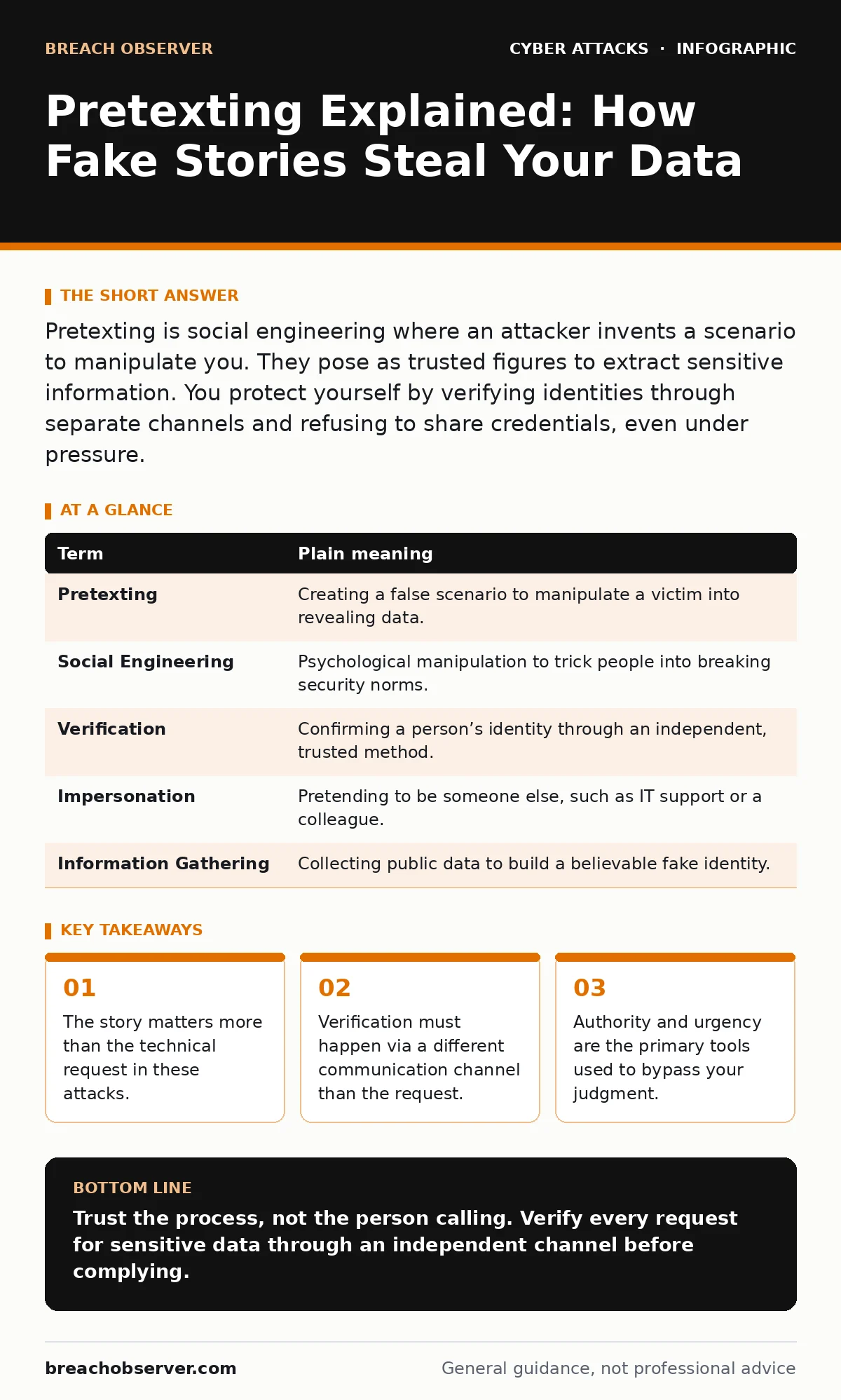
Pretexting is social engineering where an attacker invents a scenario to manipulate you. They pose as trusted figures to extract sensitive information. You protect yourself by verifying identities through separate channels and refusing to share credentials, even under pressure.
The Lost Delivery Driver Analogy
Imagine a delivery driver knocks on your door. They hold a package addressed to you. They say the signature is missing and ask for your house number to confirm the address. This seems harmless. You give the number. They then ask for your postcode to "update their system". You provide it. Finally, they need your mother’s maiden name to "verify the insurance claim". You hesitate, but the driver looks official and urgent. You comply. You have just been pretexted.
The driver never needed to break into your home. You opened the door. The package was never real. The goal was the information you handed over, piece by piece, because the context felt safe.
Defining the Mechanism
Pretexting is a form of social engineering. It relies on a fabricated scenario, or pretext, to gain your trust. The attacker does not hack your system directly. They hack your willingness to help. They build a narrative that makes their request seem logical and necessary.
This differs from phishing, which often relies on mass emails. Pretexting is targeted. The attacker researches you or your organisation. They craft a story that fits your reality. The accuracy of the details makes the lie convincing.
| Term | Plain meaning |
|---|---|
| Pretexting | Creating a false scenario to manipulate a victim into revealing data. |
| Social Engineering | Psychological manipulation to trick people into breaking security norms. |
| Verification | Confirming a person’s identity through an independent, trusted method. |
| Impersonation | Pretending to be someone else, such as IT support or a colleague. |
| Information Gathering | Collecting public data to build a believable fake identity. |
The Psychology of Compliance
Attackers exploit two human traits: deference to authority and the desire to be helpful. If someone claims to be from IT or legal, you assume they have a right to ask for access. You fear offending a superior or delaying a critical process.
Suppose an attacker calls you as "HR". They say they are updating payroll records. They need your password to "reset the portal". This links to payroll diversion fraud, where attackers redirect funds. By posing as HR, they bypass your technical defences. You think you are helping your employer. You are actually handing over keys to the attacker.
The pressure is often time-based. "I need this now or the system locks." Urgency shuts down critical thinking. You act before you verify. This is the core vulnerability.
What This Means for You
For an ordinary user, the risk is not just data theft. It is account takeover. Once an attacker has your credentials, they can access email, banking, or corporate networks. They can reset passwords for other services. They can install malware.
The danger is that these attacks often start small. A request for a username is harmless. A request for a password is not. But the attacker builds momentum. Each small "yes" makes the next request feel normal. This is why attack vectors often combine multiple steps. The pretext is just the entry point.
You might also face MFA fatigue attacks. After gaining your password, the attacker triggers multi-factor authentication prompts. They wait until you approve one, thinking it is a legitimate login. The initial pretext gave them the first layer of access.
Simple Safety Habits
You do not need advanced technical skills to defend against this. You need a habit of verification. Never trust the caller ID or email address alone. These can be spoofed. If someone asks for sensitive data, hang up. Call them back on a known, official number.
Check the context. Would IT really call you to ask for a password? Would HR ask for your tax code over the phone? Most organisations have strict policies against asking for credentials via phone or email. If the request violates standard procedure, it is likely a pretext.
Be wary of unsolicited help. If someone contacts you saying they fixed an issue, verify it yourself. Log in to your account directly. Do not click links they provide. This protects you from session cookie theft, where attackers hijack your active login session.
Try This Now
- Pause and Verify: When asked for sensitive info, stop. Ask for the person’s full name and department. Then call their official office number to confirm the request.
- Challenge the Urgency: If told "act now", reply "I will verify this first". Legitimate staff will understand security protocols. Attackers will pressure you further.
- Check Internal Policy: Know your organisation’s rules on data sharing. If the request breaks policy, report it immediately. This also helps mitigate risks like shoulder surfing by reinforcing a culture of caution.
The Hidden Cost of Trust
The most dangerous aspect of pretexting is that it leaves no digital footprint on the attacker’s side. No malware was installed. No port was scanned. The interaction happened in plain sight. This makes detection difficult.
Security tools like web filtering can block malicious sites, but they cannot stop a phone call. They cannot read your mind. If you voluntarily share data, the tools are blind. This is why human behaviour is the critical control.
Imagine an attacker uses DNS spoofing to redirect you to a fake login page. You enter your details. The pretext is "urgent system update". The technical trick is the DNS manipulation. Both are needed for the attack to succeed. Defending against one is not enough.
Key takeaways
- The story matters more than the technical request in these attacks.
- Verification must happen via a different communication channel than the request.
- Authority and urgency are the primary tools used to bypass your judgment.
Trust the process, not the person calling. Verify every request for sensitive data through an independent channel before complying.
Frequently asked questions
How do I know if a call is really from IT?
Hang up and call the IT helpdesk number listed on your company intranet or official documentation. Do not use the number provided by the caller.
Is pretexting only for businesses?
No. Individuals are targeted too. Attackers may pose as bank staff or government agents to steal personal financial data or identity details.
How this guide was produced: written by the Breach Observer editorial team with AI assistance, checked against the public references listed below, and reviewed when the facts change. See our editorial policy or report an error.