
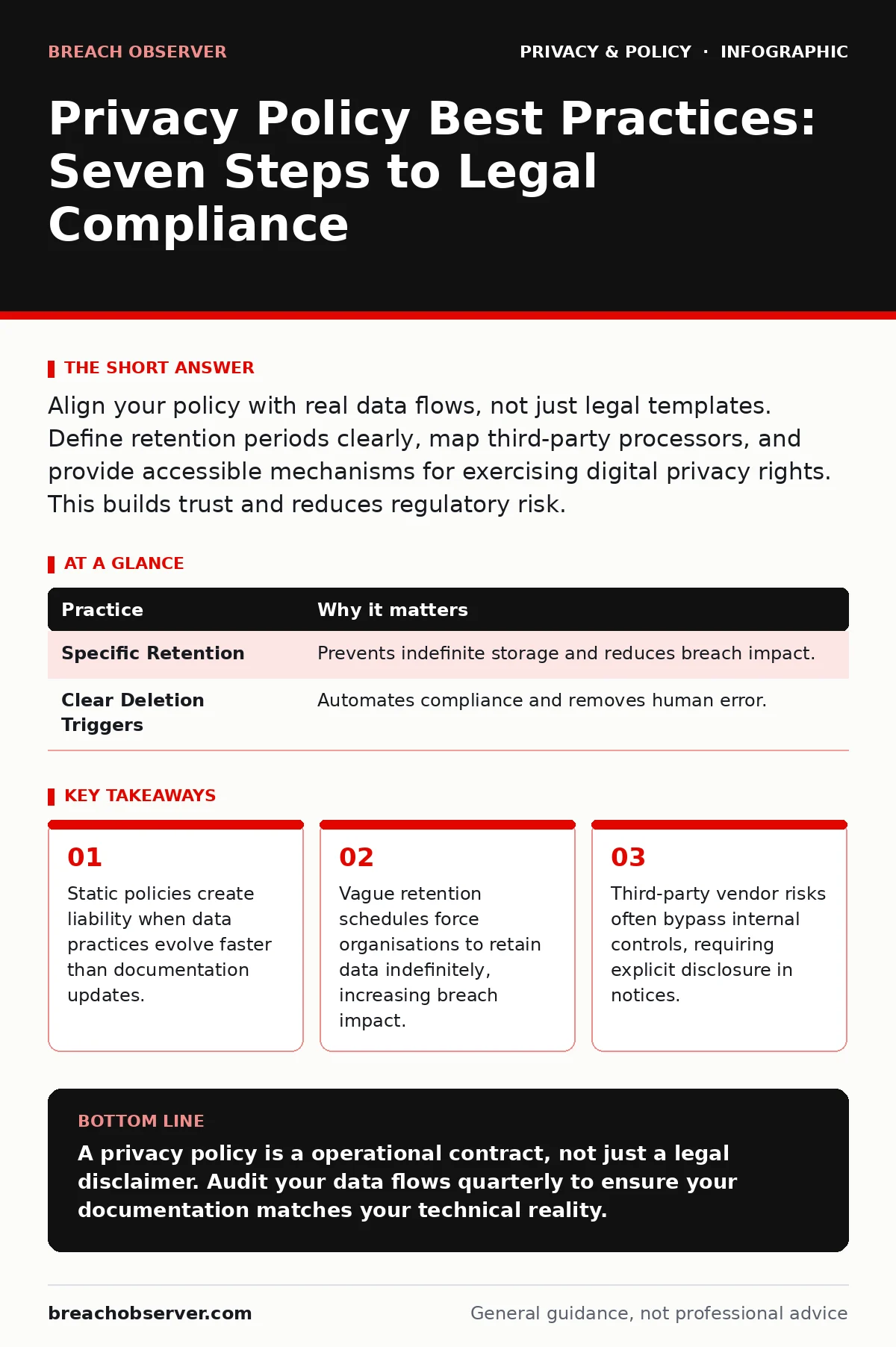
Align your policy with real data flows, not just legal templates. Define retention periods clearly, map third-party processors, and provide accessible mechanisms for exercising digital privacy rights. This builds trust and reduces regulatory risk.
1. Map Data Flows Before Writing Text
Writing a privacy policy without a current inventory of data flows is like building a house without a blueprint. You may have walls, but you will not know where the pipes run or where the structure will fail. Security teams often discover that the engineering team collects telemetry data that the legal team never authorised. This disconnect creates immediate compliance gaps and erodes user trust.
You must align the policy with the actual technical reality of your systems. Identify every entry point where personal data enters your environment. Trace how that data moves through processing, storage, and deletion stages. If the map does not match the text, the text is wrong.
- Conduct a quarterly audit of data ingestion points to verify they are documented.
2. Define Retention Periods with Specific Triggers
Vague language such as "we retain data for as long as necessary" is legally dangerous and operationally costly. It gives no clear instruction to engineers on when to delete records, leading to indefinite storage. Indefinite storage increases the blast radius of any potential breach and violates the principle of data minimisation.
Specify the exact event that triggers deletion. This could be account closure, contract expiry, or the end of a statutory limitation period. Link these triggers to automated deletion scripts where possible. This removes human error from the lifecycle management process.
- Replace "as long as necessary" with specific timeframes or event-based triggers.
| Practice | Why it matters |
|---|---|
| Specific Retention | Prevents indefinite storage and reduces breach impact. |
| Clear Deletion Triggers | Automates compliance and removes human error. |
3. Disclose Third-Party Processors Explicitly
Many organisations assume that signing a data processing agreement with a vendor protects them from liability. This is incorrect. The responsibility for transparency lies with the data controller, not the processor. If you use a analytics provider, a cloud host, or a payment gateway, users must know who sees their data.
Listing vendors by category is often insufficient for high-risk data. Name the specific processors or provide a direct link to a dynamically updated list. Explain the purpose of sharing data with each entity. This transparency allows users to assess the risk chain beyond your direct control.
4. Explain Legitimate Interest with Balance Tests
When you rely on legitimate interest under the GDPR rather than explicit consent, you must justify why your interests override the individual’s rights. Simply stating "we have a legitimate interest" is not enough. Regulators require a balance test that considers the impact on the data subject.
Describe the specific interest you are pursuing. Explain why consent is not appropriate for this use case. Detail the safeguards you have put in place to mitigate any negative impact on the user. This transparency demonstrates that you have considered the trade-offs and chosen a proportionate approach.
- Include a brief summary of your balance test for each legitimate interest claim.
5. Provide Accessible Data Subject Access Requests
A privacy policy is useless if users cannot exercise their rights easily. Complex forms, hidden email addresses, or slow response times create friction that discourages legitimate requests. This friction can be interpreted as bad faith by regulators and users alike.
Provide a dedicated, easy-to-find interface for submitting data subject access requests. Clearly state the timeframe for responses and what documentation you require to verify identity. Automate the initial intake process to ensure no request is lost or delayed. This operationalises your commitment to digital privacy rights.
- Test your request submission process annually to ensure it remains user-friendly.
6. Clarify Automated Decision-Making Logic
If you use algorithms to make decisions that significantly affect users, you must explain the logic involved. This includes credit scoring, hiring decisions, or targeted advertising. Users have a right to understand how these systems work and to challenge the outcomes.
Describe the main factors the algorithm considers. Explain that they have the right to obtain human intervention. Clarify that automated decisions are not the only factor in final outcomes. This does not require disclosing proprietary source code, but it does require transparency about the inputs and the weight given to each factor.
- Add a specific section detailing automated decision-making processes and user recourse.
7. Maintain Version Control and Change Logs
Privacy policies are living documents. As your data practices evolve, your policy must reflect those changes immediately. Failing to update your policy creates a discrepancy between what you say you do and what you actually do. This discrepancy is a primary source of regulatory fines.
Implement a version control system for your privacy policy. Maintain a public log of changes, including the date of the change and a summary of what was updated. Notify users of material changes through direct communication channels, not just by updating the footer link. This ensures users are aware of how their data usage has changed.
8. Address Children’s Data with Heightened Care
Data collected from children requires stricter protection and clearer language. General privacy policies are often too complex for young users and their guardians to understand. Regulators expect age-appropriate language and additional safeguards for this vulnerable group.
Create a separate, simplified privacy notice for services directed at children. Use plain language that a child can understand. Explicitly state how you obtain parental consent and how you limit data collection. This demonstrates respect for the unique vulnerabilities of younger users and aligns with global standards for online safety.
- Review your language for simplicity and clarity, removing legal jargon where possible.
9. Integrate Anonymization Standards Clearly
If you claim to anonymise data, you must define what that means in your context. Pseudonymization, where data can be re-identified with a key, is not the same as true anonymization. Users need to know whether their data can still be linked back to them.
Explain the techniques you use to anonymise data. State clearly whether the data remains pseudonymized or is truly anonymized. Describe the risks of re-identification and the safeguards you have in place. This clarity helps users understand the residual risk associated with their data usage.
Key takeaways
- Static policies create liability when data practices evolve faster than documentation updates.
- Vague retention schedules force organisations to retain data indefinitely, increasing breach impact.
- Third-party vendor risks often bypass internal controls, requiring explicit disclosure in notices.
A privacy policy is a operational contract, not just a legal disclaimer. Audit your data flows quarterly to ensure your documentation matches your technical reality.
Frequently asked questions
How often should I update my privacy policy?
Update it whenever your data processing activities change materially. Regular quarterly reviews are recommended to catch drift.
Do I need separate policies for different regions?
You can have a global policy if it meets the highest standard required by any jurisdiction you operate in. Supplement with regional appendices if necessary.
What is the difference between anonymization and pseudonymization?
Anonymization removes all identifiers so the data cannot be linked back to an individual. Pseudonymization replaces identifiers with a key, allowing re-identification.
How do I handle third-party cookies in my policy?
Disclose all third-party cookies, their purpose, and the entities that set them. Provide users with a clear mechanism to opt out where required.
How this guide was produced: written by the Breach Observer editorial team with AI assistance, checked against the public references listed below, and reviewed when the facts change. See our editorial policy or report an error.