
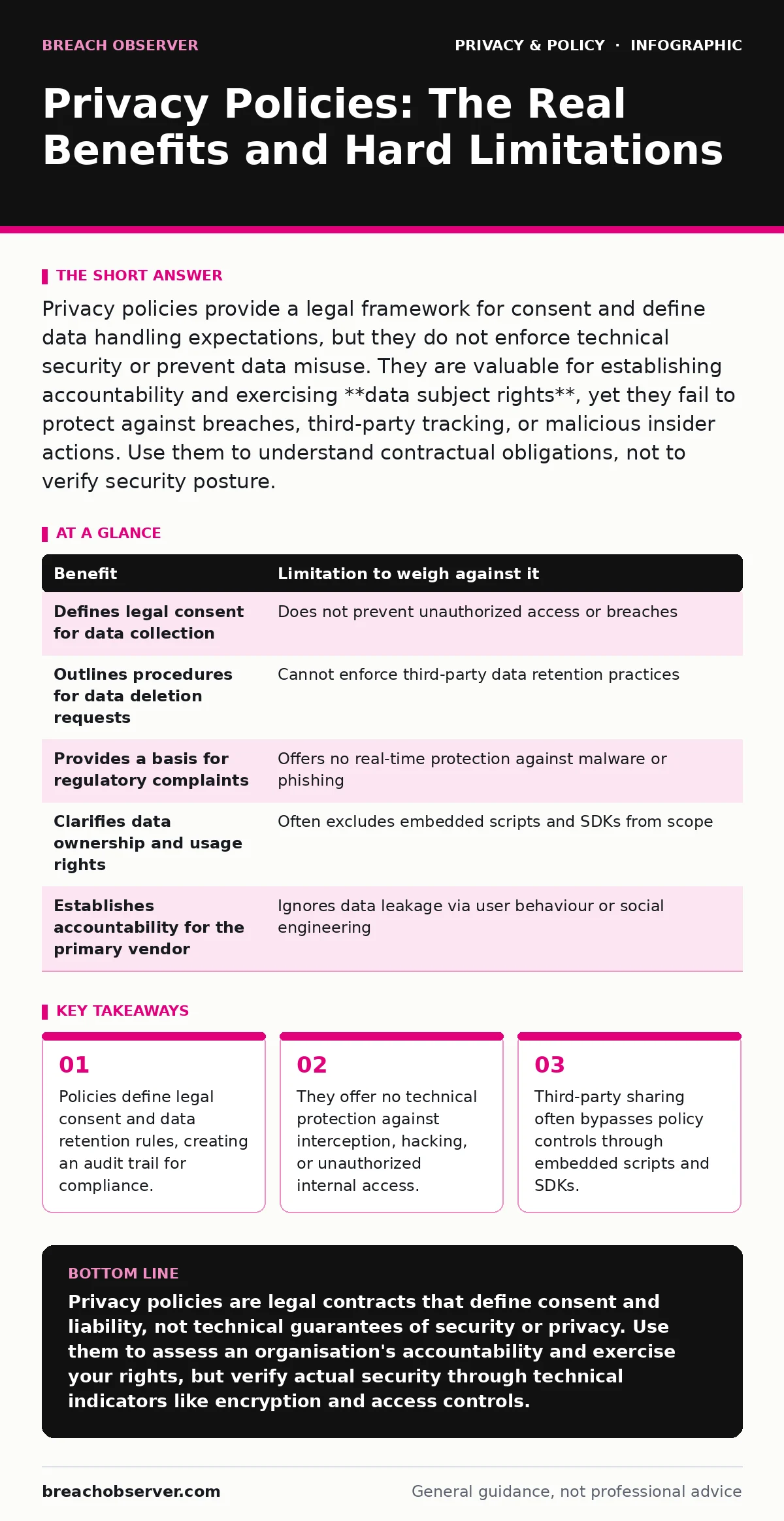
Privacy policies provide a legal framework for consent and define data handling expectations, but they do not enforce technical security or prevent data misuse. They are valuable for establishing accountability and exercising **data subject rights**, yet they fail to protect against breaches, third-party tracking, or malicious insider actions. Use them to understand contractual obligations, not to verify security posture.
The Legal Contract, Not the Technical Shield
You often treat a privacy policy as a promise of safety. It is not. It is a legal document that defines the relationship between you and the organisation holding your data. This distinction matters because legal compliance and technical security operate on entirely different tracks. A company can be fully compliant with its own policy while simultaneously suffering from poor encryption standards.
The primary function of this document is to establish consent. It outlines what data is collected, why it is collected, and how long it is retained. This creates a binding agreement. If the organisation deviates from this text, it breaches the contract. This breach can lead to regulatory fines or civil liability. However, this legal recourse does not restore your privacy once the data is exposed.
Imagine you hand over your keys to a hotel. The privacy policy is the receipt stating they will only use those keys to open your room. It does not guarantee the lock is unbreakable. If a thief picks the lock, the hotel may still be following its stated procedure of "not using the keys," but your belongings are gone. The policy governs intent, not capability.
Concrete Benefits of Documented Transparency
Despite their limitations, these documents provide specific, actionable benefits. The most significant is the establishment of data minimization principles. By forcing an organisation to list what it collects, the policy creates a baseline for scrutiny. You can compare this list against the actual functionality of the service. If a simple calculator app claims to need access to your contact list, the policy reveals a mismatch between utility and data hunger.
Another benefit is the formalisation of user rights. The policy must explain how you can request access, correction, or deletion of your data. This is not just bureaucratic language; it is the operational mechanism for exercising your digital privacy rights. Without this documented process, asserting your right to be forgotten becomes a legal guesswork exercise. The policy provides the channel through which you can demand accountability.
The policy also defines the scope of liability. It clarifies what the organisation accepts responsibility for and what it excludes. For instance, it may state that it is not liable for data loss during transmission over insecure networks. This forces you, the user, to consider the security of your own connection. It shifts some responsibility back to you, which is a useful, if uncomfortable, reality check.
The Hard Limitations of Text-Only Protections
The most dangerous assumption is that a well-written policy implies a secure system. It does not. A policy is a static document. It cannot react to dynamic threats like zero-day exploits or evolving phishing techniques. It offers no real-time protection. If malware infects your device, the privacy policy of the software you installed does not stop the exfiltration of your credentials.
Furthermore, policies rarely cover the full ecosystem of data processing. They focus on the primary service provider. They often omit detailed descriptions of third-party integrations. When you click "Accept," you are often consenting to data sharing with analytics firms, ad networks, and cloud infrastructure providers that operate outside the primary policy’s direct control. This creates a blind spot. You trust the main vendor, but the data flows to entities you have never heard of.
The language itself is often deliberately ambiguous. Terms like "legitimate interest" or "service improvement" can be interpreted broadly. This allows organisations to expand data usage without updating the policy or seeking new consent. The legal flexibility intended to allow business innovation becomes a loophole for privacy erosion. You are agreeing to a moving target.
The Hidden Cost of Compliance Over Security
There is a non-obvious consequence of heavy reliance on privacy policies: it can distract from actual security engineering. Organisations may invest heavily in legal review and policy drafting to satisfy regulators, while underfunding penetration testing or encryption upgrades. This misallocation of resources creates a false sense of security. The system looks compliant on paper but remains fragile in practice.
This dynamic affects you as a user. You may spend time reading a polished policy, feeling reassured, while ignoring more critical security indicators. For example, you might overlook the absence of end-to-end encryption because the policy claims to "protect your data." The policy describes the goal; the encryption describes the method. Without the method, the goal is unachievable.
Consider the difference between a policy and a technical protocol. A policy says "we secure your emails." The protocol (like PGP or S/MIME) actually encrypts them. If the protocol is missing, the policy is merely aspirational. You must look for technical evidence of security, not just legal assurances.
Benefits vs Limitations: A Comparative Table
To weigh the value of a privacy policy, compare its legal benefits against its technical limitations.
| Benefit | Limitation to weigh against it |
|---|---|
| Defines legal consent for data collection | Does not prevent unauthorized access or breaches |
| Outlines procedures for data deletion requests | Cannot enforce third-party data retention practices |
| Provides a basis for regulatory complaints | Offers no real-time protection against malware or phishing |
| Clarifies data ownership and usage rights | Often excludes embedded scripts and SDKs from scope |
| Establishes accountability for the primary vendor | Ignores data leakage via user behaviour or social engineering |
See also: GDPR in Germany: How Strict Enforcement Shapes Data Compliance · What the CIA triad stands for and how to enforce it
When It Is Worth It
You should engage with privacy policies when the data involved is sensitive and the consequences of misuse are high. This includes health records, financial information, and biometric data. In these cases, the policy serves as a critical risk assessment tool. If the policy is vague, overly broad, or lacks a clear data retention schedule, it is a strong indicator that the organisation does not prioritise data stewardship.
It is also worth reviewing the policy when you suspect ad tracking or data brokerage is occurring. Look for sections on "Third-Party Services" or "Analytics." If the policy lists specific vendors or describes the data shared with them, you can cross-reference this with browser extensions or network monitoring tools. This allows you to verify if the technical reality matches the legal promise.
For organisations, maintaining a clear policy is worth the effort because it builds trust. It demonstrates that you have thought about data flow and have controls in place. It is a necessary component of privacy by design, showing that privacy considerations were integrated into the product development lifecycle, not added as an afterthought.
When It Is Not Worth It
Do not rely on a privacy policy to assess the security of a connection or a device. Reading the policy of a public Wi-Fi provider will not tell you if the network is sniffing your traffic. For that, you need to understand public Wi-Fi risks and use a VPN. The policy is irrelevant to the technical threat.
Similarly, do not expect a policy to protect you from facial recognition risks if the technology is already deployed in public spaces. The policy may govern how the data is stored, but it cannot stop the initial capture. In these scenarios, the policy is a post-hoc justification, not a preventive measure. Your protection lies in physical avoidance or regulatory pressure, not in reading the terms of service.
Finally, do not waste time negotiating with automated systems that do not honour their policies. If you request data deletion and receive a generic refusal, the policy was never intended to be a user protection tool. It was a legal shield. Recognise this early and withdraw your data or discontinue use. The energy spent arguing with a bot is better spent finding a service that respects anonymization principles by default.
Key takeaways
- Policies define legal consent and data retention rules, creating an audit trail for compliance.
- They offer no technical protection against interception, hacking, or unauthorized internal access.
- Third-party sharing often bypasses policy controls through embedded scripts and SDKs.
Privacy policies are legal contracts that define consent and liability, not technical guarantees of security or privacy. Use them to assess an organisation's accountability and exercise your rights, but verify actual security through technical indicators like encryption and access controls.
Frequently asked questions
Does a privacy policy prevent my data from being sold to advertisers?
Not necessarily. Many policies include clauses that allow data sharing with partners for advertising purposes, provided it is anonymized or aggregated. You must read the "Sharing" or "Third Parties" section carefully to see if direct sale or profiling is permitted.
What is the difference between a privacy policy and a security policy?
A privacy policy explains what data is collected and why, focusing on legal compliance and user consent. A security policy describes the technical and administrative measures used to protect that data from unauthorized access or breaches. Both are needed for full protection.
Can I sue a company if they violate their privacy policy?
In many jurisdictions, a privacy policy forms part of the contractual agreement between you and the service provider. Violations can lead to legal action for breach of contract or regulatory penalties, depending on local laws and the severity of the breach.
Why do some apps ask for more permissions than their policy states?
This discrepancy can indicate poor data governance or excessive data collection. The app may be using third-party libraries that request permissions automatically. This is a red flag, as it suggests the organisation may not have full control over what data its product actually accesses.
How this guide was produced: written by the Breach Observer editorial team with AI assistance, checked against the public references listed below, and reviewed when the facts change. See our editorial policy or report an error.