
Legitimate interest allows data processing without consent when you have a valid reason, the processing is necessary, and your interests do not override the individual’s rights. You must document this balance carefully to withstand regulatory scrutiny.
The Foundation of Legitimate Interest
Legitimate interest is one of six lawful bases for processing personal data under the General Data Protection Regulation. Unlike consent, it does not require active permission from the individual. This makes it attractive for routine operations like fraud prevention or network security. However, it carries a higher burden of proof. You must demonstrate that your interest is real and that the processing is necessary to achieve it.
This basis is not a free pass. It requires a structured assessment. If you skip steps or document poorly, regulators will view the processing as unlawful. The risk is not just a fine. It is the loss of trust and the potential for data subjects to exercise their digital privacy rights against you.
Stage 1: The Purpose Test
The first step is identifying your specific purpose for processing the data. You must define why you need the information and what you intend to do with it. Vague purposes like "business improvement" are insufficient. The purpose must be clear, specific, and documented.
Ask yourself if the processing is necessary for that purpose. If you can achieve the same goal with less intrusive methods, you fail this stage. For example, if you need to verify identity, collecting a full address might be excessive when a postcode suffices. This aligns with the principle of privacy by design, where data minimisation is built into the process from the start.
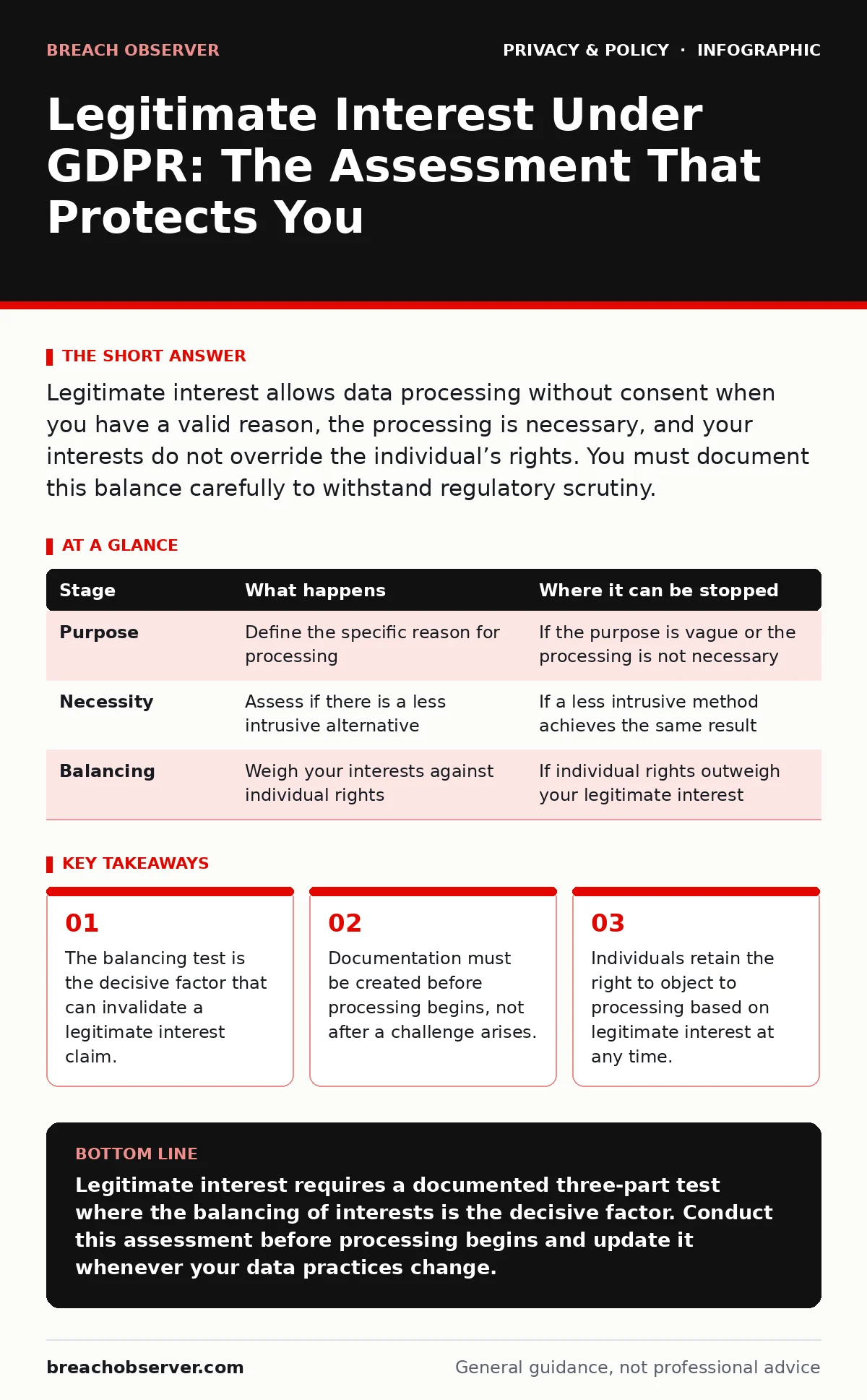
| Stage | What happens | Where it can be stopped |
|---|---|---|
| Purpose | Define the specific reason for processing | If the purpose is vague or the processing is not necessary |
| Necessity | Assess if there is a less intrusive alternative | If a less intrusive method achieves the same result |
| Balancing | Weigh your interests against individual rights | If individual rights outweigh your legitimate interest |
Stage 2: The Necessity Test
Necessity means there is no other way to achieve your purpose. You must consider whether the data is strictly required. If you can anonymise the data, you should do so. Anonymisation removes the data from the scope of data protection law entirely because it can no longer be linked to an individual.
This stage often fails when organisations collect data "just in case". Collecting extra fields for future use violates necessity. You must justify every data point. If a data field does not directly contribute to the stated purpose, remove it. This reduces risk and simplifies compliance.
Stage 3: The Balancing Test
This is the most critical stage. You must weigh your legitimate interests against the individual’s rights and freedoms. Consider the impact on the individual. Would they reasonably expect you to process this data? If the processing is intrusive, unexpected, or harmful, your interest likely fails.
Power imbalances matter. If you hold significant power over the individual, such as an employer over an employee, the threshold for legitimate interest is higher. In such cases, consent or contractual necessity may be more appropriate. You must document this analysis. A lack of documentation is often treated as a failure of the test.
Documenting the Assessment
You must record your reasoning. This document is known as a Legitimate Interest Assessment. It should detail the purpose, the necessity analysis, and the balancing test. Include how you mitigate risks to individuals, such as limiting access to the data or setting short retention periods.
This document is not a formality. It is evidence of compliance. If challenged, you must produce it. It should be reviewed regularly, especially if the processing changes. If you change the purpose or the data collected, you must repeat the assessment.
See also: Cross-Border Data Transfers: Small Business Compliance Rules · What is CCPA request: rights, process and business impact
Handling Objections
Individuals have the right to object to processing based on legitimate interest. They do not need to give a reason for the objection. When an objection is received, you must stop processing immediately unless you can demonstrate compelling legitimate grounds that override the individual’s interests, rights, and freedoms.
This is a high bar. You must prove that your interest is so strong that it outweighs the individual’s objection. In most cases, you will need to stop processing. This is similar to the right to be forgotten, where the individual’s choice to erase data must be respected unless a legal exception applies.
Practical Application and Edge Cases
Imagine you run a small online store. You want to use customer data for marketing. You cannot rely on legitimate interest for direct marketing to existing customers if they have not opted out. In this specific case, legitimate interest may apply, but the individual’s right to object is absolute. You must provide a clear way to opt out.
For new customers, legitimate interest is harder to justify for marketing. Consent is usually the safer route. Using legitimate interest here often fails the balancing test because individuals do not expect marketing from companies they have not yet engaged with.
Another edge case involves employee monitoring. Monitoring internet usage for security is often legitimate. However, monitoring content for productivity reasons usually fails the balancing test. The intrusion into privacy outweighs the employer’s interest in productivity.
Review and Maintenance
Legitimate interest is not a one-time check. You must review your assessments periodically. Changes in technology, law, or business practices can alter the balance. If a new regulation increases the sensitivity of certain data, your previous assessment may no longer hold.
Integrate this review into your data governance framework. Assign responsibility for maintaining these records. Ensure that staff understand the difference between legitimate interest and consent. Misclassification is a common error that leads to non-compliance.
Conclusion of the Process
Legitimate interest provides flexibility but demands rigour. You must prove necessity and balance interests carefully. Documentation is your primary defence. Without it, your processing is vulnerable to challenge.
Treat each assessment as a living document. Update it when processes change. Respect the right to object. By following these steps, you protect your organisation and respect individual privacy. This approach builds trust and reduces legal risk.
Key takeaways
- The balancing test is the decisive factor that can invalidate a legitimate interest claim.
- Documentation must be created before processing begins, not after a challenge arises.
- Individuals retain the right to object to processing based on legitimate interest at any time.
Legitimate interest requires a documented three-part test where the balancing of interests is the decisive factor. Conduct this assessment before processing begins and update it whenever your data practices change.
Frequently asked questions
Can I use legitimate interest for direct marketing?
Yes, for existing customers, but individuals have an absolute right to object. You must provide a clear opt-out mechanism. For new contacts, consent is generally required.
How often should I review my legitimate interest assessments?
Review them annually or whenever there is a significant change in processing activities, technology, or legal requirements. Regular reviews ensure ongoing compliance.
What happens if an individual objects to processing?
You must stop processing unless you can demonstrate compelling legitimate grounds that override their interests. In most cases, you must cease processing immediately.
Is legitimate interest better than consent?
It depends on the context. Legitimate interest is easier to maintain as it does not require re-confirmation. However, it carries a higher burden of proof and risk if challenged.
How this guide was produced: written by the Breach Observer editorial team with AI assistance, checked against the public references listed below, and reviewed when the facts change. See our editorial policy or report an error.