
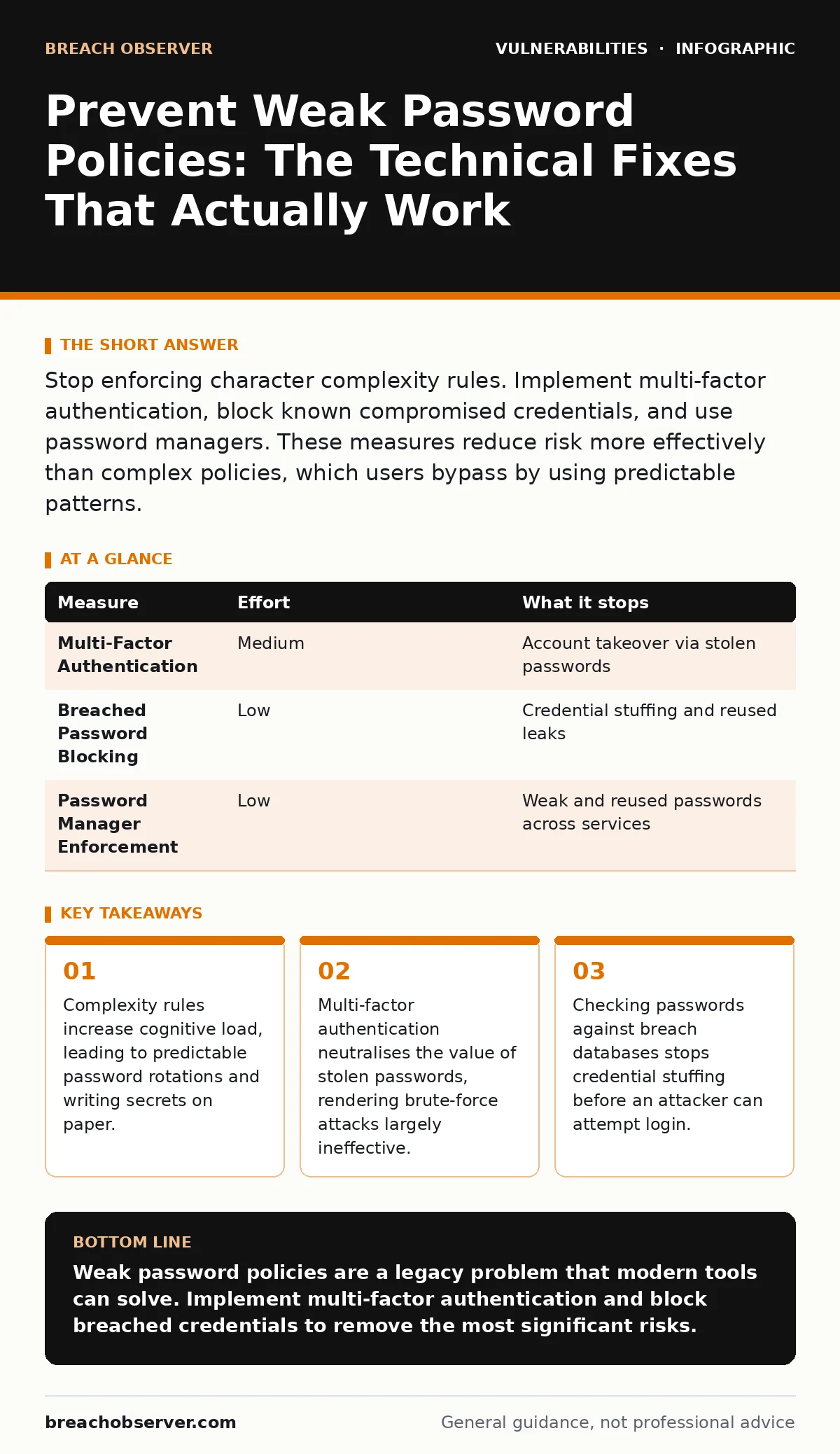
Stop enforcing character complexity rules. Implement multi-factor authentication, block known compromised credentials, and use password managers. These measures reduce risk more effectively than complex policies, which users bypass by using predictable patterns.
The Hidden Cost of Complexity Rules
For decades, organisations mandated complex passwords containing uppercase letters, numbers, and symbols. The intention was to increase the time required to crack a hash. However, this approach ignores human behaviour. When you force users to create difficult passwords every ninety days, they adopt predictable patterns. A user might change "Summer2023!" to "Winter2024!" or add a single number to the end. Attackers anticipate this behaviour. They build dictionaries that include common rotation patterns. These dictionaries crack complex-but-predictable passwords faster than they crack simple-but-random ones.
You must also consider the physical risk. If a password is too complex to remember, users write it down. A sticky note on a monitor is a direct bypass of your digital security controls. It allows any physical access to compromise an account instantly. This creates a single point of failure that no firewall can protect. The policy intended to strengthen security actually introduces a new vulnerability vector. You trade digital resilience for physical exposure.
The Role of Multi-Factor Authentication
Multi-factor authentication requires two or more verification methods to access an account. This typically combines something the user knows, like a password, with something they have, like a smartphone or hardware token. This measure removes the majority of risk associated with weak passwords. If an attacker obtains a weak password through phishing or a data leak, they cannot log in without the second factor. This renders the password strength largely irrelevant for account takeover.
You should prioritise phishing-resistant methods. SMS codes are vulnerable to SIM swapping and interception. Security keys and authenticator apps provide stronger protection. They verify the user’s identity without transmitting a static secret over the network. This reduces the attack surface significantly. Even if your password policy is weak, the account remains secure as long as the second factor is intact. This shifts the burden from user memory to device security.
Blocking Compromised Credentials
You must check passwords against known breached data. This process involves comparing the hash of a new or existing password against a database of leaked credentials. If a match is found, the system rejects the password. This stops users from reusing passwords that are already public. It prevents credential stuffing attacks, where attackers use leaked credentials from one site to gain access to another.
This measure is highly effective because it targets passwords that are already compromised. It does not rely on the user’s ability to create unique secrets. Instead, it relies on the existence of historical data. You can implement this check during password creation and periodically for existing accounts. It provides immediate risk reduction with minimal user friction. Users only need to change a password if it appears in a leak, which is a clear and understandable reason.
| Measure | Effort | What it stops |
|---|---|---|
| Multi-Factor Authentication | Medium | Account takeover via stolen passwords |
| Breached Password Blocking | Low | Credential stuffing and reused leaks |
| Password Manager Enforcement | Low | Weak and reused passwords across services |
The Necessity of Password Managers
Password managers generate and store strong, unique passwords for every account. They eliminate the need for users to remember complex secrets. This removes the cognitive load that leads to weak password creation. Users can rely on the manager to handle the complexity. This ensures that each account has a high-entropy password that is impossible to guess.
You should encourage or mandate the use of enterprise-grade password managers. These tools integrate with your identity provider and allow for centralised management. They also provide secure sharing mechanisms for team accounts. This reduces the risk of shared credentials being written down or emailed. It creates a single point of truth for credential management. This aligns digital security with user convenience.
What Does Not Work
Some measures provide a false sense of security. One common example is requiring password changes every thirty or ninety days. This practice assumes that passwords are static risks. In reality, passwords are dynamic. Users adapt to change policies by making minimal alterations. This creates a predictable pattern that attackers exploit. It also increases support tickets for password resets. This wastes time and resources without improving security.
Another ineffective measure is restricting password length to a maximum. Short passwords are easier to crack. There is no technical reason to limit length. Longer passwords are more resistant to brute-force attacks. You should encourage long passphrases instead of short complex strings. A passphrase like "correct-horse-battery-staple" is stronger and easier to remember than "Tr0ub4dor&3". This approach improves both security and usability.
See also: Family Password Managers: 7 Setup Mistakes That Leak Data
Addressing Legacy System Constraints
Some older systems do not support modern authentication methods. They may only accept plain-text passwords or have weak hashing algorithms. These systems remain vulnerable regardless of your policy. You must identify these systems through a thorough IT asset inventory. Isolate them from the main network. Use jump servers or bastion hosts to limit access. This reduces the exposure of these weak points.
You should plan for migration or replacement. Leaving legacy systems connected to the core network creates a significant risk. Attackers often target these weak links to gain initial access. Once inside, they can move laterally. This is why understanding your environment is critical. Refer to our guide on end-of-life software for strategies on managing unsupported systems. These systems require special handling to mitigate inherent risks.
The Human Element of Security
Technology alone cannot solve the password problem. Users will always find ways to bypass restrictions. They will share passwords with colleagues. They will reuse passwords for convenience. You must address these behaviours through training and culture. Education should focus on the risks of sharing credentials. It should explain why multi-factor authentication is necessary.
Avoid blaming users for weak passwords. Instead, provide tools that make security easy. If you make it hard to be secure, users will choose convenience. This is a fundamental principle of human-centred security. By removing friction, you encourage compliance. This leads to a more secure environment overall. The goal is to align user behaviour with security objectives.
Implementing a Zero Trust Approach
Zero Trust assumes that no user or device is trusted by default. It verifies every request as if it comes from an open network. This model reduces the impact of compromised credentials. Even if an attacker has a valid password, they cannot access resources without further verification. This limits the blast radius of a breach.
You should implement least privilege access. Users should only have access to the resources they need. This reduces the value of any single account. It also simplifies monitoring and detection. When an account is compromised, the attacker’s options are limited. This makes it easier to detect and respond to threats. It is a foundational element of modern security architecture.
Key takeaways
- Complexity rules increase cognitive load, leading to predictable password rotations and writing secrets on paper.
- Multi-factor authentication neutralises the value of stolen passwords, rendering brute-force attacks largely ineffective.
- Checking passwords against breach databases stops credential stuffing before an attacker can attempt login.
Weak password policies are a legacy problem that modern tools can solve. Implement multi-factor authentication and block breached credentials to remove the most significant risks.
Frequently asked questions
Should I still require special characters in passwords?
No. Length and randomness are more important than character types. Simple rules allow for longer, more memorable passphrases that are harder to crack.
How do I handle shared service accounts?
Use a password manager with secure sharing features. Avoid using personal accounts for shared services. This ensures proper audit trails and access control.
What if my users forget their second factor?
Provide backup codes or alternative verification methods. Ensure these are stored securely. Test the recovery process regularly to avoid lockouts.
Can I automate password checks for all systems?
Yes, if your identity provider supports it. Integrate checks at the login point. This centralises policy enforcement and reduces administrative overhead.
How this guide was produced: written by the Breach Observer editorial team with AI assistance, checked against the public references listed below, and reviewed when the facts change. See our editorial policy or report an error.