
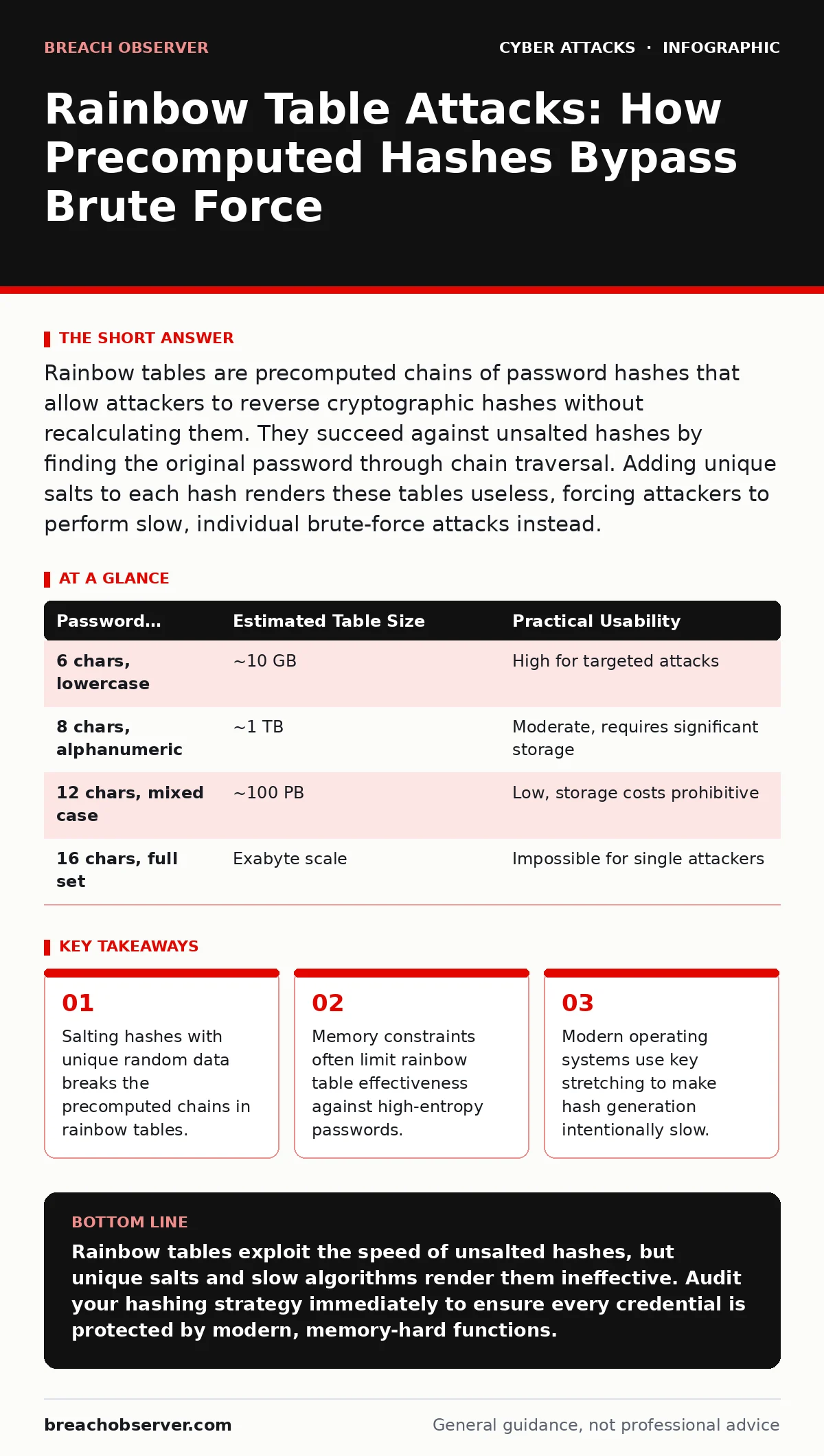
Rainbow tables are precomputed chains of password hashes that allow attackers to reverse cryptographic hashes without recalculating them. They succeed against unsalted hashes by finding the original password through chain traversal. Adding unique salts to each hash renders these tables useless, forcing attackers to perform slow, individual brute-force attacks instead.
What is a rainbow table attack?
A rainbow table attack uses precomputed tables of password hashes to reverse cryptographic hashing functions rapidly. Attackers generate these tables offline, mapping common passwords to their corresponding hash outputs. When they obtain a database of hashed passwords, they search the table for matches rather than guessing passwords in real time. This method bypasses rate-limiting mechanisms that protect online login systems. The attack relies entirely on the predictability of the hashing process and the lack of unique identifiers for each password.
How do rainbow tables differ from brute force?
Brute force attacks attempt every possible character combination until a match is found, which consumes significant processing power and time. Rainbow tables trade computational time for storage space by calculating hashes in advance. An attacker generates the table once and reuses it against multiple compromised databases. This approach eliminates the need for repeated calculations during the breach response phase. While brute force is resource-intensive during the attack, rainbow tables require substantial disk space to store the precomputed data.
Why do salts defeat rainbow tables?
Salts are random data strings added to a password before hashing, ensuring that identical passwords produce different hash outputs. Rainbow tables assume a fixed relationship between passwords and hashes, which salts disrupt completely. An attacker would need a separate rainbow table for every unique salt value, making the storage requirements astronomically high. This forces the attacker to revert to slower, per-password guessing methods. Implementing unique salts per user is the primary defence against this specific threat.
Can rainbow tables crack modern password hashes?
Modern hashing algorithms like Argon2 or bcrypt incorporate memory-hard functions and key stretching, making precomputation impractical. These algorithms intentionally slow down the hashing process, increasing the cost of generating each entry in a potential table. Rainbow tables remain effective only against fast, unsalted hashes like MD5 or SHA-1 without additional security layers. Using outdated hashing methods leaves systems vulnerable to rapid offline cracking. Upgrading to memory-hard functions significantly raises the barrier for attackers using precomputed data.
How large are rainbow tables in practice?
Rainbow tables grow exponentially with password length and character set complexity. A table covering all 8-character alphanumeric passwords requires terabytes of storage space. Including special characters or increasing length to 12 characters makes the table size prohibitive for most attackers. Storage costs and generation time limit the practical scope of these tables to shorter, simpler passwords. Attackers often focus on subsets of likely passwords rather than exhaustive character sets.
| Password Complexity | Estimated Table Size | Practical Usability |
|---|---|---|
| 6 chars, lowercase | ~10 GB | High for targeted attacks |
| 8 chars, alphanumeric | ~1 TB | Moderate, requires significant storage |
| 12 chars, mixed case | ~100 PB | Low, storage costs prohibitive |
| 16 chars, full set | Exabyte scale | Impossible for single attackers |
See also: Family Password Managers: 7 Setup Mistakes That Leak Data
What is the role of key stretching?
Key stretching involves repeating the hashing process thousands or millions of times to increase computational cost. This technique, used in algorithms like PBKDF2, makes generating rainbow table entries excessively slow. Each additional iteration multiplies the time required to precompute the table. Attackers cannot justify the time investment when the payoff is limited to unsalted, weak passwords. Key stretching complements salting by adding a time-based barrier to offline cracking attempts.
How do attackers optimise rainbow table generation?
Attackers use differentiation functions to reduce memory usage while maintaining coverage of the password space. These functions compress the table by storing only start and end points of hash chains, reconstructing intermediate values during lookup. This optimisation allows larger tables to fit on consumer hardware. It also introduces a trade-off between lookup speed and table size. Understanding these optimisations helps defenders anticipate the resources attackers might deploy against legacy systems.
What are the limitations of rainbow tables?
Rainbow tables cannot crack passwords that exceed the character set or length defined during table generation. They are ineffective against passwords containing rare symbols or non-standard encodings. Furthermore, they require the attacker to possess the raw hash data, meaning they only apply to offline attacks. If the system uses online authentication, rate limiting and account lockouts prevent the use of precomputed tables. These limitations make rainbow tables a niche threat for modern, well-configured systems.
How do you protect against rainbow table attacks?
Defenders must implement unique salts for every password and use slow, memory-hard hashing algorithms. Avoiding fast hashes like MD5 or SHA-1 is critical for any system storing user credentials. Regularly auditing legacy systems for unsalted hashes helps identify vulnerable entry points. Educating users on creating longer, complex passwords further reduces the effectiveness of any precomputed data. These measures ensure that even if hashes are stolen, they remain computationally expensive to reverse.
How does this relate to other attack vectors?
Rainbow tables are one of many attack vectors available to threat actors seeking credential access. They often complement social engineering techniques like smishing, which trick users into revealing passwords directly. While rainbow tables target stored data, session cookie theft allows attackers to bypass authentication entirely. Understanding the full spectrum of threats, from hardware security keys to DNS filtering, ensures a layered defence strategy. No single control stops all attacks, but combining technical and human factors creates resilience.
Key takeaways
- Salting hashes with unique random data breaks the precomputed chains in rainbow tables.
- Memory constraints often limit rainbow table effectiveness against high-entropy passwords.
- Modern operating systems use key stretching to make hash generation intentionally slow.
Rainbow tables exploit the speed of unsalted hashes, but unique salts and slow algorithms render them ineffective. Audit your hashing strategy immediately to ensure every credential is protected by modern, memory-hard functions.
Frequently asked questions
Can rainbow tables crack Windows SAM files?
Older Windows versions stored unsalted LM hashes, which were vulnerable to rainbow tables. Modern Windows uses NTLMv2 with salting and key stretching, making rainbow tables largely ineffective against current systems.
Do rainbow tables work on hashed emails or usernames?
No, rainbow tables are designed for password hashes. Emails and usernames are typically stored in plaintext or reversible encryption, so hash reversal is not required to access them.
Is it safe to use the same salt for all users?
No, a single salt allows attackers to build one rainbow table for the entire database. Each user must have a unique salt to prevent precomputation and force individual brute-force attempts.
How do I know if my system uses rainbow table-vulnerable hashes?
Check your authentication configuration for algorithms like MD5 or SHA-1 without salting. If your system does not explicitly mention salts or key stretching, it is likely vulnerable to this attack method.
How this guide was produced: written by the Breach Observer editorial team with AI assistance, checked against the public references listed below, and reviewed when the facts change. See our editorial policy or report an error.