
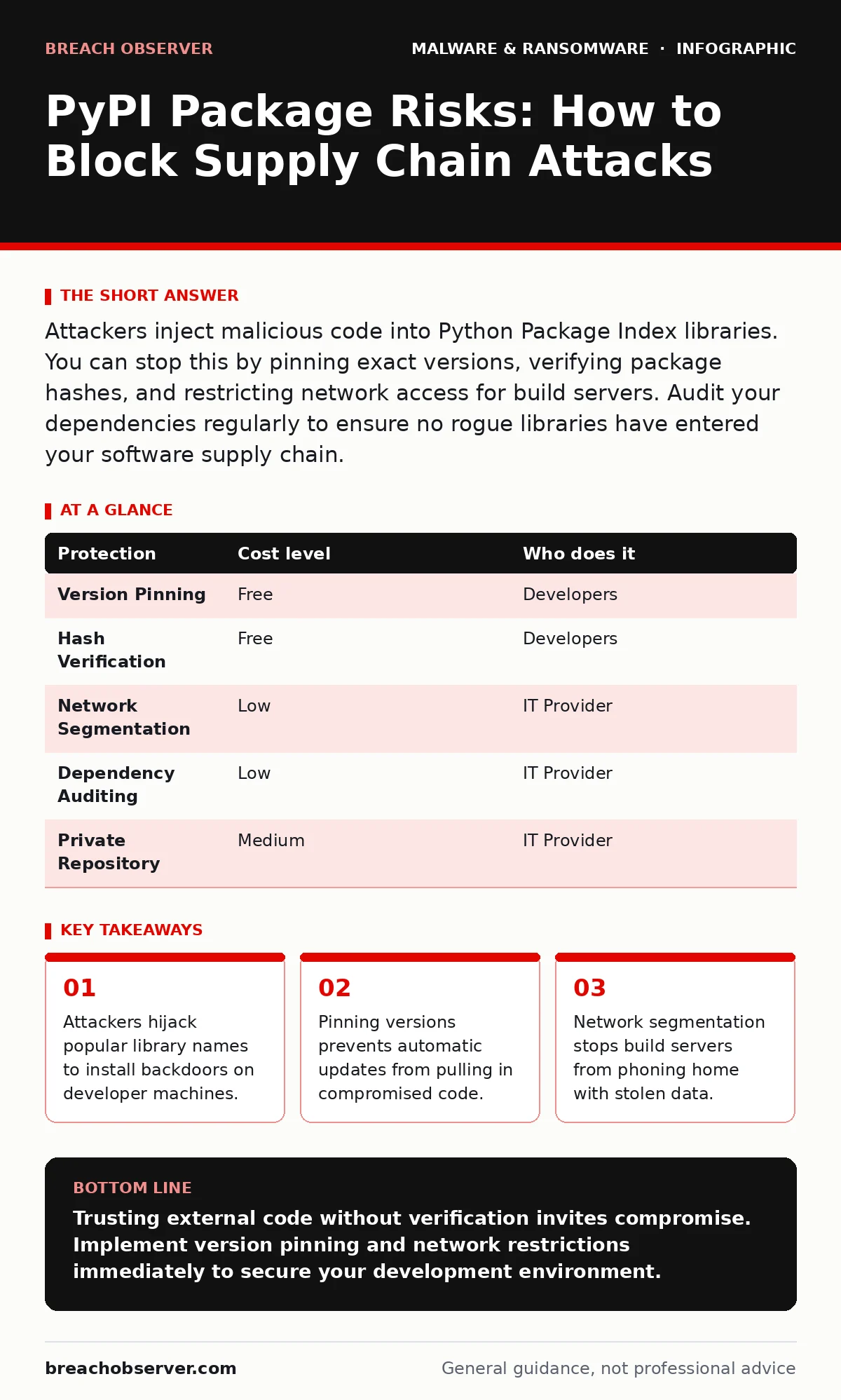
Attackers inject malicious code into Python Package Index libraries. You can stop this by pinning exact versions, verifying package hashes, and restricting network access for build servers. Audit your dependencies regularly to ensure no rogue libraries have entered your software supply chain.
The Silent Entry Point
You likely trust the Python Package Index (PyPI). It is the central repository for third-party software components in Python development. This trust is the vulnerability. Attackers do not need to breach your firewall. They wait for you to invite them in by installing a library.
Small organisations are exposed because they lack dedicated security operations teams. They rely on automated tools and quick fixes. When a developer runs a command to install dependencies, the system fetches code from the internet. If that code contains hidden instructions, it executes with the same permissions as your application.
The risk is not just data theft. It is the establishment of a foothold. Once code runs inside your network, it can map your internal structure. It can look for other systems to infect. It can modify your source code to include future backdoors. This is a supply chain attack. You are not the primary target; you are the bridge to a larger target.
Why Small Teams Are Vulnerable
Speed often overrides security in small teams. Developers want to build features, not audit code. They install packages with a single command. This convenience comes at a cost. You surrender control over what enters your environment.
Small organisations often share credentials or use personal accounts for work. If a developer’s personal PyPI account is compromised, it can affect work projects. Even if accounts are separate, the lack of visibility is dangerous. You may not know which libraries are in use across different projects.
There is also a false sense of security provided by open-source licensing. You assume that because code is public, it is safe. This is not true. Malicious code can be hidden in complex dependencies. It can appear benign for months before activating. This is known as a time-bomb payload.
The Mechanism of Compromise
Attackers use several methods to insert malicious code. Name squatting involves registering a package with a name similar to a popular one. If you mistype the name, you install the wrong library. Typosquatting is a common vector.
Another method is dependency confusion. Some build tools search internal repositories first. If an attacker publishes a package with the same name to PyPI, and your configuration is weak, your system might fetch the public, malicious version instead of your internal, safe one.
More sophisticated attacks involve compromising legitimate packages. Attackers gain access to the maintainer’s account. They update the package with malicious code. Existing users receive the update automatically. This bypasses many checks because the package ID remains the same. The hash changes, but few users verify hashes manually.
Low-Cost Protections for Limited Budgets
You do need expensive tools to reduce risk. Basic discipline and configuration changes offer significant protection. The goal is to reduce the attack surface. Make it harder for malicious code to run and easier to detect if it does.
Pinning versions is the first step. Instead of allowing any version of a library, specify the exact version in your requirements file. This prevents automatic updates from pulling in new, potentially compromised versions. You control when and how updates happen.
Verifying package hashes adds another layer. Each package has a unique digital fingerprint. You can compare the hash of the downloaded package against the hash published by the maintainer. If they differ, the package has been altered. This requires manual effort but is highly effective for critical libraries.
Restricting network access for build servers is crucial. Build servers should not have unrestricted internet access. They should only be able to reach specific, trusted repositories. This prevents malicious code from phoning home to command and control servers. It also stops accidental data exfiltration.
| Protection | Cost level | Who does it |
|---|---|---|
| Version Pinning | Free | Developers |
| Hash Verification | Free | Developers |
| Network Segmentation | Low | IT Provider |
| Dependency Auditing | Low | IT Provider |
| Private Repository | Medium | IT Provider |
What to Ask an IT Provider
If you outsource IT support, you must ensure they understand these risks. General security advice is not enough. You need specific actions related to software supply chains.
Do not assume standard antivirus software catches these threats. Malware droppers and loaders often evade traditional signatures. They look like normal code until they execute. You need an IT provider who understands application security, not just endpoint protection.
Ask your provider about their process for managing dependencies. Do they review new packages before installation? Do they monitor for known vulnerabilities in existing libraries? Are they familiar with the concept of a software bill of materials (SBOM)? An SBOM lists all components in your software. It helps you understand what you have and what might be at risk.
Also, ask about their incident response plan for supply chain attacks. If a malicious package is discovered, how quickly can they isolate affected systems? Do they have the tools to trace the origin of the infection? Can they perform forensic analysis to determine the scope of the breach?
Questions for Your IT Provider
- How do you verify the integrity of Python packages before installation?
- Do you maintain a software bill of materials for our critical applications?
- What is your process for updating libraries in a controlled manner?
- Can you segment our build environments from the general internet?
- How do you detect and respond to compromised dependencies?
Long-Term Resilience
Security is not a one-time fix. It is a continuous process. New threats emerge constantly. Libraries are updated, and new vulnerabilities are discovered. You must stay informed and adapt your practices.
Regular audits are necessary. Review your dependencies periodically. Remove unused libraries. Keep your tools up to date. This reduces the number of potential entry points. It also makes it easier to spot anomalies.
Education is key. Train your developers to recognise suspicious packages. Teach them to check package metadata. Encourage them to report unusual behaviour. A vigilant team is your best defence against social engineering and typosquatting.
Consider using a private repository for your organisation. This allows you to mirror trusted packages. It gives you full control over what your developers can install. It also speeds up builds and ensures consistency across projects.
Managing the Human Factor
Technology alone cannot solve this problem. Human error is a constant risk. Developers are under pressure to deliver. They may skip checks to save time. They may ignore warnings.
Create a culture where security is part of the development process. Make it easy to do the right thing. Automate checks where possible. Integrate security tools into your continuous integration pipeline. This ensures that every change is vetted before it reaches production.
Encourage open communication. If a developer finds a suspicious package, they should feel safe reporting it. Punishing mistakes drives them underground. Rewarding vigilance encourages a proactive stance. This cultural shift is as important as any technical control.
Remember, the goal is not to eliminate all risk. That is impossible. The goal is to manage risk effectively. To reduce the likelihood of a breach and the impact if one occurs. By understanding the mechanisms of attack and implementing layered defences, you can protect your organisation from the hidden dangers in the supply chain.
Key takeaways
- Attackers hijack popular library names to install backdoors on developer machines.
- Pinning versions prevents automatic updates from pulling in compromised code.
- Network segmentation stops build servers from phoning home with stolen data.
Trusting external code without verification invites compromise. Implement version pinning and network restrictions immediately to secure your development environment.
Frequently asked questions
Does antivirus software detect malicious PyPI packages?
Traditional antivirus often misses these threats because they masquerade as legitimate code. They may not trigger alerts until they execute malicious actions, by which point damage may be done.
How do I know if a package has been compromised?
Check for sudden changes in package metadata, unexpected dependencies, or code that contacts external servers. Use automated scanning tools to detect known vulnerabilities and anomalies.
What is the difference between name squatting and dependency confusion?
Name squatting involves registering a similar name to trick users. Dependency confusion exploits build tools to force the download of a public, malicious package instead of an internal, safe one.
Should I stop using PyPI altogether?
No, but you should use it cautiously. Always pin versions, verify hashes, and consider using a private repository to mirror and control the packages your team accesses.
How this guide was produced: written by the Breach Observer editorial team with AI assistance, checked against the public references listed below, and reviewed when the facts change. See our editorial policy or report an error.