
Dependency scanning identifies vulnerable libraries in your codebase but does not evaluate risk context. Misunderstanding its limits leads to alert fatigue, false security, and broken builds. Correct usage requires combining automated scans with manual review, semantic versioning checks, and integration into remediation tracking workflows to prioritise genuine threats.
Misreading: Finding a vulnerability means immediate exploitation
Correct reading: A scanner reports that a library contains a known flaw, but your application may never invoke the vulnerable code path. Many libraries expose multiple functions, and a vulnerability often resides in a feature your software does not use. If the vulnerable function is never called, the risk is theoretical rather than practical. You must analyse the call graph to determine if your code interacts with the affected logic. This distinction prevents wasted effort on fixing issues that cannot be triggered. Relying solely on the scanner’s severity rating ignores the context of your specific implementation.
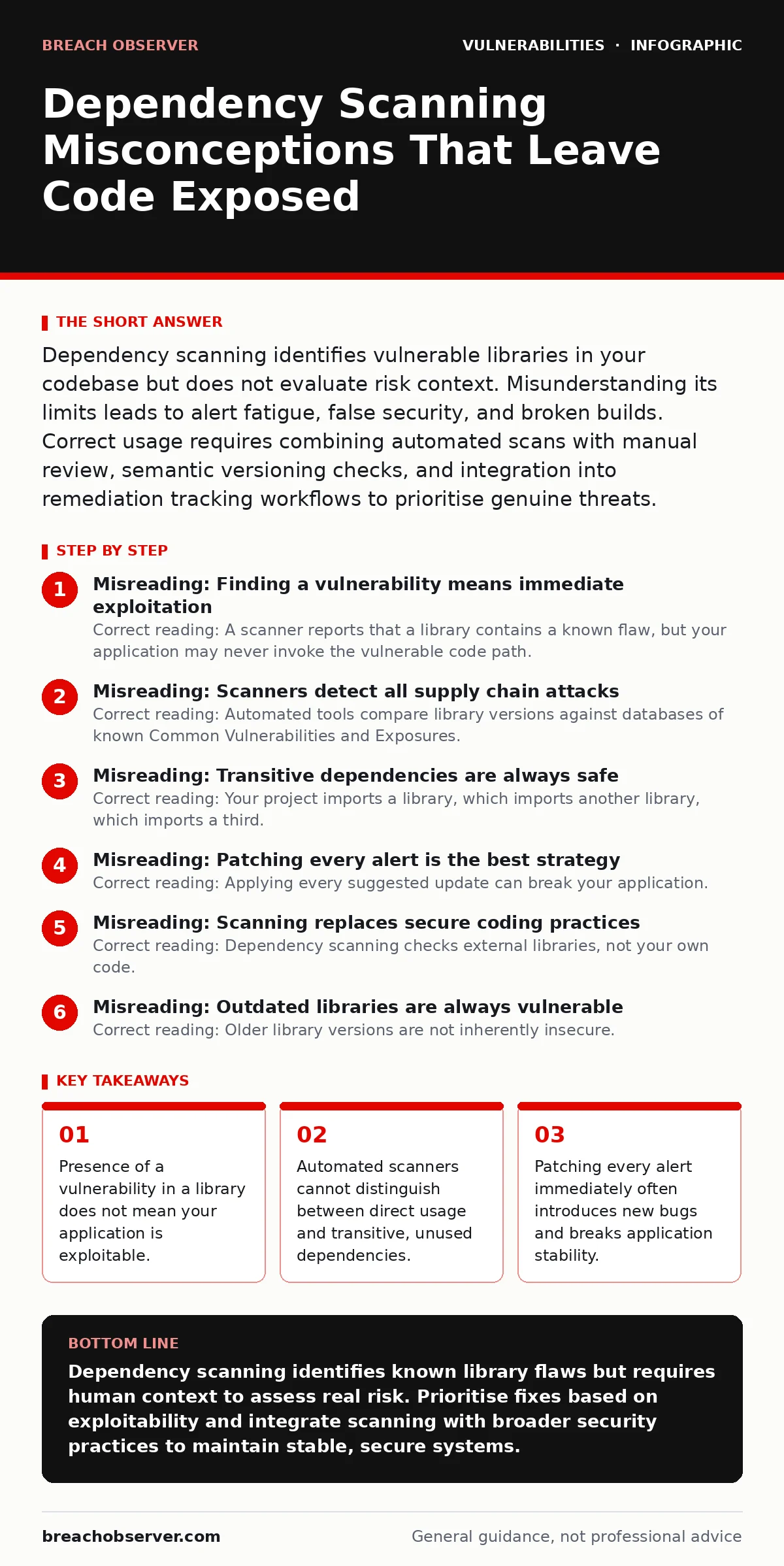
Misreading: Scanners detect all supply chain attacks
Correct reading: Automated tools compare library versions against databases of known Common Vulnerabilities and Exposures. They cannot identify logic bombs, typosquatting packages, or malicious code injected into a previously clean release. Imagine a developer publishes a new version of a popular utility that steals credentials.
The version number increases, but no CVE exists yet. Your scanner sees a valid, updated dependency and reports no issues. This blind spot requires you to monitor for unusual package behaviour and verify publisher identities. Security bulletins from maintainers often provide early warnings that scanners miss. You must complement automated checks with manual verification of source code changes.
Misreading: Transitive dependencies are always safe
Correct reading: Your project imports a library, which imports another library, which imports a third. This chain creates transitive dependencies that you do not explicitly manage. Scanners often flag these deeply nested components, but teams frequently ignore them assuming the direct library maintainer has vetted them. This assumption fails when a maintainer abandons a project or introduces a flaw in a lower-level component. You must treat transitive dependencies with the same scrutiny as direct ones. Pinning versions of critical transitive libraries prevents unexpected updates. Regular audits of the full dependency tree reveal hidden risks that superficial scans overlook.
Misreading: Patching every alert is the best strategy
Correct reading: Applying every suggested update can break your application. New library versions may introduce breaking changes, deprecate functions, or conflict with other dependencies. Blindly patching creates technical debt and operational instability. You should prioritise remediation based on exploitability and impact. Use remediation tracking to log decisions for deferred patches. Document why a specific vulnerability is accepted risk. This approach allows your team to focus on high-impact fixes while maintaining system stability. Ignoring low-risk alerts is a valid security decision when documented and reviewed regularly.
Misreading: Scanning replaces secure coding practices
Correct reading: Dependency scanning checks external libraries, not your own code. It does not find type confusion vulnerabilities in your logic or insecure configurations in your deployment. Imagine a team fixes all library alerts but leaves a hardcoded secret in their source code. The scanner reports a clean bill of health, but the secret remains exposed. You must integrate scanning into a broader security strategy. Combine it with static application security testing and penetration testing to cover different attack surfaces. Secure coding training reduces the likelihood of introducing new flaws in your custom modules. Scanning is one layer of defence, not a silver bullet.
See also: Remediation Tracking: How to Close Vulnerabilities Before Exploitation · Pre-authentication vulnerabilities: detection, exploitation and mitigation
Misreading: Outdated libraries are always vulnerable
Correct reading: Older library versions are not inherently insecure. Some mature libraries have stable codebases with no known flaws for years. Upgrading solely to meet a "latest version" policy introduces unnecessary risk. You should upgrade only when a specific vulnerability affects your usage or when the vendor drops support. Maintaining older versions allows you to control the change management process. This strategy reduces the chance of introducing bugs during updates. Verify that the older version receives security patches or has no known issues. Blind adherence to version numbers creates more work without improving security posture.
Misreading: Scanners handle semantic versioning correctly
Correct reading: Semantic versioning uses major, minor, and patch numbers to indicate compatibility. A scanner may suggest a minor update, but that update could contain breaking changes if the maintainer ignores convention. Conversely, a major update might be safe if the API remains stable. You must verify compatibility before applying updates. Test new versions in a staging environment. Automated scanners cannot predict runtime behaviour. Manual testing ensures that updates do not disrupt application functionality. This step bridges the gap between theoretical security and practical stability.
Misreading: Private repositories are invisible to attackers
Correct reading: Private libraries are not immune to compromise. If a private repository shares dependencies with public projects, vulnerabilities can propagate. Attackers may target maintainers of private tools to gain access to internal networks. You must scan private dependencies with the same rigor as public ones. Integrate scanning into your continuous integration pipeline for all code, regardless of visibility. This ensures that internal tools do not become weak points. Subdomain takeover risks can also arise from misconfigured private assets. Treat internal infrastructure with the same caution as public-facing services.
Misreading: Scanning frequency determines security
Correct reading: Running scans more often does not improve security if the results are not acted upon. Daily scans that generate hundreds of unreviewed alerts create noise and desensitise your team. You should focus on the quality of review rather than the frequency of scanning. Integrate scanning into your development workflow so that developers address issues before merging code. This shifts security left and reduces accumulation. Regular, meaningful reviews are more effective than constant, ignored alerts. Balance frequency with capacity to ensure every alert receives proper attention.
Key takeaways
- Presence of a vulnerability in a library does not mean your application is exploitable.
- Automated scanners cannot distinguish between direct usage and transitive, unused dependencies.
- Patching every alert immediately often introduces new bugs and breaks application stability.
- Supply chain attacks bypass scanners by inserting malicious code into previously trusted libraries.
Dependency scanning identifies known library flaws but requires human context to assess real risk. Prioritise fixes based on exploitability and integrate scanning with broader security practices to maintain stable, secure systems.
Frequently asked questions
How do I handle a critical vulnerability in a library with no patch?
Isolate the vulnerable code path if possible, apply virtual patching via a web application firewall, or migrate to an alternative library. Document the risk and monitor for exploits.
Can dependency scanning find malware in packages?
No, it only checks for known vulnerabilities. Use additional tools to analyse package contents and behaviour for signs of malicious code or typosquatting.
Should I pin all dependency versions?
Pinning critical libraries prevents unexpected breaking changes, but allows minor updates for non-critical ones. Balance stability with the need for security patches.
How often should I review dependency scan results?
Review new alerts during each pull request. Conduct a full review of deferred alerts monthly to ensure no new exploit information has emerged.
How this guide was produced: written by the Breach Observer editorial team with AI assistance, checked against the public references listed below, and reviewed when the facts change. See our editorial policy or report an error.