
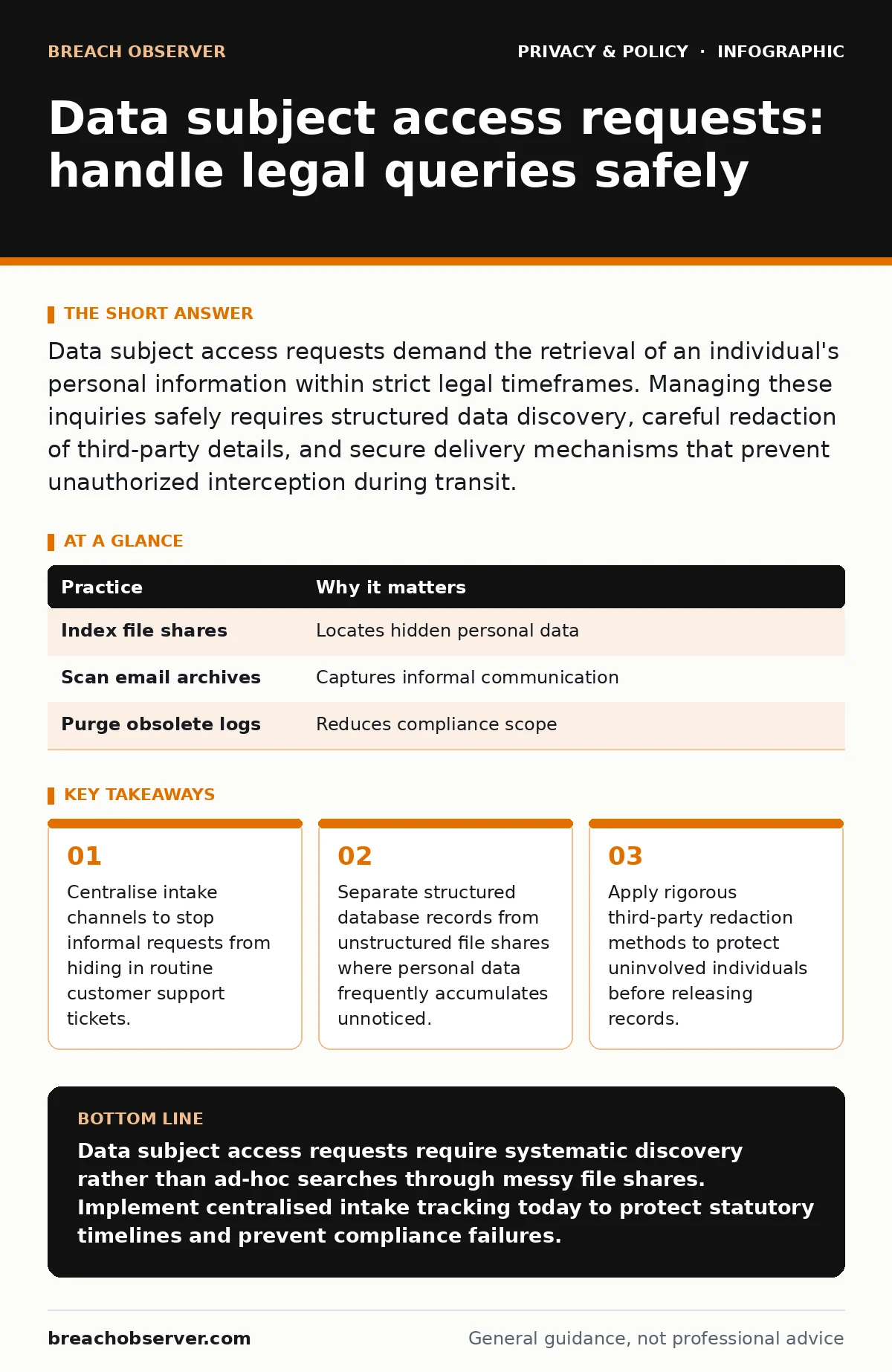
Data subject access requests demand the retrieval of an individual's personal information within strict legal timeframes. Managing these inquiries safely requires structured data discovery, careful redaction of third-party details, and secure delivery mechanisms that prevent unauthorized interception during transit.
1. Centralise intake channels
Data subject access requests arrive through every customer touchpoint, making formal intake channels necessary to prevent missed statutory deadlines. Informal requests sent to social media accounts or individual staff emails often bypass tracking systems entirely. Establishing a single routing mechanism ensures compliance teams record the exact timestamp of receipt.
- Route all public queries to a dedicated inbox.
- Train front-line staff to recognise statutory keywords.
- Issue automated acknowledgements containing reference numbers.
2. Map unstructured repositories
Personal data hides inside unstructured file shares, email archives, and collaboration platforms rather than neat database tables. Automated discovery tools scan these dark data repositories for identifying patterns like names or identification numbers. Mapping these storage locations before searching prevents incomplete disclosures that violate regulatory standards.
| Practice | Why it matters |
|---|---|
| Index file shares | Locates hidden personal data |
| Scan email archives | Captures informal communication |
| Purge obsolete logs | Reduces compliance scope |
3. Implement precise redaction
Disclosing records often exposes the personal data of third parties who never consented to sharing their information. Manual redaction removes names, addresses, and internal notes concerning other individuals. Automated redaction tools accelerate this process, but human review remains vital to catch contextual identifiers that algorithms miss.
- Mask third-party names in shared email threads.
- Review internal notes for subjective commentary about the requester.
- Verify that metadata fields do not contain hidden author names.
4. Handle cross-border complexities
Multinational operations complicate record retrieval because local subsidiaries store information under differing regional jurisdictions. Standardising your discovery process supports cross-border data transfers while respecting local confidentiality laws. Legal teams must verify whether foreign affiliates can legally transmit requested files across national boundaries.
- Coordinate with regional IT administrators early.
- Check local secrecy laws before exporting employee records.
- Encrypt data in transit between international offices.
5. Verify requester identity
Fraudsters routinely exploit access procedures to harvest corporate intelligence or conduct social engineering campaigns against staff. Verifying the identity of the person making the inquiry stops malicious actors from acquiring sensitive internal documents. Request additional authentication only when initial details fail to match existing database records.
- Require government-issued identification for high-risk inquiries.
- Use out-of-band verification methods like authenticated portals.
- Refuse verbal requests lacking verifiable credentials.
See also: Cross-Border Data Transfers: Small Business Compliance Rules · What is CCPA request: rights, process and business impact
6. Document every search step
Regulators inspect audit logs to prove your organisation conducted a reasonable search for requested personal information. Detailed documentation records which databases, folders, and archives underwent scrutiny during the discovery phase. This paper trail protects the enterprise if a requester escalates a dispute over missing records.
- Log search terms used across different platforms.
- Record reasons for excluding specific backup archives.
- Archive final disclosure packages securely for legal defense.
7. Enforce strict delivery controls
Sending bulk personal files via standard email risks interception or misdirection to the wrong recipient. Secure delivery methods require password-protected archives or authenticated download portals with automatic expiration dates. These technical controls ensure that only the verified requester accesses the disclosed package.
- Encrypt exported files using strong symmetric ciphers.
- Set download links to expire after a few days.
- Revoke access immediately if delivery errors occur.
8. Apply privacy by design principles
Minimising data collection from the outset naturally shrinks the volume of records you must search and disclose later. Designing systems with built-in retention limits ensures old files disappear before anyone can request them. This proactive approach transforms cumbersome legal obligations into manageable administrative routines.
- Set automated deletion schedules for temporary logs.
- Limit data collection to strictly necessary fields.
- Review application data flows annually.
Key takeaways
- Centralise intake channels to stop informal requests from hiding in routine customer support tickets.
- Separate structured database records from unstructured file shares where personal data frequently accumulates unnoticed.
- Apply rigorous third-party redaction methods to protect uninvolved individuals before releasing records.
Data subject access requests require systematic discovery rather than ad-hoc searches through messy file shares. Implement centralised intake tracking today to protect statutory timelines and prevent compliance failures.
Frequently asked questions
How long do organisations have to respond to a data subject access request?
Most legal frameworks grant organisations a period of 1 calendar month to locate, redact, and deliver the requested personal data, though extensions apply for complex inquiries.
Can an organisation charge a fee for fulfilling a request?
Initial requests must be fulfilled free of charge, but organisations can charge a reasonable fee or refuse requests that are manifestly unfounded or excessive.
What happens if an organisation misses the statutory response deadline?
Missing the deadline exposes the enterprise to regulatory investigations, formal reprimands, and potential financial penalties for non-compliance.
Do internal emails about an employee need to be disclosed?
Internal correspondence mentioning the requester generally forms part of the personal data package unless specific legal exemptions apply, such as protecting ongoing criminal investigations.
How this guide was produced: written by the Breach Observer editorial team with AI assistance, checked against the public references listed below, and reviewed when the facts change. See our editorial policy or report an error.