
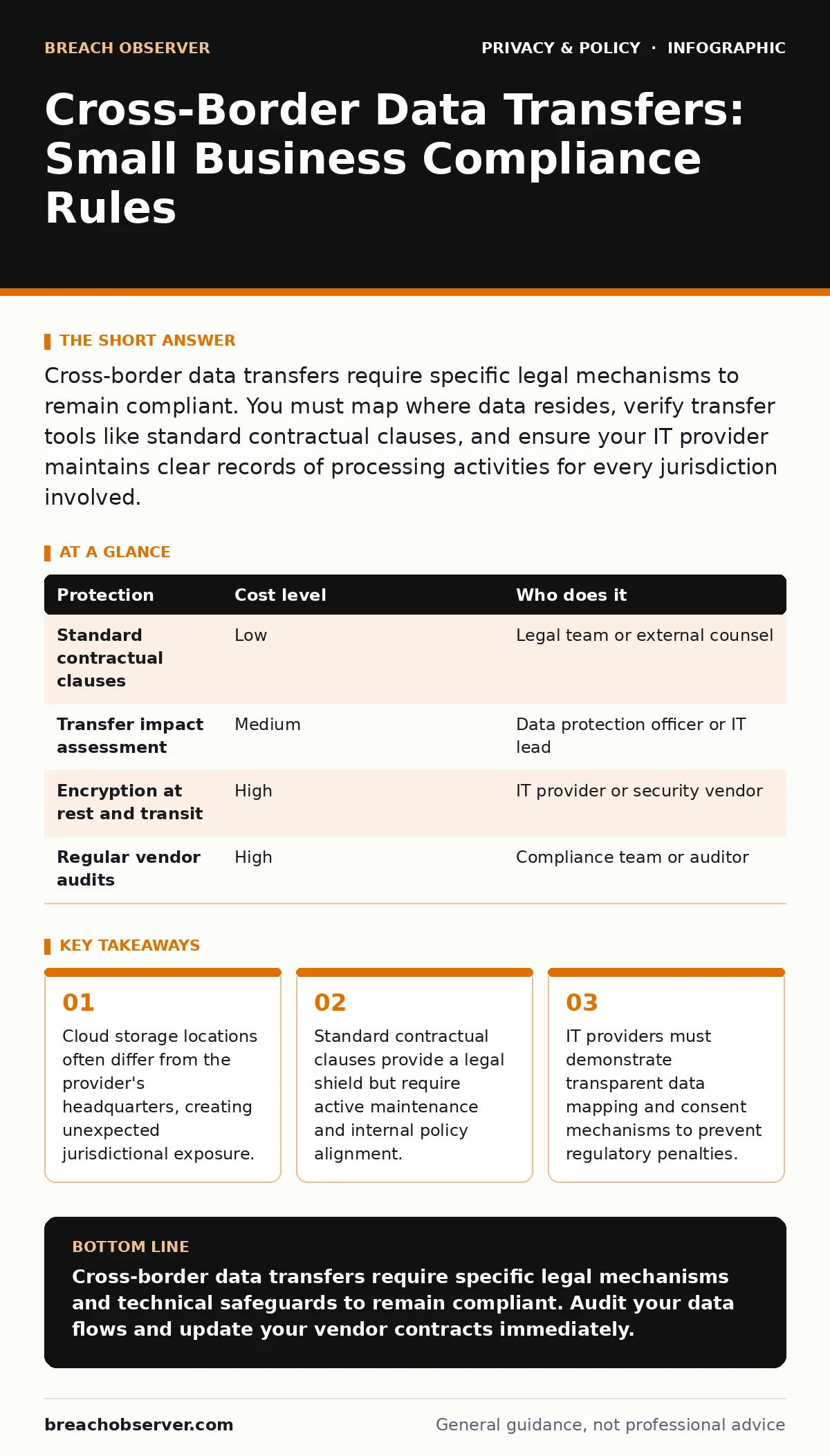
Cross-border data transfers require specific legal mechanisms to remain compliant. You must map where data resides, verify transfer tools like standard contractual clauses, and ensure your IT provider maintains clear records of processing activities for every jurisdiction involved.
Why Data Location Matters for Small Teams
Small businesses often assume that using a reputable cloud provider eliminates legal risk. This assumption fails when data crosses national borders. Privacy regulations typically restrict the movement of personal data to countries without adequate protection levels. You remain liable for the data you hold, regardless of where it is stored. The physical location of the server determines which laws apply to that data.
Jurisdictional rules vary significantly. Some regions allow broad government access to stored data. Others require explicit consent for international transfers. You must identify where your data resides at rest and in transit. A service provider headquartered in one country may store data in another. This distinction creates hidden compliance gaps. You cannot rely on the provider's marketing claims. You must verify the technical reality of data placement.
Understanding the scope of your data is the first step. Not all data requires the same level of protection. Publicly available information often has fewer restrictions. Sensitive personal data, such as health records or financial details, triggers stricter rules. You must classify your data before selecting transfer mechanisms. This classification dictates the legal tools you need. It also determines the effort required to maintain compliance.
Mapping Your Data Flows Accurately
You cannot protect what you cannot see. Many small teams lack a clear inventory of their data flows. They know what they collect but not where it goes. Third-party integrations, such as payment processors or marketing tools, often move data silently. These integrations create secondary transfer points. Each point introduces new legal and technical risks.
Start by listing every system that touches personal data. Include email servers, customer relationship management tools, and backup services. Note the destination country for each system. Check the provider's privacy policy and terms of service. Look for clauses that allow data movement to third parties. These clauses often bypass your direct control. You need to understand the full chain of custody.
Consider the impact of online tracking. If your website uses analytics tools that send data to foreign servers, you are facilitating a cross-border transfer. This applies even if you do not directly host the data. The act of sending the data triggers regulatory requirements. You must ensure these transfers have a legal basis. This often requires updating your privacy notices and obtaining user consent.
Legal Mechanisms for Safe Transfers
When moving data to a country with lower protection standards, you need a legal bridge. Standard contractual clauses (SCCs) are the most common mechanism. These are pre-approved contract terms that impose data protection obligations on the recipient. They create a binding legal framework for the transfer. You must incorporate them into your agreements with data processors.
Standard contractual clauses do not solve technical security issues. They provide a legal defence against regulatory action. You still need to ensure the data is encrypted and access-controlled. The clauses require you to assess the recipient's ability to comply. This assessment is known as a transfer impact assessment. You must document this assessment. It proves you considered the legal environment of the destination country.
Another option is binding corporate rules. These are internal policies for multinational groups. They are complex and expensive to implement. Most small businesses will not use this method. Instead, rely on standard contractual clauses and clear vendor contracts. Ensure your contracts specify the purpose of data processing. Limit the duration of data retention. Define clear deletion procedures when the contract ends.
| Protection | Cost level | Who does it |
|---|---|---|
| Standard contractual clauses | Low | Legal team or external counsel |
| Transfer impact assessment | Medium | Data protection officer or IT lead |
| Encryption at rest and transit | High | IT provider or security vendor |
| Regular vendor audits | High | Compliance team or auditor |
What to Ask Your IT Provider
Your IT provider holds the keys to your data infrastructure. They may not understand the legal nuances of cross-border transfers. You must bridge this gap with specific questions. Do not accept vague assurances about security. Ask for concrete details about data residency and processing.
Start by asking where the data is stored. Request a list of all data centres used by the provider. Ask if data moves between these centres automatically. Inquire about subcontractors. Many providers use third-party services for backups or analytics. These subcontractors may be located in different jurisdictions. You need to know who has access to your data.
Ask how the provider handles government requests. Do they notify you before handing over data? Some jurisdictions allow secret warrants. You need to know if your provider will resist these requests. Ask about their encryption standards. Is data encrypted at rest? Who holds the encryption keys? If the provider holds the keys, they can technically access your data. You prefer customer-managed keys for higher security.
- Where are your primary and backup data centres located?
- Do you use any subcontractors for data processing? If so, where are they based?
- How do you handle lawful requests for data from foreign governments?
- Can I manage my own encryption keys, or do you hold them?
- What is your process for deleting data when our contract ends?
Hidden Costs and Operational Friction
Compliance is not a one-time task. It requires ongoing management. Standard contractual clauses must be updated when regulations change. You must monitor legal developments in destination countries. Courts may invalidate existing mechanisms. This creates sudden compliance gaps. You need a process for reviewing and updating your transfer tools.
There is a hidden cost in vendor management. You must audit your providers regularly. This takes time and resources. Small teams often lack dedicated compliance staff. You may need to hire external legal counsel. This adds to your operational budget. Consider the cost of non-compliance. Fines for privacy violations can be severe. They can also damage your reputation.
Another hidden cost is technical complexity. Implementing encryption and access controls can slow down systems. It may require changes to your application architecture. You must balance security with performance. Poorly implemented controls can degrade user experience. This may affect customer satisfaction. You need to plan for these trade-offs. Engage your development team early. They can help design secure data flows without compromising functionality.
See also: What happens if VPNs are banned: impact on privacy and connectivity · Should I Worry About Data Brokers? The Real Risk
Maintaining Consent and Transparency
Users have the right to know where their data goes. Your privacy policy must reflect reality. If you move data to a country with lower protections, you must inform users. This often requires explicit consent. Generic consent forms may not be sufficient. You need to specify the destinations and the legal basis for the transfer.
Transparency builds trust. It also reduces legal risk. If users are unaware of data movements, they may challenge the legality. This can lead to complaints and investigations. Keep your privacy notices clear and accessible. Avoid legal jargon. Explain the purpose of the transfer and the safeguards in place.
Review your consent mechanisms regularly. Consent must be freely given and specific. Pre-ticked boxes are often invalid. You need active opt-in for sensitive transfers. Ensure your website or app captures this consent correctly. Store records of consent. You may need to prove it during an audit. This record-keeping is part of your accountability framework.
Practical Steps for Immediate Action
Start with a data inventory. Map every data flow across borders. Identify the legal basis for each transfer. Update your contracts with standard contractual clauses. Conduct a transfer impact assessment for high-risk destinations. Engage your IT provider to clarify data residency. Update your privacy policy to reflect these transfers. Train your staff on the importance of data location. Schedule regular reviews of your transfer mechanisms.
Key takeaways
- Cloud storage locations often differ from the provider's headquarters, creating unexpected jurisdictional exposure.
- Standard contractual clauses provide a legal shield but require active maintenance and internal policy alignment.
- IT providers must demonstrate transparent data mapping and consent mechanisms to prevent regulatory penalties.
Cross-border data transfers require specific legal mechanisms and technical safeguards to remain compliant. Audit your data flows and update your vendor contracts immediately.
Frequently asked questions
Do I need to worry about cross-border transfers if I only use email?
Yes, email providers often store data on servers in multiple countries. You must ensure your provider uses appropriate legal mechanisms for these transfers.
Can I just encrypt data to avoid legal issues?
Encryption helps security but does not replace legal requirements. You still need a valid legal basis, such as standard contractual clauses, for the transfer.
What happens if my cloud provider moves data without telling me?
This breaches your contract and potentially privacy laws. You should have clauses requiring notification of data location changes. Audit your contracts for this provision.
How often should I review my transfer mechanisms?
Review them annually or when regulations change. Monitor legal developments in destination countries. Update your assessments and contracts as needed.
How this guide was produced: written by the Breach Observer editorial team with AI assistance, checked against the public references listed below, and reviewed when the facts change. See our editorial policy or report an error.