
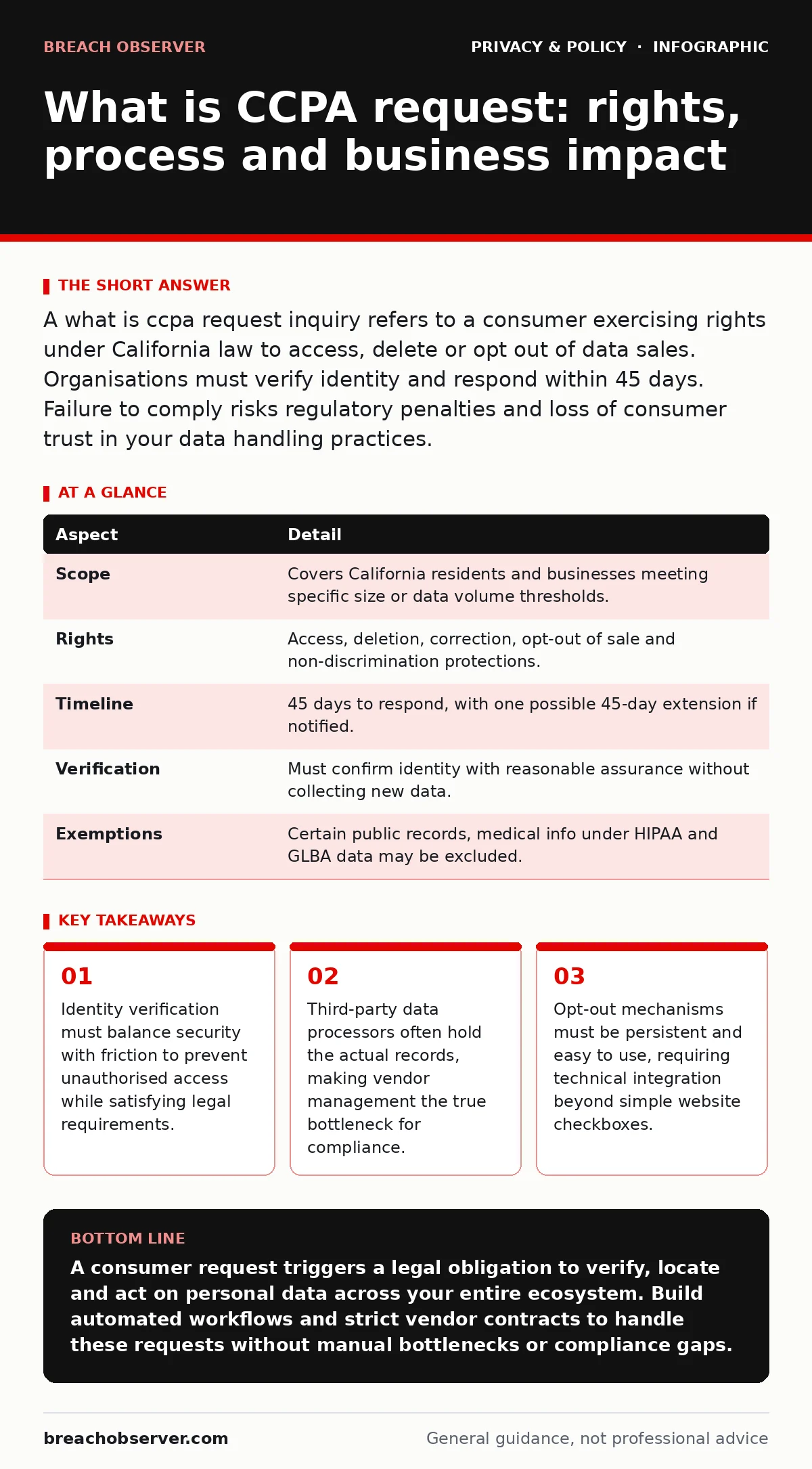
A what is ccpa request inquiry refers to a consumer exercising rights under California law to access, delete or opt out of data sales. Organisations must verify identity and respond within 45 days. Failure to comply risks regulatory penalties and loss of consumer trust in your data handling practices.
The mechanics of a digital right to be forgotten
Imagine a library that never discards books but keeps a secret ledger of who checked them out. A consumer wants that ledger erased. This analogy captures the core tension of privacy legislation. The California Consumer Privacy Act grants individuals control over their personal information. It shifts the burden of proof from the individual to the organisation holding the data. You must know what you hold, where it lives and who has copied it.
The law applies to businesses that meet specific thresholds. These include annual gross revenues above a set limit. It also covers entities that buy, sell or share the personal information of many consumers. Service providers who process data on behalf of a business are not directly liable for consumer requests. They must, however, contractually agree to assist the business in fulfilling those requests. This distinction is vital for your vendor management strategy.
| Aspect | Detail |
|---|---|
| Scope | Covers California residents and businesses meeting specific size or data volume thresholds. |
| Rights | Access, deletion, correction, opt-out of sale and non-discrimination protections. |
| Timeline | 45 days to respond, with one possible 45-day extension if notified. |
| Verification | Must confirm identity with reasonable assurance without collecting new data. |
| Exemptions | Certain public records, medical info under HIPAA and GLBA data may be excluded. |
What is ccpa request in practice
A what is ccpa request is not a simple form submission. It is a legal trigger that initiates a chain of operational tasks. The consumer submits a request through a designated method. This could be a toll-free number, a website link or an email address. You must provide these contact methods clearly. The request can ask for access to data held about them. It can ask for deletion of that data. It can ask to opt out of the sale or sharing of their information.
The most complex requests are deletion requests. You must delete the information from your own systems. You must also direct service providers to delete it. This requires robust data mapping. If you do not know where your data lives, you cannot delete it. Access requests require you to disclose categories of data collected, sources, business purposes and third parties with whom it was shared. This disclosure must be accurate and current.
Identity verification without friction
Verifying the identity of the requester is the first major hurdle. You cannot delete data for anyone who claims to be the user. Fraudsters may attempt to delete accounts to disrupt services or steal data. You must use reasonable methods to verify identity. These methods should not require the consumer to provide additional personal information. If they do, you must inform them of this requirement.
Multi-factor authentication is a common standard. If the user is already logged in, you can use that session as verification. For unauthenticated requests, you may ask for answers to security questions. You must ensure these questions are not easily guessable. The verification process must be secure. It must also not be so burdensome that it discourages legitimate requests. Friction here damages user trust and may be viewed as non-compliant.
The hidden cost of third-party data
Many organisations believe they control their data. In reality, data processors often hold the most sensitive information. Analytics providers, customer support platforms and payment gateways store copies of user data. When a consumer requests deletion, you must instruct these vendors to delete the data. This is not optional. Your contract with the vendor must include this obligation.
Failure to manage third-party data is a common failure point. Auditors will ask for proof of deletion from vendors. You must maintain records of these instructions and confirmations. This requires a clear inventory of all data processors. You must know what data each processor holds. You must know the legal basis for their processing. This inventory is often incomplete. Building it is a significant operational task.
Common misconceptions about compliance
Many believe that having a privacy policy is enough. A policy states your intentions. It does not prove your actions. Compliance requires technical implementation. It requires process documentation. It requires staff training. Another common mistake is assuming that anonymised data is safe. If you can re-identify the individual, the data is still personal. You must ensure that anonymisation is irreversible.
Some think that only large tech companies are affected. The thresholds are broad. Many mid-sized businesses fall within scope. Even if you do not meet the revenue threshold, you may meet the data volume threshold. Ignorance of the law is not a defence. Proactive compliance is cheaper than reactive remediation. Regular audits help identify gaps before they become incidents.
See also: Employee Data Breaches: How Insider Access Compromises Your Organisation · What happens if VPNs are banned: impact on privacy and connectivity
Integration with other privacy frameworks
Privacy laws are not isolated. The General Data Protection Regulation has similar rights to access and deletion. Aligning your processes with GDPR can simplify compliance. The principles of privacy by design encourage building protection into systems from the start. This reduces the need for manual intervention later. Understanding browser fingerprinting helps you identify data you may not realise you are collecting. Third-party scripts often track users without your explicit knowledge.
Data brokers play a significant role in the ecosystem. They aggregate data from various sources. Consumers can opt out of data brokers directly. However, you must still manage the data you collect. VPNs protect user traffic but do not erase data already stored. Password managers for families help users manage credentials but do not affect your compliance duties. Parental controls and children's online privacy risks are separate concerns. They require additional safeguards for younger users.
Building a sustainable response process
You need a dedicated workflow for handling requests. This workflow should include intake, verification, fulfilment and documentation. Automation can help scale this process. Manual processes are prone to error and delay. You must train staff on how to identify valid requests. They must know how to escalate complex cases. Regular testing ensures the process works as intended.
Documentation is critical. You must keep records of requests and responses. These records demonstrate compliance. They also help identify trends. If many users request deletion, you may need to review your data retention policies. Continuous improvement is key. The regulatory environment evolves. Your processes must adapt. Stay informed about changes in legislation. Engage with legal counsel to ensure alignment.
Key takeaways
- Identity verification must balance security with friction to prevent unauthorised access while satisfying legal requirements.
- Third-party data processors often hold the actual records, making vendor management the true bottleneck for compliance.
- Opt-out mechanisms must be persistent and easy to use, requiring technical integration beyond simple website checkboxes.
A consumer request triggers a legal obligation to verify, locate and act on personal data across your entire ecosystem. Build automated workflows and strict vendor contracts to handle these requests without manual bottlenecks or compliance gaps.
Frequently asked questions
How long do I have to respond to a request?
You have 45 days to respond. You may extend this by 45 days if you notify the consumer of the reason for the delay.
Can I charge a fee for processing requests?
You cannot charge a fee for most requests. You may charge a reasonable fee for excessive or repetitive requests, but this is narrowly defined.
What if the consumer is not a California resident?
The law generally applies to California residents. However, best practice suggests applying consistent privacy standards globally to simplify operations.
Does this apply to B2B data?
Recent amendments have expanded the scope to include certain B2B information. You must review the specific definitions of personal information to determine applicability.
How this guide was produced: written by the Breach Observer editorial team with AI assistance, checked against the public references listed below, and reviewed when the facts change. See our editorial policy or report an error.