
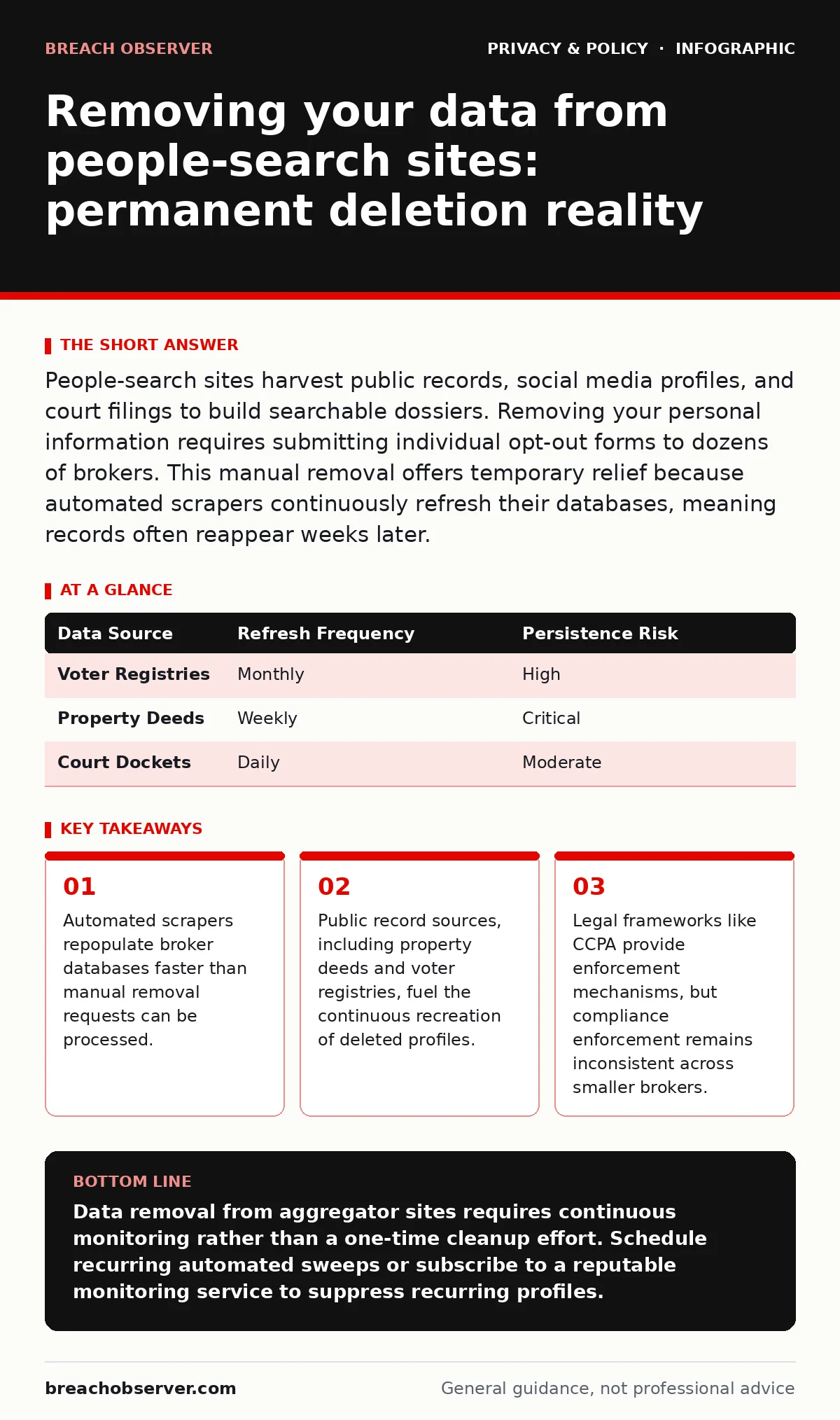
People-search sites harvest public records, social media profiles, and court filings to build searchable dossiers. Removing your personal information requires submitting individual opt-out forms to dozens of brokers. This manual removal offers temporary relief because automated scrapers continuously refresh their databases, meaning records often reappear weeks later.
Why do people-search sites keep reposting records after successful removal?
People-search sites repost records because automated scrapers continuously harvest fresh data from primary public sources. Manual opt-out requests only remove the specific database entry visible at that exact moment. When local governments publish new property deeds, marriage licenses, or court judgments, ingestion algorithms match those fresh records to your historical identifier. Database reconstruction happens automatically, bypassing previous suppression flags stored in local broker suppression lists.
| Data Source | Refresh Frequency | Persistence Risk |
|---|---|---|
| Voter Registries | Monthly | High |
| Property Deeds | Weekly | Critical |
| Court Dockets | Daily | Moderate |
How do automated removal services actually operate behind the scenes?
Automated removal services operate by dispatching programmatic web requests to broker opt-out endpoints continuously. These software routines parse CAPTCHA challenges, fill out verification forms, and monitor confirmation emails without human intervention. Continuous monitoring catches newly spawned profiles within hours of publication. Subscription models pay for this relentless persistence, matching the automated velocity of the data brokers themselves.
Can legal frameworks force brokers to delete your information permanently?
Legal frameworks force brokers to delete information permanently only when backed by statutory fines and dedicated enforcement agencies. Jurisdictions operating under the CCPA grant residents the right to demand complete data deletion and opt out of sale. Brokers ignore requests from non-covered jurisdictions because compliance costs money. Geographic boundaries dictate whether a legal demand carries real weight or ends up ignored in an automated queue.
What happens to secondary profiles created from derived data?
Secondary profiles created from derived data persist because algorithms infer connections between family members and previous addresses. Data brokers link disparate records using probabilistic matching algorithms rather than exact identifiers. Removing a primary record leaves behind shadow profiles built from neighbor associations and historical phone logs. These synthetic entries require separate discovery and individual suppression requests to clear completely.
Why do verification emails sometimes create new security risks?
Verification emails create new security risks by forcing you to supply valid communication channels directly to data brokers. Providing a primary email address confirms active engagement and links your real identity to the opt-out request. Shady brokers harvest these verification addresses, selling the newly confirmed contact vector to marketing partners. Using disposable email addresses prevents brokers from associating your real inbox with your removal history.
See also: Cross-Border Data Transfers: Small Business Compliance Rules · What is CCPA request: rights, process and business impact
How do court records bypass standard privacy opt-out mechanisms?
Court records bypass standard privacy opt-out mechanisms because statutory mandates require local governments to maintain public access dockets. Data brokers scrape these municipal portals daily, treating judicial filings as exempt from standard consumer privacy rules. Redacting underlying details at the courthouse level remains extremely difficult without specific safety exemptions. Consequently, legal disputes often leave permanent digital traces across aggregator networks regardless of consumer choices.
Are phone numbers and email addresses harder to scrub than physical addresses?
Phone numbers and email addresses are harder to scrub than physical addresses because digital identifiers propagate across breached credential repositories. Aggregators purchase lists from marketing partners who track online account creations and newsletter subscriptions. A single compromised web form leaks contact vectors directly into the broker ecosystem. Physical real estate deeds change slowly, whereas digital contact points multiply constantly across modern applications.
Does freezing credit reports prevent people-search aggregation?
Freezing credit reports prevents people-search aggregation by blocking financial institutions from sharing address history changes with third-party bureaus. Credit bureaus operate distinct data-sharing networks that feed commercial aggregators whenever you apply for credit. Locking your credit files stops this specific telemetry pipeline from updating broker dossiers. Financial freezes protect against identity theft, but they leave historical property and voter records completely untouched.
Key takeaways
- Automated scrapers repopulate broker databases faster than manual removal requests can be processed.
- Public record sources, including property deeds and voter registries, fuel the continuous recreation of deleted profiles.
- Legal frameworks like CCPA provide enforcement mechanisms, but compliance enforcement remains inconsistent across smaller brokers.
Data removal from aggregator sites requires continuous monitoring rather than a one-time cleanup effort. Schedule recurring automated sweeps or subscribe to a reputable monitoring service to suppress recurring profiles.
Frequently asked questions
Can I sue a data broker for refusing to remove my information?
Litigation is rarely practical because jurisdictional hurdles and arbitration clauses in website terms of service limit individual lawsuits. Statutory damages under specific privacy laws require proving actual financial harm rather than mere existence on a directory.
Do browser extensions block people-search trackers effectively?
Privacy extensions block malicious scripts and advertising trackers, but they do not stop third-party brokers from indexing public records stored on municipal servers.
How do family members compromise my own data removal efforts?
Shared surnames, linked property deeds, and historical co-residency allow aggregation algorithms to reconstruct family dossiers even after you delete your personal profile.
Why do some brokers demand a copy of my government ID for removal?
Shady brokers demand government identification documents to harvest more valuable personal data under the guise of identity verification for opt-out requests.
How this guide was produced: written by the Breach Observer editorial team with AI assistance, checked against the public references listed below, and reviewed when the facts change. See our editorial policy or report an error.