
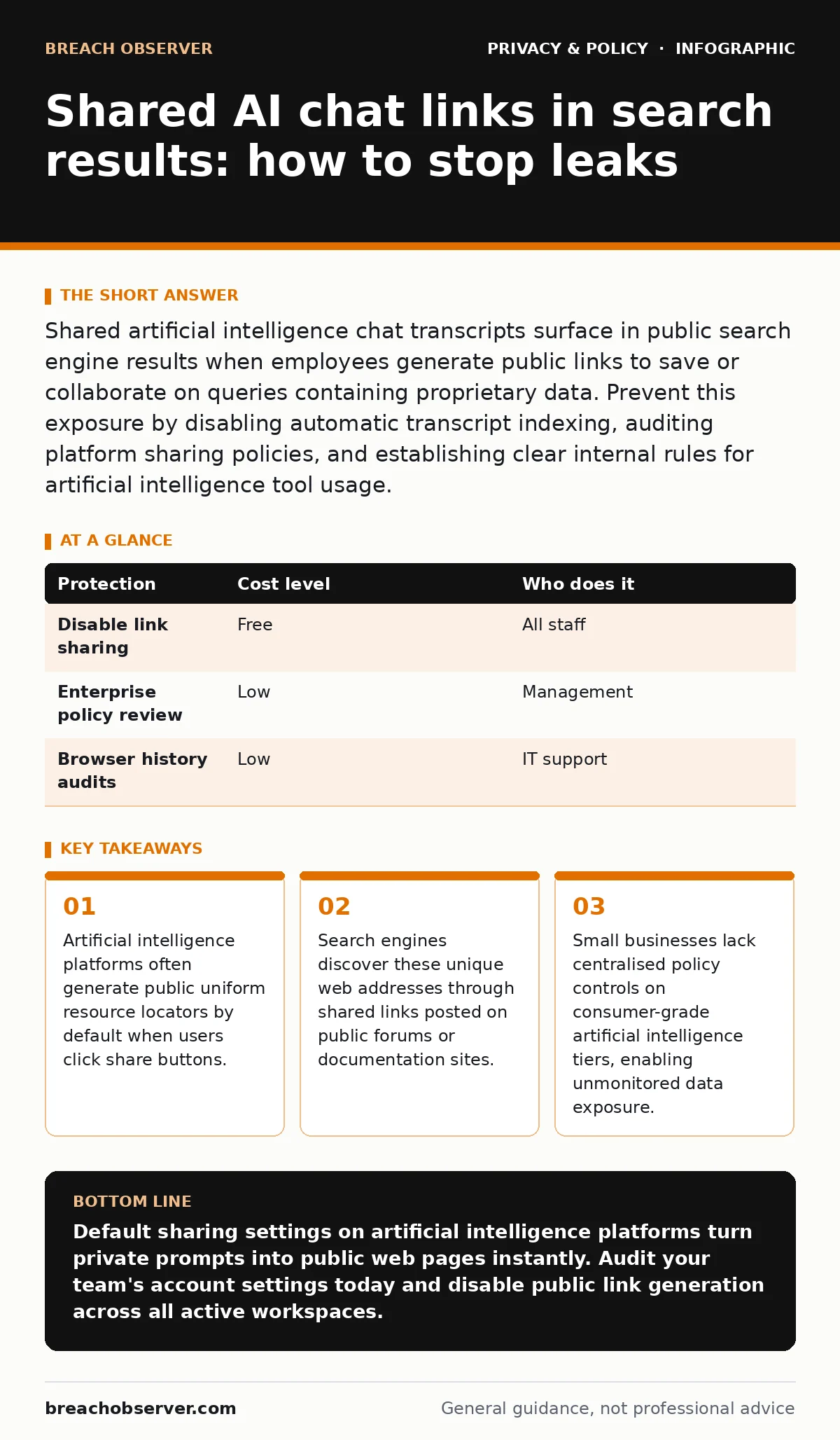
Shared artificial intelligence chat transcripts surface in public search engine results when employees generate public links to save or collaborate on queries containing proprietary data. Prevent this exposure by disabling automatic transcript indexing, auditing platform sharing policies, and establishing clear internal rules for artificial intelligence tool usage.
Why shared chat links appear in search engines
Search engines discover content through hyperlinks, sitemaps, and direct navigation. When an employee clicks a button to share an artificial intelligence conversation, the platform generates a unique web address designed to render the full transcript in any web browser. Search engine crawlers traverse these addresses just like any other public web page. Once indexed, proprietary source code, customer names, and internal financial projections sit openly in public search results for anyone to find.
The hidden exposure in small organisations
Small organisations face unique risks because employees often use personal accounts on artificial intelligence platforms for daily work tasks. Consumer-grade tiers lack administrative dashboards, meaning business owners cannot disable public sharing globally or monitor what information staff paste into prompt windows. When a worker shares a conversation to get a second opinion on a difficult email or a piece of software logic, that action inadvertently publishes the entire context window to the open internet.
Platform design choices actively encourage this behaviour by placing prominent share buttons next to every generated response. Users assume sharing works like an internal local area network link, failing to realise the destination is a globally accessible web page. Furthermore, artificial intelligence platforms continually update their user interfaces, sometimes resetting privacy defaults or enabling new sharing features without explicit user notification.
Non-obvious consequences of transcript indexing
Indexed chat transcripts create permanent digital footprints that persist long after you delete the original conversation from your local account dashboard. Web archives and caching systems take snapshots of indexed pages independently of the original host. Even if you revoke a shared link, search engine caches may continue serving the historical transcript for weeks or months. This delayed removal window leaves sensitive strategic plans exposed long after the initial mistake occurred.
Competitive intelligence gatherers actively monitor search engine indexes for accidental data leaks involving proprietary frameworks, pricing models, and unreleased product specifications. Unlike a traditional data breach involving malicious intrusion, search engine exposure happens quietly through standard platform functionality. Your proprietary data becomes public record without triggering intrusion detection systems or security alerts.
Low-cost protections for lean teams
Lean teams must implement practical administrative controls to mitigate sharing risks without expensive security software. You can drastically reduce exposure by establishing strict operating procedures and leveraging existing platform settings. Consider how these measures balance security against administrative overhead in your daily operations.
| Protection | Cost level | Who does it |
|---|---|---|
| Disable link sharing | Free | All staff |
| Enterprise policy review | Low | Management |
| Browser history audits | Low | IT support |
Enterprise-tier accounts offer administrative controls that prevent employees from generating public links entirely, rendering accidental exposure technically impossible. While these tiers carry a per-user subscription cost, they eliminate the reliance on individual staff compliance. If upgrading is not feasible, mandate that staff use encrypted messaging apps when collaborating on sensitive topics instead of pasting work materials into consumer artificial intelligence chat windows.
What to ask your technology provider
External technology providers often assume small businesses want maximum feature availability without restriction. You must challenge these default configurations by asking targeted operational questions during your next review.
- Can you enforce global restrictions against public link generation across all cloud software subscriptions?
- How do you monitor for unauthorised shadow tools that bypass corporate identity providers?
- What alerting mechanisms exist when corporate email domains appear in public data scraping indexes?
- Do our current service agreements protect intellectual property inputs from being used to train public foundational models?
See also: Cross-Border Data Transfers: Small Business Compliance Rules · What is CCPA request: rights, process and business impact
Managing related privacy vectors
Securing artificial intelligence usage requires attention to broader data hygiene practices across your entire digital footprint. Poor privacy configurations often compound across multiple platforms, turning minor oversights into major compliance failures. For instance, careless handling of employee data can easily trigger regulatory penalties related to legitimate interest under the GDPR when personal records end up inside training datasets.
Similarly, relying solely on VPNs provides zero protection against data leaks caused by voluntary actions like clicking public share buttons. A network tunnel encrypts traffic in transit but does not alter the privacy settings of cloud application interfaces. You must address the application layer directly rather than relying on network-level controls to solve policy-driven exposures.
Key takeaways
- Artificial intelligence platforms often generate public uniform resource locators by default when users click share buttons.
- Search engines discover these unique web addresses through shared links posted on public forums or documentation sites.
- Small businesses lack centralised policy controls on consumer-grade artificial intelligence tiers, enabling unmonitored data exposure.
Default sharing settings on artificial intelligence platforms turn private prompts into public web pages instantly. Audit your team's account settings today and disable public link generation across all active workspaces.
Frequently asked questions
Can search engines find chats if I did not click the share button?
No, standard conversations remain private to your user account unless you explicitly generate and distribute a public link.
Does clearing my browser history remove indexed chat transcripts?
Clearing local browser history only affects your device and does not delete content stored on remote servers or already indexed by search engines.
Are paid artificial intelligence accounts automatically safe from public indexing?
Paid tiers offer better privacy guarantees and administrative controls, but you must still configure settings to disable public sharing features.
What should I do if I find a company chat transcript in search results?
Immediately revoke the shared link inside the platform dashboard and submit a removal request directly to the search engine provider.
How this guide was produced: written by the Breach Observer editorial team with AI assistance, checked against the public references listed below, and reviewed when the facts change. See our editorial policy or report an error.