
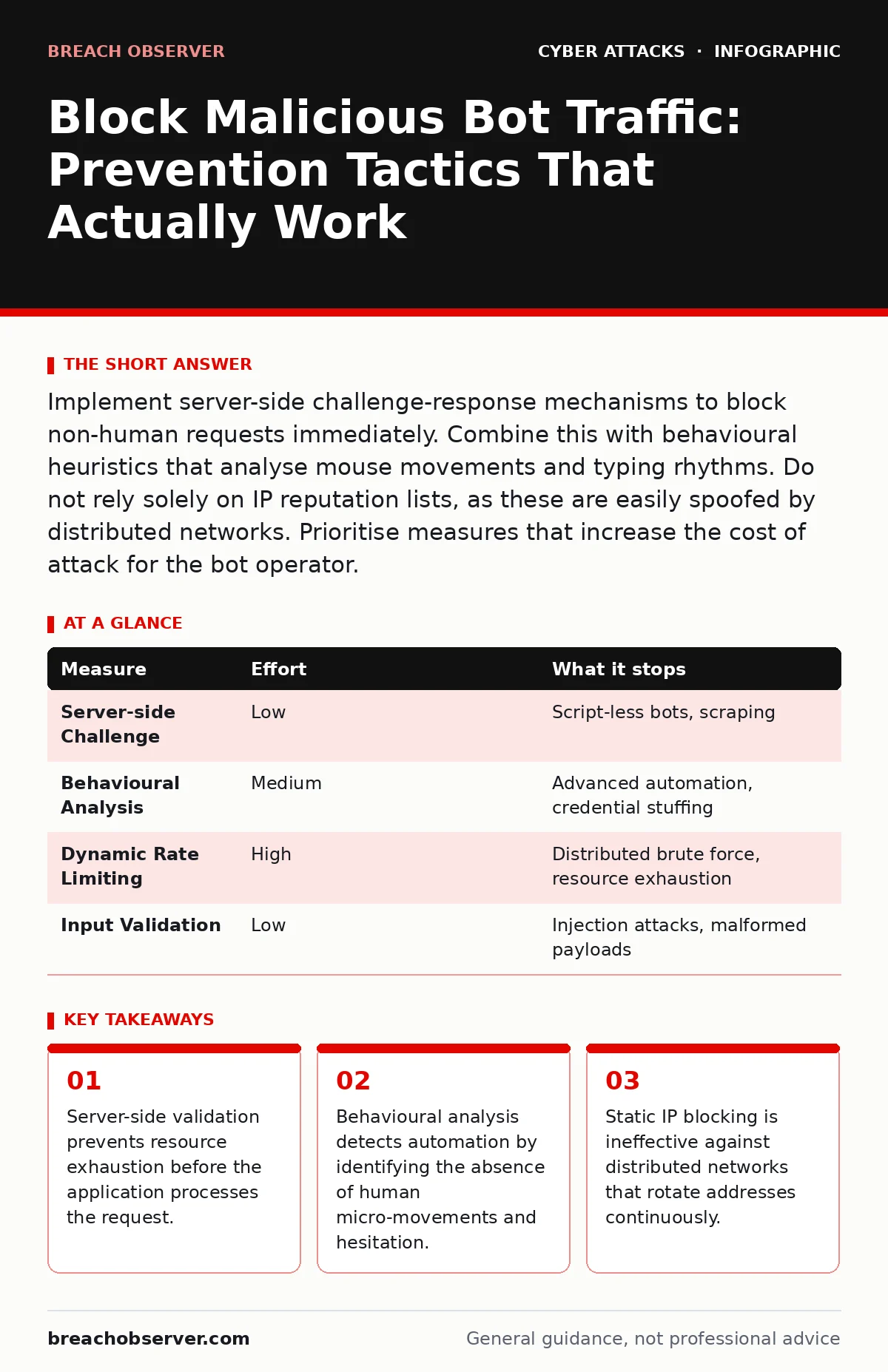
Implement server-side challenge-response mechanisms to block non-human requests immediately. Combine this with behavioural heuristics that analyse mouse movements and typing rhythms. Do not rely solely on IP reputation lists, as these are easily spoofed by distributed networks. Prioritise measures that increase the cost of attack for the bot operator.
Prioritise Server-Side Challenge-Response Mechanisms
Malicious bot traffic consumes server resources before your application logic can evaluate the request. You must challenge the client at the network edge or application gateway layer. This forces the requester to prove it can execute JavaScript or solve a cryptographic puzzle. Legitimate browsers execute this code automatically. Automated scripts fail because they do not render the page or execute the script engine. This measure stops credential stuffing and scraping bots that do not execute client-side code.
It removes the risk of backend database queries being triggered by automated loops. The trade-off is a slight increase in latency for legitimate users during the challenge phase. You must ensure the challenge is lightweight to avoid degrading user experience. Server-side validation ensures that the decision to block happens before the request reaches your business logic. This prevents the application from wasting CPU cycles on malicious inputs. It also reduces the noise in your logs, making it easier to detect sophisticated attacks that bypass initial checks.
Analyse Behavioural Heuristics for Human Presence
Bots can execute JavaScript, so challenge-response alone is insufficient for advanced automation. You must analyse how the user interacts with the interface. Human users exhibit micro-movements in their mouse trajectories and irregular typing rhythms. Automated scripts move the cursor in straight lines and type at constant intervals. These behavioural heuristics create a fingerprint that distinguishes humans from machines. You collect this data client-side and send it to a scoring engine. The engine assigns a risk score based on the deviation from human patterns.
High-risk scores trigger additional verification steps. This measure stops bots that mimic browser headers and execute scripts. It does not block all automation, as some tools are designed to simulate human movement. However, it raises the cost of attack significantly. Attackers must invest in sophisticated simulation software to bypass this detection. This investment reduces the volume of low-effort malicious traffic. You must balance detection sensitivity with false positive rates to avoid locking out legitimate users.
Implement Dynamic Rate Limiting with Context
Static rate limits allow attackers to stay just below the threshold. They distribute requests across many IP addresses to avoid detection. Dynamic rate limiting adjusts thresholds based on the context of the request. It considers the endpoint sensitivity, the user’s reputation, and the current traffic pattern. Login endpoints receive stricter limits than public content pages. This measure stops brute force attacks that spread across distributed networks. It prevents the exhaustion of application resources during sudden spikes.
You must define baselines for normal traffic to identify anomalies accurately. Dynamic limits adapt to these baselines in real-time. This ensures that legitimate traffic bursts do not trigger false blocks. The trade-off is the complexity of implementing accurate baselines. You need historical data to train the system. Without accurate baselines, the system may block legitimate users or allow attacks. Regular review of thresholds is necessary to maintain effectiveness as traffic patterns change.
Validate Input Formats and Payload Sizes
Malicious bots often send malformed data to probe for vulnerabilities. They attempt to inject code or exploit parsing errors. You must validate all input formats and payload sizes at the earliest possible stage. Reject requests that do not conform to expected schemas. This stops injection attacks and buffer overflow attempts. It also reduces the processing load on your application. Validation rules should be strict and explicit. Allow only known good patterns rather than blocking known bad ones.
This approach prevents attackers from using novel techniques that are not yet in block lists. You must update validation rules as your application evolves. New endpoints may require new validation patterns. Neglecting this maintenance creates gaps in your defence. Input validation is a foundational control that supports other measures. It ensures that only well-formed data reaches your business logic. This reduces the risk of application errors and security vulnerabilities.
| Measure | Effort | What it stops |
|---|---|---|
| Server-side Challenge | Low | Script-less bots, scraping |
| Behavioural Analysis | Medium | Advanced automation, credential stuffing |
| Dynamic Rate Limiting | High | Distributed brute force, resource exhaustion |
| Input Validation | Low | Injection attacks, malformed payloads |
Avoid Static IP Blacklisting and Whitelisting
Static IP lists become outdated quickly. Attackers use distributed networks that rotate IP addresses frequently. Blocking a single IP address has little effect on such networks. Whitelisting IPs is impractical for public-facing services. It restricts access to known addresses, which excludes mobile users and dynamic IP assignments. This measure does not stop malicious bot traffic effectively. It may block legitimate users whose IPs change.
You should use IP reputation services that update dynamically. These services aggregate data from multiple sources to identify malicious activity. However, they are not infallible. Clean IPs can be compromised and used for attacks. You must combine reputation data with other signals. Relying on IP reputation alone leaves gaps in your defence. Contextual analysis provides a more accurate picture of risk.
See also: Exploit Kits: How Automated Malware Delivery Works and Fails
Monitor for Session Hijacking Indicators
Bots often target active sessions to bypass authentication. They steal session cookies to impersonate legitimate users. You must monitor for unusual session activity. This includes sudden changes in geographic location or device fingerprint. Detecting these anomalies allows you to terminate suspicious sessions. This measure stops session hijacking and account takeover. It does not prevent the initial theft of the cookie.
You must also secure session cookies with flags like HttpOnly and Secure. These flags prevent client-side scripts from accessing the cookie. However, they do not prevent network-level interception. You must also implement short session timeouts. This reduces the window of opportunity for attackers. Combining monitoring with secure cookie handling provides layered defence.
Combine Signals for Accurate Risk Scoring
No single measure provides complete protection. You must combine signals from multiple sources. This includes IP reputation, behavioural data, and device fingerprinting. A risk scoring engine aggregates these signals to make a decision. High-risk requests are blocked or challenged. Low-risk requests are allowed. This approach reduces false positives and improves detection accuracy.
It adapts to new attack techniques by learning from new data. You must tune the scoring model regularly. Adjust weights based on the effectiveness of each signal. This ensures that the system remains effective against evolving threats. The trade-off is the complexity of managing multiple data sources. You need infrastructure to collect, store, and analyse this data. Proper integration is essential for accurate scoring.
Checklist for Immediate Implementation
- Enable server-side challenge-response for all login and payment endpoints.
- Implement behavioural analysis to detect non-human mouse and keyboard patterns.
- Review and update input validation rules for all new and existing endpoints.
Key takeaways
- Server-side validation prevents resource exhaustion before the application processes the request.
- Behavioural analysis detects automation by identifying the absence of human micro-movements and hesitation.
- Static IP blocking is ineffective against distributed networks that rotate addresses continuously.
Frequently asked questions
How do I distinguish between a good bot and a bad bot?
Good bots, like search engine crawlers, identify themselves with standard user-agent strings and respect robots.txt files. Bad bots hide their identity, ignore robots.txt, and exhibit aggressive scraping or login patterns. You should verify the bot’s behaviour against your site’s usage policies.
Does using a CDN stop malicious bot traffic?
A CDN can provide basic bot protection features, but it is not a complete solution. It offloads traffic and may block known malicious IPs. However, sophisticated bots can bypass CDN-level filters. You must implement application-layer controls like behavioural analysis and challenge-response.
How often should I update my bot protection rules?
You should review and update rules regularly, ideally after any significant change in traffic patterns or attack types. Automated systems can adjust thresholds in real-time. Manual reviews should occur monthly to ensure alignment with current threats.
Can I block all bot traffic to prevent abuse?
Blocking all bot traffic is impractical for public websites. Search engines and monitoring services use bots to access content. You must allow good bots while blocking malicious ones. Use allowlists for known good bots and blocklists for known bad actors. BOTTOM LINE: Layered controls that combine server-side challenges with behavioural analysis provide the most effective defence against malicious bot traffic. Implement server-side validation today to reduce immediate resource exhaustion risks.
How this guide was produced: written by the Breach Observer editorial team with AI assistance, checked against the public references listed below, and reviewed when the facts change. See our editorial policy or report an error.