
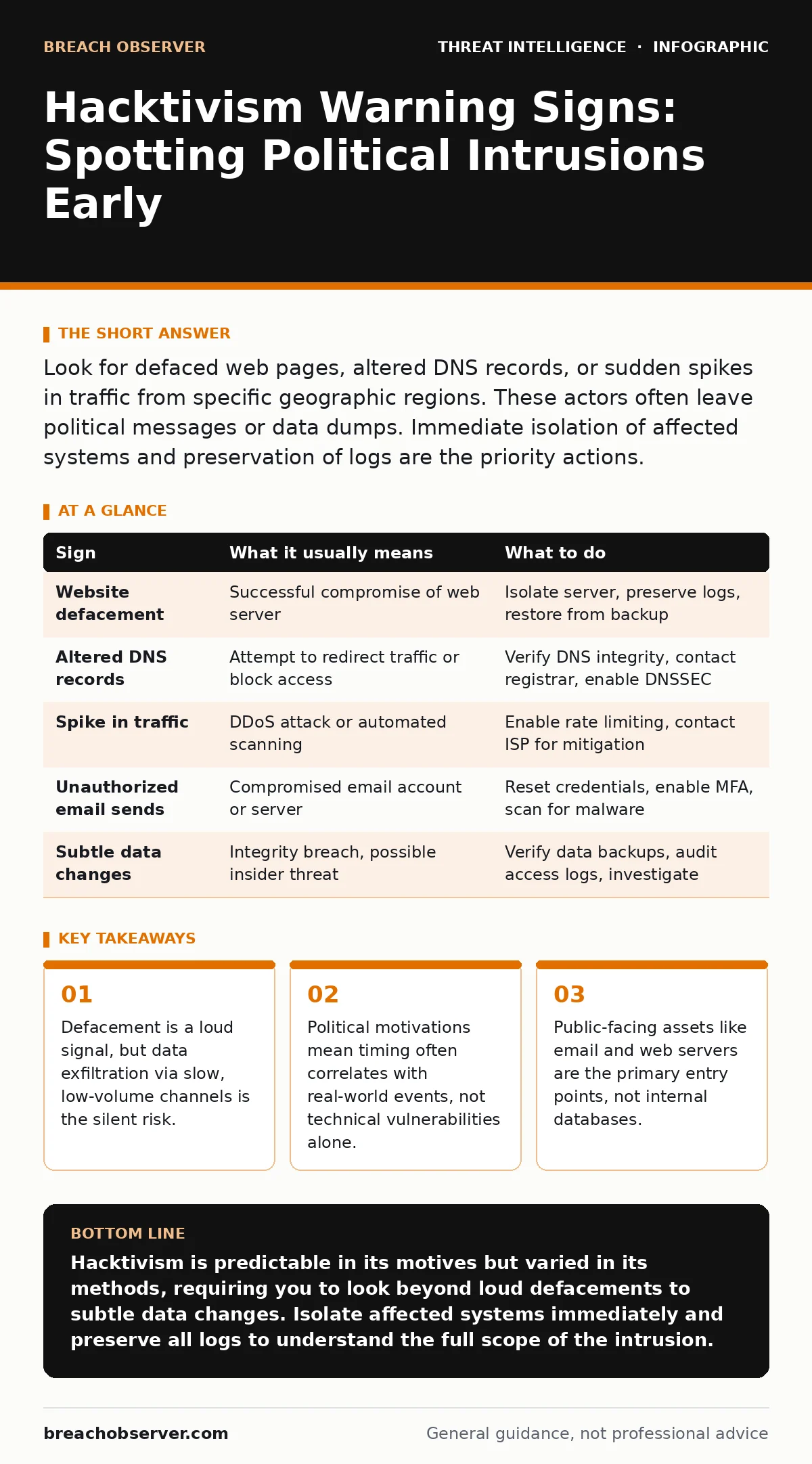
Look for defaced web pages, altered DNS records, or sudden spikes in traffic from specific geographic regions. These actors often leave political messages or data dumps. Immediate isolation of affected systems and preservation of logs are the priority actions.
The Loud Signals: Obvious Defacement and Disruption
You notice hacktivism first when the noise becomes impossible to ignore. A website displays a political statement, a logo is replaced, or a service stops responding entirely. These actions are designed for public consumption, not just for you. The attacker wants an audience.
This visibility is a double-edged sword. It confirms a breach but also signals that the attacker has achieved their primary goal: attention. If you see defacement, the initial intrusion likely occurred days or even weeks prior. The time between entry and exposure is where the real damage happens.
The Quiet Signs: Subtle Data Manipulation
Not all hacktivism involves screaming headlines. Some groups prefer to alter data subtly, changing a single character in a financial report or modifying a news article’s headline. This is often harder to detect than a full page defacement. Integrity checks are your only defence here.
Another subtle sign is the use of legitimate user credentials. Hacktivists often steal passwords through phishing or credential stuffing. They log in as real employees, making their activity look like normal business operations. Your network detection and response tools may flag this as standard user behaviour unless you monitor for anomalous access times or locations.
The Timing Factor: Correlation with Events
Hacktivism is driven by ideology, not just profit. Attacks often spike during political elections, social unrest, or international conflicts. If your organisation is a target of public debate, expect increased scrutiny. The timing of an intrusion is a significant indicator of intent.
Suppose a protest movement gains momentum online. You might see a surge in automated attacks against your web servers. These are often Distributed Denial of Service (DDoS) attempts, designed to overwhelm your resources. Understanding the external political context helps you distinguish between random noise and targeted campaigns.
Entry Points: Public-Facing Weaknesses
Hacktivists rarely have the resources for complex, zero-day exploits. They rely on known vulnerabilities in public-facing systems. Email servers, customer portals, and content management systems are the usual targets. These services must be accessible to the public, creating a large attack surface.
If you have not patched your public-facing applications recently, you are vulnerable. Attackers scan for these weaknesses constantly. A simple misconfiguration in an email server can allow an attacker to send spam or steal credentials. Regular updates are not just good practice; they are the primary barrier against these common entry vectors.
Response Actions: Containment and Analysis
When you spot a sign, your first instinct might be to take the system offline. This stops the bleeding but destroys evidence. Instead, isolate the affected system from the network while keeping it powered on. This preserves memory and log data for analysis.
Document everything. Take screenshots of defaced pages, save log files, and record the time of detection. This information is vital for understanding the scope of the breach. You may also need to review your threat intelligence program to see if this group has targeted others recently. Sharing indicators of compromise with trusted partners can help identify broader trends.
See also: Incident Response Runbooks: 6 Common Misunderstandings Fixed · Implement a Threat Intelligence Program: Step-by-Step Execution
Understanding the Actor: Motivation vs Capability
It helps to understand who you are dealing with. Unlike state-sponsored groups or criminal syndicates, hacktivists often prioritise message over methodology. They may use open-source tools and publicly available exploits. This makes their attacks easier to detect but also more frequent.
Refer to threat actor naming conventions to categorise these groups correctly. Misidentifying a hacktivist as a criminal actor can lead to wasted resources on the wrong defensive measures. Similarly, understanding the Diamond Model of intrusion analysis can help you map their capabilities, infrastructure, and motives. This structured approach prevents you from reacting emotionally to the defacement and focuses on the technical reality.
Prevention: Hardening the Perimeter
Prevention starts with reducing your attack surface. Disable unnecessary services, enforce multi-factor authentication on all public-facing accounts, and regularly update your software. Network scanning and network enumeration are techniques attackers use to find weaknesses. By auditing your own systems regularly, you stay ahead of their reconnaissance.
Defense evasion is a tactic where attackers hide their tracks. While hacktivists are less sophisticated than advanced persistent threats, they still attempt to cover their footsteps. Ensure your logging is comprehensive and sent to a secure, remote server. If an attacker modifies local logs, you still have a copy elsewhere. This simple step provides a safety net when the obvious signs are cleaned up.
| Sign | What it usually means | What to do |
|---|---|---|
| Website defacement | Successful compromise of web server | Isolate server, preserve logs, restore from backup |
| Altered DNS records | Attempt to redirect traffic or block access | Verify DNS integrity, contact registrar, enable DNSSEC |
| Spike in traffic | DDoS attack or automated scanning | Enable rate limiting, contact ISP for mitigation |
| Unauthorized email sends | Compromised email account or server | Reset credentials, enable MFA, scan for malware |
| Subtle data changes | Integrity breach, possible insider threat | Verify data backups, audit access logs, investigate |
Key takeaways
- Defacement is a loud signal, but data exfiltration via slow, low-volume channels is the silent risk.
- Political motivations mean timing often correlates with real-world events, not technical vulnerabilities alone.
- Public-facing assets like email and web servers are the primary entry points, not internal databases.
Hacktivism is predictable in its motives but varied in its methods, requiring you to look beyond loud defacements to subtle data changes. Isolate affected systems immediately and preserve all logs to understand the full scope of the intrusion.
Frequently asked questions
How long does it take for hacktivists to strike after a political event?
Attacks can begin immediately or be delayed for days, depending on the group’s coordination and resource availability.
Can hacktivists access internal networks from a compromised website?
Yes, if the website server has access to internal resources or if attackers use it as a pivot point for further lateral movement.
Is multi-factor authentication enough to stop hacktivists?
MFA significantly reduces the risk of credential-based attacks but does not protect against software vulnerabilities or social engineering.
Should I report hacktivism to law enforcement?
Reporting depends on local laws and the severity of the breach. It can help in tracking broader campaigns but may not result in immediate recovery.
How this guide was produced: written by the Breach Observer editorial team with AI assistance, checked against the public references listed below, and reviewed when the facts change. See our editorial policy or report an error.