
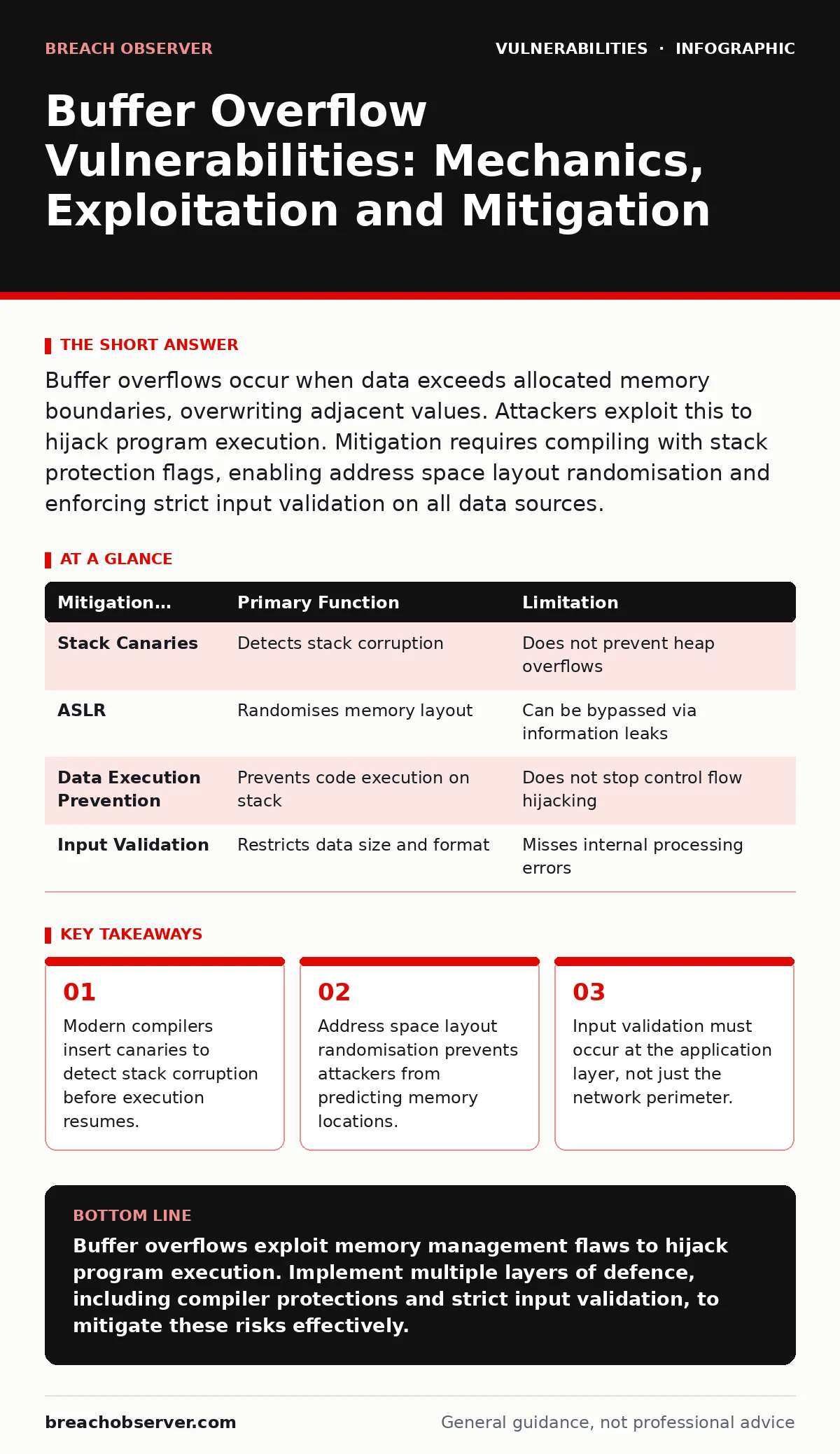
Buffer overflows occur when data exceeds allocated memory boundaries, overwriting adjacent values. Attackers exploit this to hijack program execution. Mitigation requires compiling with stack protection flags, enabling address space layout randomisation and enforcing strict input validation on all data sources.
What causes a buffer overflow vulnerability?
A buffer overflow occurs when a program writes more data to a fixed-size memory block than it can hold. This excess data spills into adjacent memory locations, overwriting variables, return addresses or function pointers. The mechanism relies on the lack of boundary checks during memory operations. Imagine a cup that holds 200 millilitres of water.
Pouring 300 millilitres causes spillage onto the table. In software, this spillage corrupts critical control structures. The vulnerability exists because many legacy languages do not automatically verify array bounds. Developers must manually ensure that input size never exceeds the allocated buffer size. Failure to do so creates an entry point for memory corruption attacks.
How do attackers exploit these memory errors?
Attackers exploit buffer overflows by injecting malicious code into the overflowed buffer and redirecting program execution to that code. They overwrite the return address stored on the stack with the memory location of their payload. When the function completes, the processor jumps to the attacker’s code instead of the intended next instruction. This technique allows arbitrary code execution with the privileges of the compromised process. The attacker must guess the memory address of their payload, which is difficult with modern protections. However, information leaks or brute-force attempts can bypass these hurdles. The result is full control over the affected system component.
Why are stack canaries effective against overflows?
Stack canaries are secret values placed between local variables and the return address on the stack. Before a function returns, the program checks if the canary value remains intact. If an overflow has occurred, the canary is overwritten, and the program terminates immediately. This prevents the attacker’s code from executing. The mechanism adds minimal performance overhead while providing significant security. It does not prevent the overflow itself but detects the corruption early. Attackers cannot predict the canary value, making blind exploitation difficult. This defence works best when combined with other mitigation techniques.
What role does address space layout randomisation play?
Address space layout randomisation randomises the memory locations of key program components at runtime. The stack, heap and shared libraries load at different addresses each time the program starts. This unpredictability makes it difficult for attackers to guess where their injected code resides. Even if they overwrite a return address, jumping to a fixed location is unlikely to succeed. The technique reduces the success rate of exploitation attempts significantly. It is a standard feature in modern operating systems. Disabling it increases the risk of successful attacks substantially.
Can input validation prevent all buffer overflows?
Input validation cannot prevent all buffer overflows, but it significantly reduces the attack surface. Validating data length, type and format before processing ensures that only expected data enters the buffer. However, internal data transformations can still cause overflows if not managed correctly. For example, string concatenation or format string expansion may exceed original size estimates. Relying solely on input validation is insufficient. Defence in depth requires multiple layers of protection. Combining validation with compiler protections and OS-level mitigations provides the strongest security posture.
| Mitigation Technique | Primary Function | Limitation |
|---|---|---|
| Stack Canaries | Detects stack corruption | Does not prevent heap overflows |
| ASLR | Randomises memory layout | Can be bypassed via information leaks |
| Data Execution Prevention | Prevents code execution on stack | Does not stop control flow hijacking |
| Input Validation | Restricts data size and format | Misses internal processing errors |
See also: Remediation Tracking: How to Close Vulnerabilities Before Exploitation
Why do heap overflows remain dangerous?
Heap overflows occur in dynamically allocated memory, which lacks the structured protection of the stack. The heap manages memory blocks of varying sizes, making corruption harder to detect. An overflow can overwrite metadata used by the memory allocator, allowing attackers to manipulate memory allocation. This can lead to arbitrary write primitives, enabling the modification of function pointers or security checks. Heap exploitation is complex and often requires specific conditions. However, successful exploitation grants powerful control over the application state. Proper memory management and sanitisation are critical to mitigating these risks.
How do format string vulnerabilities relate to overflows?
Format string vulnerabilities arise when user-supplied data is used directly as the format string in printing functions. This allows attackers to read or write arbitrary memory locations. While distinct from traditional buffer overflows, they often serve a similar purpose: memory corruption. Attackers can overwrite function pointers or global variables using format specifiers. This bypasses the need for a traditional overflow in some cases. Proper coding practices require using static format strings. Never pass user input directly as the format specifier. This simple rule prevents a wide class of memory corruption issues.
What is the impact of modern compiler protections?
Modern compilers include numerous protections that make buffer overflow exploitation difficult. These include stack canaries, address space layout randomisation integration and data execution prevention. Compilers also optimise code to reduce the attack surface. However, these protections are not perfect. Advanced attackers use techniques like return-oriented programming to bypass execution prevention. They chain together small code snippets already present in the application. This requires deep knowledge of the binary and the environment. Nevertheless, the barrier to entry for exploitation has increased significantly.
How should organisations respond to disclosed vulnerabilities?
Organisations must treat disclosed vulnerabilities as urgent but manageable risks. Prioritise patching based on the severity and exploitability of the issue. Monitor security bulletins for updates on known vulnerabilities. Implement coordinated vulnerability disclosure programs to receive early warnings. Test patches in a staging environment before deployment. Ensure that configuration changes, such as enabling ASLR, are applied consistently. Regular code reviews and static analysis help identify potential issues early. A proactive approach reduces the window of exposure.
Key takeaways
- Modern compilers insert canaries to detect stack corruption before execution resumes.
- Address space layout randomisation prevents attackers from predicting memory locations.
- Input validation must occur at the application layer, not just the network perimeter.
Buffer overflows exploit memory management flaws to hijack program execution. Implement multiple layers of defence, including compiler protections and strict input validation, to mitigate these risks effectively.
Frequently asked questions
Are buffer overflows still relevant in modern software?
Yes, buffer overflows remain relevant, particularly in legacy systems and applications written in languages without automatic memory management.
Can static analysis tools detect all buffer overflows?
Static analysis tools can detect many buffer overflows, but they may miss complex logic errors or dynamic allocation issues.
How does ASLR protect against exploitation?
ASLR randomises memory layout, making it difficult for attackers to predict the location of their injected code or existing functions.
What is return-oriented programming?
Return-oriented programming is an exploitation technique that uses existing code snippets to bypass data execution prevention mechanisms.
How this guide was produced: written by the Breach Observer editorial team with AI assistance, checked against the public references listed below, and reviewed when the facts change. See our editorial policy or report an error.