
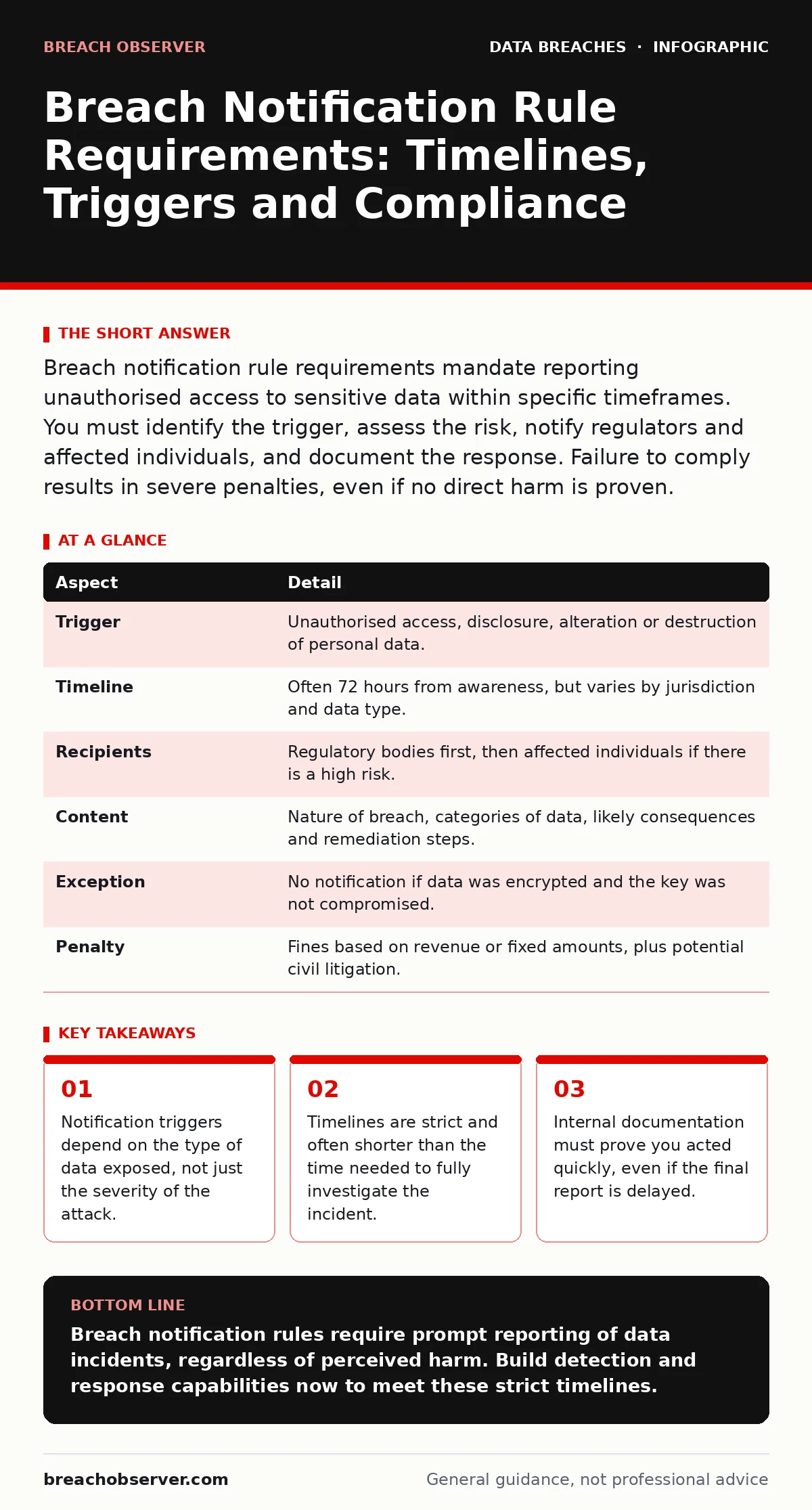
Breach notification rule requirements mandate reporting unauthorised access to sensitive data within specific timeframes. You must identify the trigger, assess the risk, notify regulators and affected individuals, and document the response. Failure to comply results in severe penalties, even if no direct harm is proven.
Breach notification rule requirements explained
Imagine a library where a book falls out of a shelf. The rule is not about whether someone read the book, but about the fact that it was outside its protected place. Breach notification works similarly. It is a legal obligation to report instances where protected data has been accessed, disclosed or altered without authorisation. This duty exists to ensure transparency and allow individuals to take protective measures. The core mechanism is simple: detect the incident, assess the risk, and notify the relevant parties within a set period.
The rules apply to any organisation that holds personal or sensitive information. This includes healthcare providers, financial institutions, technology companies and even small businesses. The scope is broad because data privacy is a fundamental right in many jurisdictions. You do not need to be a large corporation to be subject to these rules. If you process data, you are likely accountable. The definition of a "breach" is wider than many expect. It includes accidental deletion, misdirected emails and lost devices, not just sophisticated cyberattacks.
| Aspect | Detail |
|---|---|
| Trigger | Unauthorised access, disclosure, alteration or destruction of personal data. |
| Timeline | Often 72 hours from awareness, but varies by jurisdiction and data type. |
| Recipients | Regulatory bodies first, then affected individuals if there is a high risk. |
| Content | Nature of breach, categories of data, likely consequences and remediation steps. |
| Exception | No notification if data was encrypted and the key was not compromised. |
| Penalty | Fines based on revenue or fixed amounts, plus potential civil litigation. |
How the notification mechanism works
The process begins with detection. You must have monitoring systems in place to identify anomalies. Once an anomaly is detected, you must determine if it constitutes a breach. This involves checking if the data was actually accessed or just attempted. If accessed, you assess whether the data was protected. If the data was encrypted and the encryption key remains secure, the risk is low. In this case, notification may not be required. This is why data encryption is a primary defence strategy. It reduces the legal obligation to notify, saving time and reputation.
If the data was not encrypted, or the key was compromised, you must assess the risk to individuals. This risk assessment considers the sensitivity of the data, the number of people affected and the potential for identity theft or fraud. High-risk breaches require immediate notification to the regulator. Lower-risk breaches may allow for more time, but you must still document your assessment. The clock starts when you become aware of the breach, not when you confirm the full extent. This creates a pressure to act quickly with incomplete information.
Who is affected by these rules
Every organisation that handles personal data is affected. This includes employees, customers, suppliers and partners. The rules do not distinguish between intentional attacks and accidental leaks. A hacker stealing data triggers the same requirement as a clerk losing a laptop. The impact is global if your organisation operates across borders. Different regions have different rules, but they all move towards stricter timelines and heavier penalties. You must understand the regulations in every jurisdiction where you process data.
Individuals are the primary beneficiaries of these rules. They have the right to know when their data is at risk. This allows them to monitor their accounts, change passwords and freeze credit. Without notification, individuals remain unaware of the exposure. This delays their protective actions and increases the likelihood of fraud. The rules shift the burden of proof to the organisation. You must prove that you notified promptly and accurately. Silence is not an option.
What to do about a potential breach
When you suspect a breach, activate your incident response plan. Do not wait for confirmation. Time is the most critical factor. 1. Contain the breach to prevent further data loss. 2. Preserve evidence for forensic analysis. 3. Assess the risk to individuals. 4. Notify the regulator within the required timeframe. 5. Notify affected individuals if the risk is high. 6. Document every step taken. This documentation is your defence against penalties.
You must communicate clearly with affected individuals. Avoid technical jargon. Explain what happened, what data was involved, what you are doing to fix it and what they should do. Provide contact details for questions. This transparency builds trust, even in a crisis. Hiding details or using vague language can lead to legal challenges and reputational damage. Be honest about the uncertainty. It is better to say "we are still investigating" than to guess and be wrong.
Common mistakes in breach reporting
Many organisations delay notification until they have a full picture of the incident. This is a critical error. The clock starts at awareness, not at resolution. Delaying notification to "get all the facts" often results in missing the deadline. Regulators expect initial notifications with available information, followed by updates as more is known. Silence is interpreted as negligence. You must balance the need for accuracy with the need for speed.
Another common mistake is underestimating the scope of the breach. Organisations often focus on the obvious data loss, such as a database dump. They miss indirect exposures, such as logs containing IP addresses or metadata. This leads to incomplete notifications. If you later discover more data was exposed, you must issue a follow-up notification. This looks bad and increases regulatory scrutiny. Conduct a thorough initial assessment to avoid this.
See also: Employee Data Breaches: How Insider Access Compromises Your Organisation · What happens if VPNs are banned: impact on privacy and connectivity
The hidden cost of compliance
Compliance is not just about avoiding fines. It is about operational resilience. You need systems to detect breaches quickly. You need processes to assess risk accurately. You need templates for notifications. This requires investment in technology and training. Many organisations underestimate the cost of building these capabilities. They react to breaches rather than preparing for them. This reactive approach is more expensive in the long run.
The hidden cost is also reputational. Even if you comply with the rules, the notification itself causes damage. Customers see the news and lose trust. You must manage this communication carefully. Proactive engagement with customers can mitigate the damage. Show that you are taking the issue seriously and taking steps to prevent recurrence. This requires a clear communication strategy, not just a legal one.
Integrating with broader security practices
Breach notification is part of a larger security framework. It relies on credential leaks monitoring to detect compromised accounts. It depends on data exfiltration detection to identify data leaving the network. It connects with backup strategies to ensure data can be restored after an attack. Without these underlying practices, notification becomes a reactive afterthought. You cannot notify accurately if you do not know what was taken.
You should also consider stolen session tokens as a breach vector. If an attacker hijacks a session, they may access data without triggering traditional alerts. This is a subtle breach that is often missed. Ensure your monitoring covers session anomalies. Similarly, password leaks in public dumps can indicate a higher risk of future breaches. Proactively monitoring for your users' credentials can help you prepare for potential incidents.
Key takeaways
- Notification triggers depend on the type of data exposed, not just the severity of the attack.
- Timelines are strict and often shorter than the time needed to fully investigate the incident.
- Internal documentation must prove you acted quickly, even if the final report is delayed.
Breach notification rules require prompt reporting of data incidents, regardless of perceived harm. Build detection and response capabilities now to meet these strict timelines.
Frequently asked questions
Do I need to notify if the data was encrypted?
No, if the encryption key was not compromised, the risk is considered low and notification is often not required. Check local laws for specific exemptions.
How soon must I notify the regulator?
Typically within 72 hours of becoming aware of the breach. Some jurisdictions require faster notification for certain types of data.
What if I am not sure if it is a breach?
If there is a reasonable possibility of unauthorised access, treat it as a breach. Conduct an immediate assessment and notify if risk is confirmed.
Can I notify individuals later?
Initial notification to the regulator is urgent. Individual notification can follow if the risk assessment confirms high risk, but delays must be justified.
How this guide was produced: written by the Breach Observer editorial team with AI assistance, checked against the public references listed below, and reviewed when the facts change. See our editorial policy or report an error.