
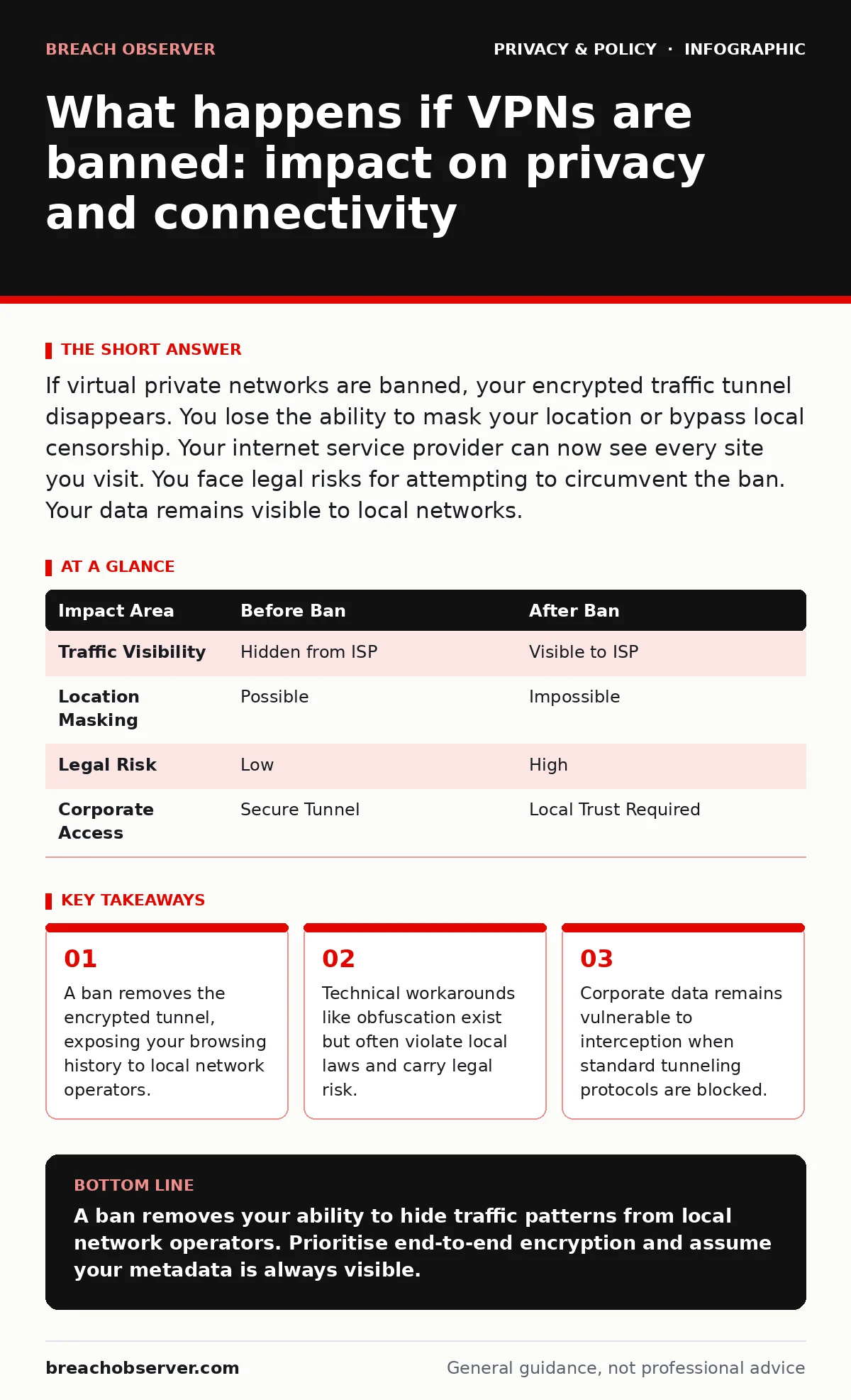
If virtual private networks are banned, your encrypted traffic tunnel disappears. You lose the ability to mask your location or bypass local censorship. Your internet service provider can now see every site you visit. You face legal risks for attempting to circumvent the ban. Your data remains visible to local networks.
What happens if vpns are banned
When a jurisdiction bans virtual private networks, the immediate consequence is the loss of a private communication channel over public networks. A virtual private network creates an encrypted tunnel between your device and a remote server. This tunnel hides your traffic from intermediate observers. If the tunnel is illegal, you cannot use it to protect your data from local snooping. Your internet service provider can now inspect your traffic content. You lose the ability to appear as if you are connecting from another location.
Can you still access the internet without a VPN
You can still access the internet, but your connection loses its privacy layer. Standard web browsing uses HTTPS encryption for individual websites. This protects the content of your messages from casual eavesdropping. It does not hide the fact that you are visiting a specific site. Your network operator sees the domain names you request. This metadata reveals your interests, health queries, and political leanings. You remain connected, but you are no longer anonymous to your infrastructure provider.
How do authorities block VPN traffic
Authorities typically block virtual private networks by inspecting network packets for known signatures. They use deep packet inspection to identify the cryptographic handshakes unique to common protocols like OpenVPN or WireGuard. Once identified, the firewall drops the connection. Some regimes block all traffic on non-standard ports. This forces users onto standard HTTP and HTTPS ports. This makes it harder to distinguish legitimate web traffic from tunnel traffic. It also slows down legitimate services that rely on custom port configurations.
What are the technical workarounds available
Users often turn to obfuscation techniques to bypass these blocks. Obfuscation disguises the virtual private network traffic as regular web traffic. It wraps the encrypted tunnel inside another layer of encryption or HTTP requests. This makes the traffic look like standard browsing to simple filters. However, advanced deep packet inspection can still detect anomalies in packet timing or size. Using these methods may be considered a criminal act in some jurisdictions. You risk legal penalties for attempting to circumvent the ban.
Does a ban affect corporate data transfers
A ban significantly complicates secure corporate communications. Many organisations rely on virtual private networks for branch office connectivity. These tunnels ensure that sensitive data remains encrypted while traversing public internet links. If the ban forces companies to use local infrastructure, they must trust the local provider. This trust is often misplaced in restrictive regimes. Companies may choose to route data through compliant local data centres. This increases latency and reduces control over data sovereignty.
| Impact Area | Before Ban | After Ban |
|---|---|---|
| Traffic Visibility | Hidden from ISP | Visible to ISP |
| Location Masking | Possible | Impossible |
| Legal Risk | Low | High |
| Corporate Access | Secure Tunnel | Local Trust Required |
See also: Employee Data Breaches: How Insider Access Compromises Your Organisation · Should I Worry About Data Brokers? The Real Risk
Are there exceptions to the VPN ban
Most bans include exceptions for licensed or government-approved providers. These approved services often come with strict logging requirements. The provider must store connection logs and user identity data. They may be required to hand this data to authorities upon request. This creates a false sense of security. You are still protected from casual eavesdropping, but not from state surveillance. Your traffic is no longer private from the entity operating the tunnel.
How does this relate to data privacy laws
A virtual private network ban often conflicts with broader data privacy frameworks. Regulations like GDPR aim to protect personal data and give users control. A ban strips users of the technical means to protect their own metadata. It forces data to flow through local infrastructure, potentially violating cross-border data transfers rules. Organisations must assess whether local compliance overrides global privacy commitments. This creates a complex legal environment for multinational companies.
What should you do if VPNs are banned
You must assess your risk profile and legal obligations. If you are a resident, using prohibited tools may endanger you. Rely on standard HTTPS encryption for sensitive transactions. Use encrypted messaging apps for private communication, as these often survive basic filtering. If you are a visitor, avoid accessing sensitive accounts over public networks. Understand that your digital footprint is now visible to local operators.
How to maintain security without tunneling
Focus on end-to-end encryption for your applications. A virtual private network protects the path, not the message. End-to-end encryption protects the message regardless of the path. Use applications that implement this standard by default. Ensure your devices are patched and secure. Reduce the amount of sensitive data you transmit over public networks. Assume that all metadata is visible to your network provider.
Key takeaways
- A ban removes the encrypted tunnel, exposing your browsing history to local network operators.
- Technical workarounds like obfuscation exist but often violate local laws and carry legal risk.
- Corporate data remains vulnerable to interception when standard tunneling protocols are blocked.
A ban removes your ability to hide traffic patterns from local network operators. Prioritise end-to-end encryption and assume your metadata is always visible.
Frequently asked questions
Can a ISP see what I search if VPNs are banned
Yes, your internet service provider can see the domains you visit and often the search queries if they are not fully encrypted end-to-end.
Is using a proxy server legal if VPNs are banned
Proxy servers often face the same legal restrictions as virtual private networks if they are used to circumvent censorship or hide identity.
Do encrypted messaging apps work without a VPN
Yes, encrypted messaging apps work independently of tunneling protocols, though they may be blocked if the regime targets specific applications.
Can I use my company VPN in a country that bans them
You likely cannot use it legally, and doing so may expose your company and yourself to significant legal and operational risks.
How this guide was produced: written by the Breach Observer editorial team with AI assistance, checked against the public references listed below, and reviewed when the facts change. See our editorial policy or report an error.