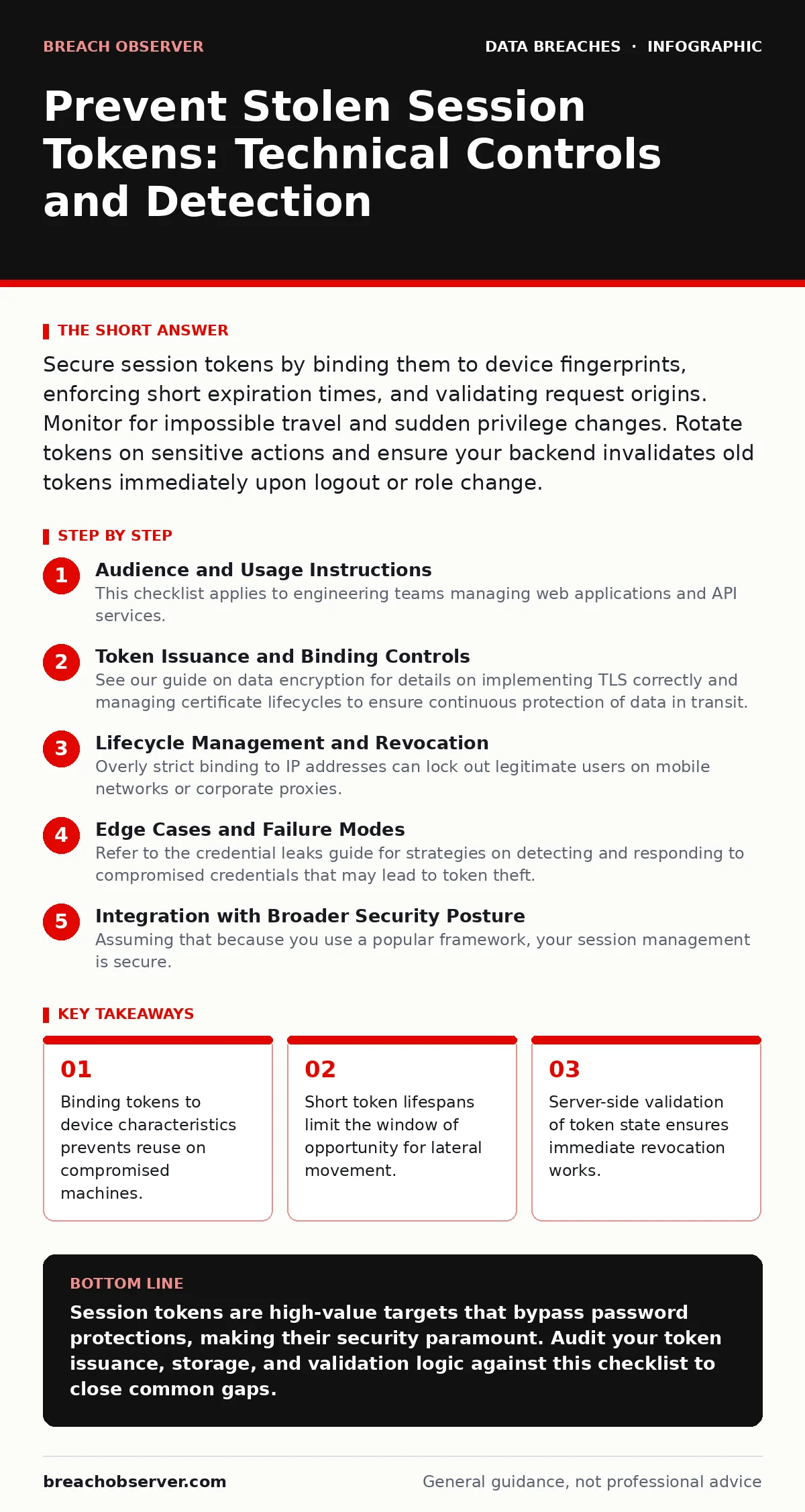
Secure session tokens by binding them to device fingerprints, enforcing short expiration times, and validating request origins. Monitor for impossible travel and sudden privilege changes. Rotate tokens on sensitive actions and ensure your backend invalidates old tokens immediately upon logout or role change.
Audience and Usage Instructions
This checklist applies to engineering teams managing web applications and API services. Use it to audit your current session management logic against modern threat models. Each item represents a specific control that mitigates the risk of token theft. You do not need to implement every item immediately, but you must address the highest-risk items first. The goal is to reduce the value of a stolen token and increase the difficulty of its reuse.
Token Issuance and Binding Controls
- Bind tokens to user-agent strings: This prevents an attacker from using a stolen token from a different browser or device, as the server will reject requests with mismatched headers.
- Include IP address or network context in validation: Restricting token usage to the originating IP range or ASN makes it harder for remote attackers to hijack sessions, though it may impact users on dynamic IPs.
- Use short-lived access tokens with refresh mechanisms: Short lifespans limit the damage window if a token is exfiltrated, while refresh tokens allow seamless user experience without frequent re-authentication.
- Implement cryptographic signing for token integrity: Ensuring tokens are signed with a secret key prevents attackers from modifying claims or extending expiration dates without detection.
Storage and Transmission Security
- Set HttpOnly and Secure flags on cookies: The HttpOnly flag prevents JavaScript from accessing the cookie, mitigating cross-site scripting attacks, while Secure ensures transmission only over HTTPS.
- Use SameSite attribute for cookie isolation: Setting SameSite to Strict or Lax prevents the browser from sending cookies during cross-site requests, reducing the risk of cross-site request forgery.
- Avoid storing tokens in localStorage or sessionStorage: These storage locations are accessible to JavaScript, making them vulnerable to theft if your application suffers from cross-site scripting vulnerabilities.
- Enforce TLS for all endpoints: Transport Layer Security encrypts data in transit, preventing network-level interception of tokens. Without TLS, tokens are sent in plain text and easily captured.
See our guide on data encryption for details on implementing TLS correctly and managing certificate lifecycles to ensure continuous protection of data in transit.
Lifecycle Management and Revocation
- Implement server-side session stores for critical actions: Storing session state on the server allows for immediate invalidation, whereas stateless tokens require waiting for expiration or complex revocation lists.
- Invalidate all sessions on password change: Forcing re-authentication when a user changes their password ensures that any previously issued tokens become useless, closing the window for unauthorized access.
- Rotate tokens on privilege escalation: Issuing a new token when a user performs a sensitive action or changes roles prevents replay attacks and ensures the new token has appropriate permissions.
- Set absolute maximum session durations: Even with refresh tokens, enforcing a hard limit on how long a session can remain active without re-authentication reduces the risk of long-term dormant access.
Monitoring and Anomaly Detection
- Log token issuance and usage patterns: Recording when and where tokens are used provides the audit trail necessary to detect unusual activity or potential compromise.
- Alert on impossible travel scenarios: Notifying security teams when a user logs in from two geographically distant locations within a short timeframe can indicate token theft or credential sharing.
- Monitor for sudden spikes in request volume: An abnormal increase in requests from a single token may indicate automated scraping or an attacker trying to extract data rapidly.
- Detect changes in user-agent or IP mid-session: Triggering re-authentication when the client environment changes during an active session helps mitigate session hijacking attempts.
See also: Data Exfiltration: How Attackers Steal Information and How to Stop It · Stop Credential Leaks: 3 Immediate Actions to Secure Accounts
Edge Cases and Failure Modes
- Handle token expiration gracefully on the client side: Ensure your application can detect expired tokens and prompt for re-authentication without crashing or leaking error details to attackers.
- Secure refresh token rotation: Rotate refresh tokens on each use and invalidate the old one. This prevents an attacker who steals a refresh token from maintaining long-term access.
- Validate token claims on every request: Do not trust client-side modifications to token claims. Always verify the signature and check expiration and audience claims server-side.
- Implement rate limiting on authentication endpoints: Protecting login and token issuance endpoints from brute-force attacks prevents attackers from generating valid tokens through credential stuffing.
Refer to the credential leaks guide for strategies on detecting and responding to compromised credentials that may lead to token theft.
Integration with Broader Security Posture
- Align token policies with incident response plans: Ensure your team knows how to revoke tokens en masse if a breach is detected. Slow revocation extends the impact of a breach.
- Test for cross-site scripting vulnerabilities regularly: Since XSS is the primary vector for token theft, regular testing helps identify and fix code flaws before attackers exploit them.
- Educate developers on secure session management: Training ensures that new features are built with security in mind, reducing the likelihood of introducing vulnerabilities like insecure token storage.
- Review third-party library dependencies: Ensure that any libraries handling session management are up-to-date and free of known vulnerabilities that could compromise token integrity.
See our guide on incident communication plans to understand how to coordinate token revocation and user notification during a security event.
Final Verification Steps
- Conduct a penetration test focused on session handling: External testers can identify logical flaws in token validation and storage that automated scans might miss.
- Review server logs for token-related errors: Analyzing error logs can reveal attempts to use invalid or expired tokens, indicating potential attack activity.
- Verify that logout functionality invalidates tokens: Ensure that logging out removes the token from the client and invalidates it server-side, preventing reuse.
- Document your session management strategy: Clear documentation helps new team members understand the security controls in place and reduces the risk of accidental misconfiguration.
Key takeaways
- Binding tokens to device characteristics prevents reuse on compromised machines.
- Short token lifespans limit the window of opportunity for lateral movement.
- Server-side validation of token state ensures immediate revocation works.
Session tokens are high-value targets that bypass password protections, making their security paramount. Audit your token issuance, storage, and validation logic against this checklist to close common gaps.
Frequently asked questions
How do I know if my session tokens have been stolen?
Look for anomalous login locations, impossible travel alerts, or sudden spikes in activity from a single session. Review server logs for unauthorized access attempts.
Should I use JWTs or server-side sessions?
Server-side sessions offer easier revocation and are generally safer for high-security applications. JWTs are stateless but require careful management of expiration and revocation lists.
Can I prevent all session hijacking?
No, but you can significantly reduce risk by binding tokens to device characteristics, using short lifespans, and implementing robust monitoring and revocation mechanisms.
What is the impact of a stolen refresh token?
A stolen refresh token allows an attacker to generate new access tokens indefinitely. Rotate refresh tokens on use and invalidate them immediately if theft is suspected.
How this guide was produced: written by the Breach Observer editorial team with AI assistance, checked against the public references listed below, and reviewed when the facts change. See our editorial policy or report an error.