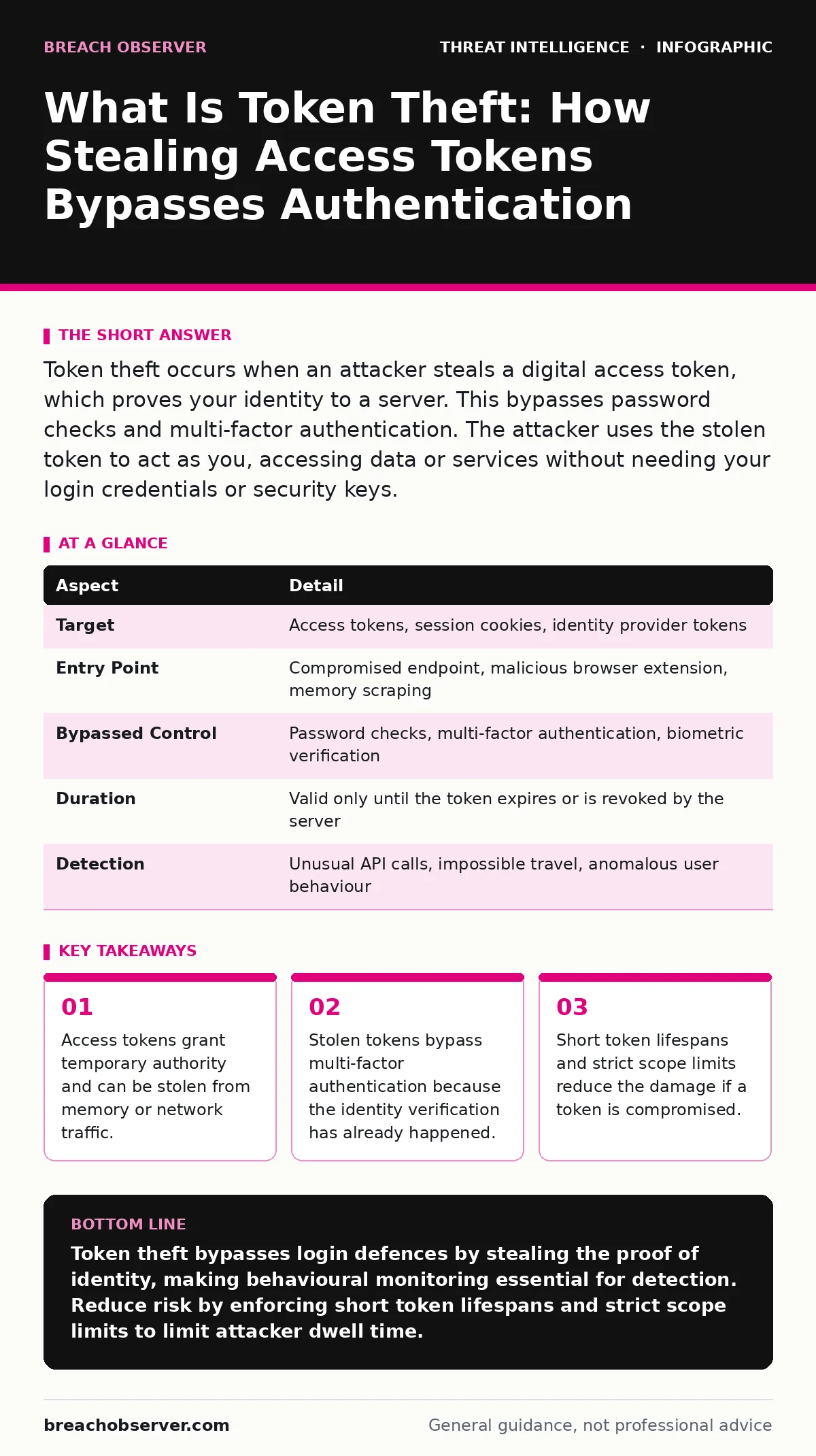
Token theft occurs when an attacker steals a digital access token, which proves your identity to a server. This bypasses password checks and multi-factor authentication. The attacker uses the stolen token to act as you, accessing data or services without needing your login credentials or security keys.
What Is Token Theft
Token theft is the process of stealing a digital access token that proves a user’s identity to a server. An access token is a string of data issued after a successful login, telling the system what resources the user may access. When an attacker obtains this token, they can present it to the service as if they were the legitimate user.
The system trusts the token and grants access, ignoring the fact that the person holding it is not the original owner. This method bypasses traditional login defences because the authentication step has already occurred. The attacker does not need to guess a password or defeat multi-factor authentication. They simply replay the valid credential that was already issued.
How Token Theft Works in Practice
The attack begins after a user has successfully logged in. The application stores the access token locally, often in memory, a browser cookie, or a local storage file. The attacker uses malware or a browser extension to read this storage location. Once the token is extracted, it is sent to the attacker’s command and control server.
The attacker then uses the token to make API calls or access web interfaces. The server sees a valid token with a correct signature and active expiry time. It processes the request normally, unaware that the source is malicious. This technique exploits the trust relationship between the client and the server. The server assumes that anyone holding the token is the authorised user.
| Aspect | Detail |
|---|---|
| Target | Access tokens, session cookies, identity provider tokens |
| Entry Point | Compromised endpoint, malicious browser extension, memory scraping |
| Bypassed Control | Password checks, multi-factor authentication, biometric verification |
| Duration | Valid only until the token expires or is revoked by the server |
| Detection | Unusual API calls, impossible travel, anomalous user behaviour |
Who Is Affected by Token Theft
Any organisation that uses modern identity protocols is vulnerable. Token theft affects users of single sign-on systems, cloud applications, and internal enterprise tools. The risk is highest for users with high-privilege accounts, such as system administrators or financial officers. These accounts have tokens that grant access to sensitive data and critical infrastructure.
The attack also impacts developers who test applications with elevated permissions. Their tokens often have broad scopes, allowing access to multiple services. Remote workers are particularly exposed because their devices may lack the physical security of an office environment. If a remote device is infected, the attacker can harvest tokens directly from the operating system memory.
Common Misconceptions About Token Security
Many security teams believe that multi-factor authentication stops token theft. This is incorrect. Multi-factor authentication verifies the user at the login stage. Once the token is issued, the system no longer checks for the second factor. The token itself is the proof of identity. Another common error is assuming that strong passwords prevent token theft.
Password strength is irrelevant once the token is stolen. The attacker does not need the password to use the token. Some teams also think that encrypting data at rest protects against this attack. Encryption protects stored data, but it does not stop an attacker from using a live token to request data from the server. The server decrypts the data and sends it to the holder of the valid token.
Real-World Impact and Detection
Imagine a financial analyst who logs into a trading platform from a home laptop. A piece of malware on the laptop scrapes the browser memory and steals the session token. The analyst notices nothing unusual. The attacker uses the token to place orders on the platform. The system logs these actions as coming from the analyst’s account. Without specific monitoring, these actions look like normal user behaviour.
The damage occurs because the system trusts the token. Detection requires looking for anomalies in user activity, not just login attempts. Security telemetry must track API calls and resource access patterns. If a user accesses data from a new location or at an unusual time, the system should flag it. This approach relies on behavioural analysis rather than credential checking.
See also: Detect Password Reuse in Logs and Identity Systems · Account Lockout Policies for Small Business: Prevent Lockouts and Breaches
Mitigating Token Theft Risks
Reducing the impact of token theft requires limiting token lifespan and scope. Short-lived tokens expire quickly, giving the attacker a narrow window to act. If the token expires in minutes rather than hours, the attacker must constantly re-authenticate, which increases the chance of detection. Scope limitation ensures that a token only grants access to the specific resources needed.
A token for a chat application should not allow access to financial data. This principle of least privilege restricts the damage even if the token is stolen. Implementing token binding is another effective measure. Token binding ties the token to the specific device or network connection that requested it. If an attacker tries to use the token from a different location, the server rejects it.
Monitoring and Response Strategies
Effective monitoring requires integrating identity logs with network activity. You must correlate login events with subsequent API calls. Look for tokens being used from multiple geographic locations in a short time. This is known as impossible travel. Also watch for tokens accessing resources that the user never touches.
If a marketing user’s token starts accessing source code repositories, it is likely stolen. Automated systems should revoke tokens immediately when anomalous behaviour is detected. Revocation stops the attacker from using the token further. You should also review your security telemetry to ensure it captures token issuance and usage events. Without this data, you cannot detect the theft or the subsequent abuse.
The Role of Threat Intelligence
Understanding token theft requires context from strategic threat intelligence. Attackers often combine token theft with other techniques to maintain persistence. They may use the stolen token to move laterally across the network. This aligns with the cyber kill chain, where initial access is followed by lateral movement. By studying how attackers use stolen tokens, you can refine your detection rules. You can also look for indicators of compromise related to token scraping malware. This intelligence helps you prioritise which accounts to monitor closely. It also informs your response plans, ensuring you know how to revoke tokens and contain the breach effectively.
Preventing Future Compromise
Prevention starts with secure application design. Developers must store tokens securely, avoiding plain text storage in local files. They should use secure HTTP-only cookies that cannot be accessed by JavaScript. This prevents cross-site scripting attacks from stealing tokens. Users should keep their devices updated and free of malware. Regular software updates patch vulnerabilities that attackers use to inject token-stealing code.
Organisations should enforce strict access controls and review permissions regularly. Removing unnecessary privileges reduces the value of any stolen token. Combining these technical measures with user awareness creates a layered defence. No single control stops token theft, but together they make it significantly harder for attackers to succeed.
Key takeaways
- Access tokens grant temporary authority and can be stolen from memory or network traffic.
- Stolen tokens bypass multi-factor authentication because the identity verification has already happened.
- Short token lifespans and strict scope limits reduce the damage if a token is compromised.
Token theft bypasses login defences by stealing the proof of identity, making behavioural monitoring essential for detection. Reduce risk by enforcing short token lifespans and strict scope limits to limit attacker dwell time.
Frequently asked questions
Can antivirus software stop token theft?
Antivirus can remove the malware that steals tokens, but it cannot recover the token once it is sent to the attacker. You must monitor for abuse after the theft.
How do I know if my token has been stolen?
Look for unusual activity in your account, such as logins from new locations or access to resources you do not use. Contact your security team immediately if you see these signs.
Does changing my password stop a stolen token?
Changing your password does not automatically invalidate existing access tokens. You must explicitly revoke the session or token through your identity provider to stop the attacker.
Are all tokens vulnerable to theft?
Yes, any token stored on a client device is vulnerable if the device is compromised. The risk varies based on how long the token lasts and what permissions it grants.
How this guide was produced: written by the Breach Observer editorial team with AI assistance, checked against the public references listed below, and reviewed when the facts change. See our editorial policy or report an error.