
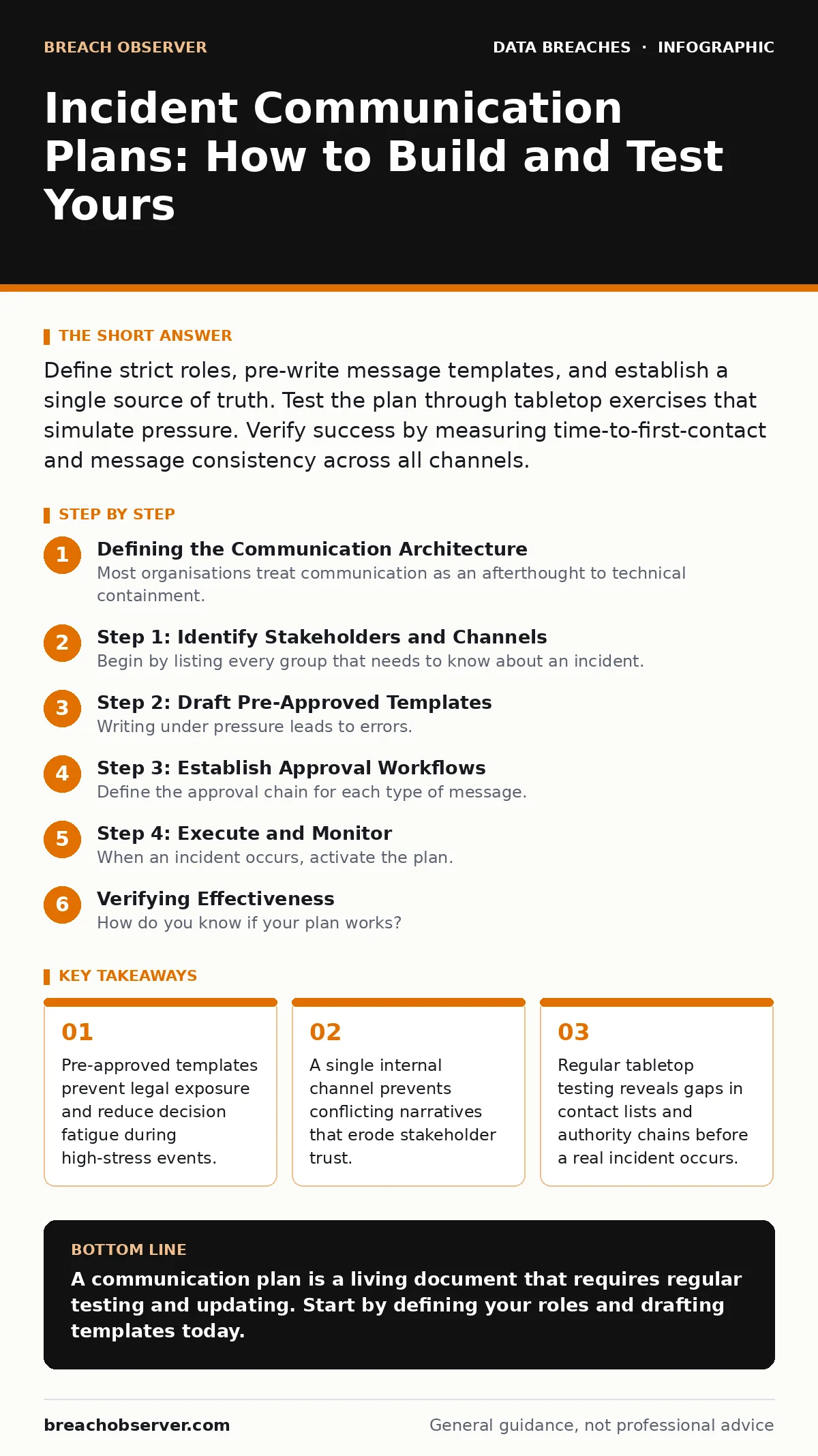
Define strict roles, pre-write message templates, and establish a single source of truth. Test the plan through tabletop exercises that simulate pressure. Verify success by measuring time-to-first-contact and message consistency across all channels.
Defining the Communication Architecture
Most organisations treat communication as an afterthought to technical containment. This is a fatal error. The narrative you control in the first hours often determines the long-term reputational and financial impact of an incident. You must separate the technical response team from the communication team. The technical team focuses on containment and eradication, while the communication team manages internal and external messaging.
You need a clear hierarchy. Define who has the authority to approve messages. Without this, you risk multiple people sending conflicting updates. This confusion creates noise that distracts responders and alarms stakeholders unnecessarily. Establish a primary spokesperson and a backup. The backup must have equal access to information and approval rights.
Consider the channels you will use. Email is standard but can be missed. SMS provides immediacy. A dedicated incident management platform offers a single source of truth. You should use a combination. The goal is redundancy. If one channel fails, another must carry the message. This aligns with good backup strategies, where multiple copies exist in different formats to ensure availability.
Step 1: Identify Stakeholders and Channels
Begin by listing every group that needs to know about an incident. This includes employees, customers, regulators, law enforcement, and media. Do not assume everyone needs the same level of detail. Employees need instructions on what to do. Customers need reassurance and next steps. Regulators need factual timelines.
For each stakeholder group, define the primary and secondary contact methods. Create a distribution list for each. Verify these lists regularly. People change roles. Email addresses expire. Phone numbers change. A stale contact list is a broken pipe. You cannot communicate if you do not know where to send the message.
| Stakeholder Group | Primary Channel | Secondary Channel | Message Type |
|---|---|---|---|
| Employees | Intranet/Email | SMS Alert | Instructional |
| Customers | Email Portal | Social Media | Reassuring |
| Regulators | Secure Portal | Formal Letter | Factual |
| Media | Press Release | Spokesperson | Controlled |
Step 2: Draft Pre-Approved Templates
Writing under pressure leads to errors. You will make mistakes in grammar, tone, or fact. These mistakes can be exploited by adversaries or misunderstood by the public. Draft templates for common scenarios. Include a template for initial notification, updates, and resolution.
Leave placeholders for specific details. These placeholders should be filled by the technical team, but the tone and structure remain fixed. This ensures consistency. It also speeds up the process. You are not writing from scratch; you are populating a form. This reduces the cognitive load on the incident commander.
Step 3: Establish Approval Workflows
Define the approval chain for each type of message. Internal updates may require only the incident commander’s sign-off. External messages to customers or regulators often require legal and executive approval. This adds time, so you must plan for it.
Set strict time limits for approvals. If a legal review takes too long, the message becomes stale. Define a fallback. If the legal team is unavailable, who has the authority to release a holding statement? A holding statement acknowledges the issue without admitting liability or providing unverified details. It buys time for the technical team to assess the scope.
This process mirrors the discipline required in digital forensics. You must maintain a chain of custody for evidence. Similarly, you must maintain a chain of custody for your narrative. Every message sent must be logged and approved. This creates an audit trail that protects the organisation later.
Step 4: Execute and Monitor
When an incident occurs, activate the plan. The incident commander notifies the communication lead. The lead selects the appropriate template. The technical team provides the facts. The communication team drafts the message. The approval chain reviews it. The message is distributed.
Monitor the response. Are customers confused? Are media outlets misinterpreting the message? Adjust your communications as needed. Do not stick rigidly to the template if the situation changes. Flexibility within structure is key. Update stakeholders regularly, even if there is no new information. Silence breeds speculation.
See also: Incident Response Runbooks: 6 Common Misunderstandings Fixed · Implement a Threat Intelligence Program: Step-by-Step Execution
Verifying Effectiveness
How do you know if your plan works? You cannot wait for a real breach to find out. You must test it. Conduct tabletop exercises. Simulate a breach scenario. Walk through the communication steps. Time how long it takes to send the first message. Identify bottlenecks.
Check for clarity. Did the recipients understand the message? Did they know what to do? Check for consistency. Did all channels send the same core message? Check for completeness. Did you miss any stakeholder group? Document the lessons learned. Update the plan accordingly.
- All stakeholder groups received the correct message.
- Messages were approved within the defined time limits.
- No conflicting information was released.
- Feedback was collected from recipients.
- The plan was updated based on the exercise.
Maintaining the Plan
A communication plan is not a static document. It decays over time. Contacts change. Roles shift. New regulations emerge. New technologies introduce new risks. You must review the plan regularly. At least every six months, verify contact lists. Test the distribution channels. Update templates to reflect new scenarios.
Train your team. New employees may not know their role in the communication plan. Provide training. Ensure they understand the importance of silence. Do not discuss the incident on social media. Do not talk to the media unless authorised. Direct all inquiries to the spokesperson.
This discipline is similar to managing password reuse. You must enforce consistent, secure practices across the organisation. Inconsistent communication is a vulnerability. It exposes you to reputational risk and legal liability. Keep the plan sharp. Keep the team ready.
Integrating with Technical Responses
Communication does not exist in a vacuum. It is intertwined with technical actions. If you announce containment before it is achieved, you lose credibility. If you delay announcement to protect the investigation, you may violate regulatory requirements. Balance is required.
Coordinate closely with the technical team. Understand the scope and impact. Data inventory and mapping helps you know what data is affected. This information is critical for accurate communication. You cannot tell customers if their data is at risk if you do not know what data you hold.
Consider the implications of data extortion. If attackers threaten to release data, your communication strategy must address this threat. You must prepare for the worst-case scenario. Have templates ready for extortion events. These messages must be firm, reassuring, and legally sound. Consult legal counsel early.
The Human Element
Technology fails. People react. Your communication plan must account for human emotion. Fear, anger, and confusion are natural responses to a breach. Acknowledge these emotions. Show empathy. Do not be robotic.
Listen to feedback. Address concerns. Be transparent about what you know and what you do not know. Admitting uncertainty is better than guessing incorrectly. Trust is built on honesty, not perfection. Your goal is to maintain trust, even in the face of failure.
Remember that stolen session tokens or password leaks can have immediate personal impacts on users. Your messages should provide actionable advice. Tell them what to do next. Change passwords. Enable multi-factor authentication. Monitor accounts. Empower your users to protect themselves. This shifts the burden from you to them, in a helpful way.
Key takeaways
- Pre-approved templates prevent legal exposure and reduce decision fatigue during high-stress events.
- A single internal channel prevents conflicting narratives that erode stakeholder trust.
- Regular tabletop testing reveals gaps in contact lists and authority chains before a real incident occurs.
A communication plan is a living document that requires regular testing and updating. Start by defining your roles and drafting templates today.
Frequently asked questions
How often should I test my incident communication plan?
Test your plan at least twice a year. More frequent testing is better, especially after significant organisational changes or new regulatory requirements.
Who should be the primary spokesperson during an incident?
The primary spokesperson should be a senior leader with authority and communication skills. They must be trusted by stakeholders and able to handle pressure.
What if the technical team disagrees with the communication message?
Establish a resolution process in advance. The incident commander usually has the final say, but legal and executive input is critical. Document the disagreement and the rationale for the final decision.
Can I use automated tools for incident communication?
Yes, automated tools can help distribute messages quickly. However, ensure they are configured correctly and have manual overrides. Automated errors can damage trust instantly.
How this guide was produced: written by the Breach Observer editorial team with AI assistance, checked against the public references listed below, and reviewed when the facts change. See our editorial policy or report an error.