
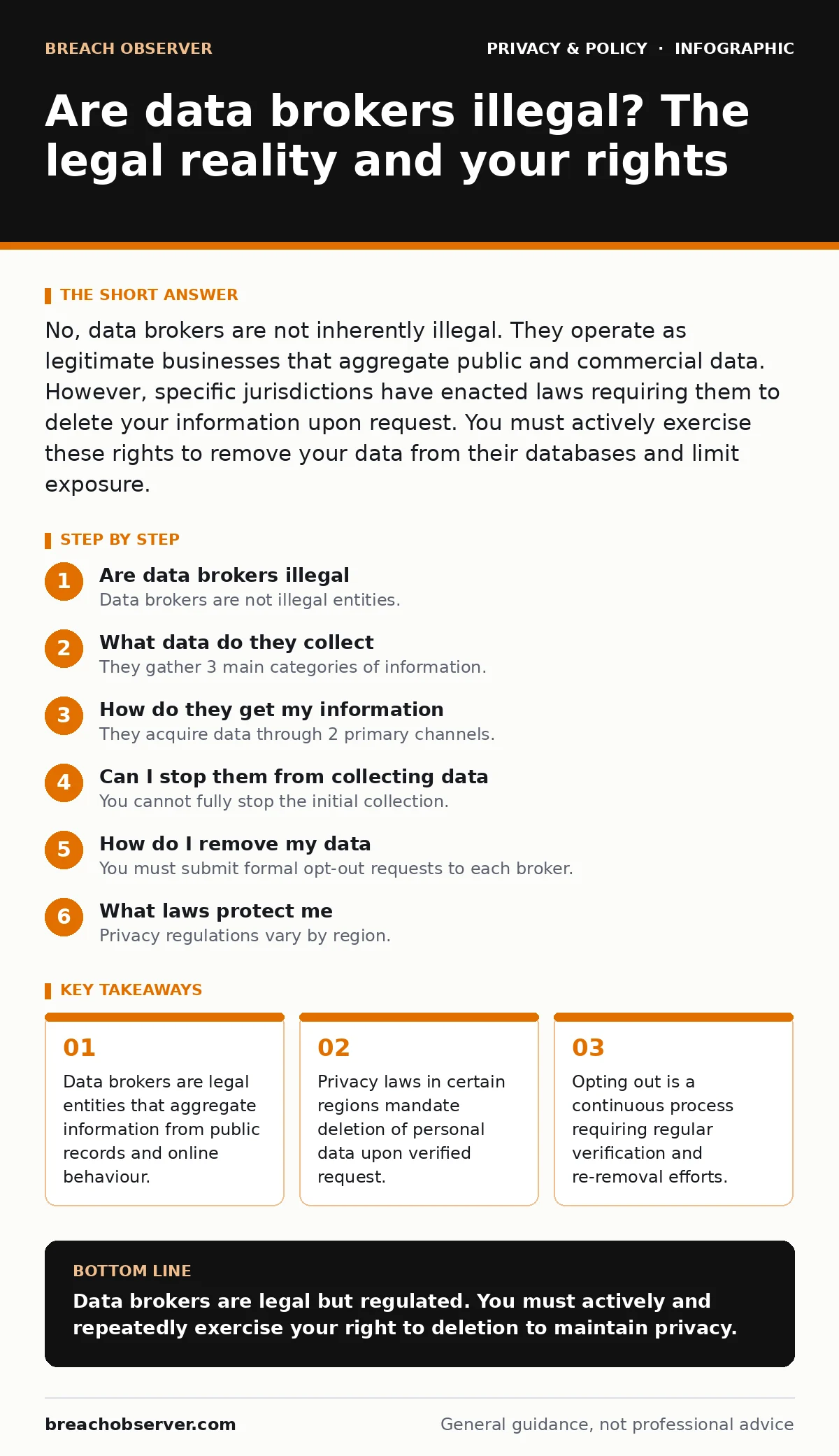
No, data brokers are not inherently illegal. They operate as legitimate businesses that aggregate public and commercial data. However, specific jurisdictions have enacted laws requiring them to delete your information upon request. You must actively exercise these rights to remove your data from their databases and limit exposure.
Are data brokers illegal
Data brokers are not illegal entities. They operate as standard commercial businesses that collect, aggregate and sell personal information. Most jurisdictions treat them as lawful information service providers. The legality stems from their use of publicly available data and consensual data sharing agreements. You can assume their existence is legal unless a specific local law bans certain data types.
What data do they collect
They gather 3 main categories of information. Public records include property ownership, court filings and professional licences. Commercial data comes from purchase histories, loyalty programmes and credit applications. Behavioural data tracks online activity, browsing habits and device identifiers. This combination creates a detailed profile that predicts your lifestyle and spending habits.
How do they get my information
They acquire data through 2 primary channels. Direct collection occurs when you fill out forms, sign up for services or share details on social media. Indirect collection involves purchasing data from other brokers or scraping public websites. They also infer details by cross-referencing disparate datasets. For example, linking a zip code to a shopping receipt reveals household income without direct disclosure.
Can I stop them from collecting data
You cannot fully stop the initial collection. They scrape public records and aggregate data from third parties automatically. You can, however, limit the spread of your data. Using encrypted messaging apps reduces the digital footprint available for aggregation. Disabling location services on mobile devices prevents real-time tracking. These measures reduce the volume of fresh data entering the broker ecosystem.
How do I remove my data
You must submit formal opt-out requests to each broker. Most brokers provide a dedicated web form for this purpose. You must verify your identity to prove ownership of the data. This verification often requires providing a copy of your driver’s licence or utility bill. Once verified, the broker deletes your record from their active database. Some brokers may retain anonymised data for statistical purposes.
What laws protect me
Privacy regulations vary by region. The right to be forgotten allows individuals to request deletion of personal data under specific conditions. The CCPA grants California residents the right to know what data is collected and to opt out of its sale. Other frameworks impose similar duties on data processors. These laws shift the burden of proof to the broker to demonstrate lawful retention of your data.
Why do they keep my data
They retain data because it has commercial value. Insurers use it for risk assessment. Employers use it for background checks. Marketers use it for targeted advertising. The economic incentive to retain accurate, up-to-date profiles is strong. Brokers compete on the freshness and depth of their datasets. Deleting your data reduces their competitive advantage, which is why verification processes are often cumbersome.
| Data Type | Source | Removal Difficulty | Legal Basis for Retention |
|---|---|---|---|
| Public Records | Government databases | High | Public interest and legal compliance |
| Purchase History | Retailers and banks | Medium | Contractual performance and legitimate interest |
| Online Behaviour | Websites and apps | Low | Consent and marketing preferences |
What are the risks of exposure
Exposure leads to 3 primary risks. Identity theft occurs when criminals use your aggregated data to impersonate you. Facial recognition risks increase when brokers link photos to your contact details. Stalking and harassment become easier when your home address and routine are publicly accessible. The aggregation of minor data points creates a security surface that did not exist in any single source.
How to maintain privacy long term
Privacy requires continuous maintenance. Brokers frequently re-collect data from public sources. You must check your presence on broker sites every 6 months. Automated removal services exist but often lack transparency about their methods. Manual removal gives you control over the verification process. Combining manual checks with strict digital hygiene provides the best defence. Regularly reviewing your browser fingerprinting settings also limits passive data collection.
Key takeaways
- Data brokers are legal entities that aggregate information from public records and online behaviour.
- Privacy laws in certain regions mandate deletion of personal data upon verified request.
- Opting out is a continuous process requiring regular verification and re-removal efforts.
Data brokers are legal but regulated. You must actively and repeatedly exercise your right to deletion to maintain privacy.
Frequently asked questions
Can I sue a data broker for collecting my data?
You can sue if they violate specific privacy laws or fail to delete data after a valid request. General collection is usually protected unless it involves sensitive biometric data or illegal harassment.
Do password managers for families help with data brokers?
Password managers do not directly remove data from brokers. They prevent credential leaks that brokers might harvest. Keeping your accounts secure reduces the amount of personal data available for aggregation.
Is parental controls effective against data brokers?
Parental controls limit children’s online activity and data sharing. They do not remove existing data from broker databases. You must still submit opt-out requests for any data already collected about your children.
How do I verify my identity without sending sensitive documents?
Some brokers allow verification through alternative methods, such as answering security questions or providing a utility bill. If a broker demands excessive sensitive data, check if local privacy laws permit less invasive verification.
How this guide was produced: written by the Breach Observer editorial team with AI assistance, checked against the public references listed below, and reviewed when the facts change. See our editorial policy or report an error.