
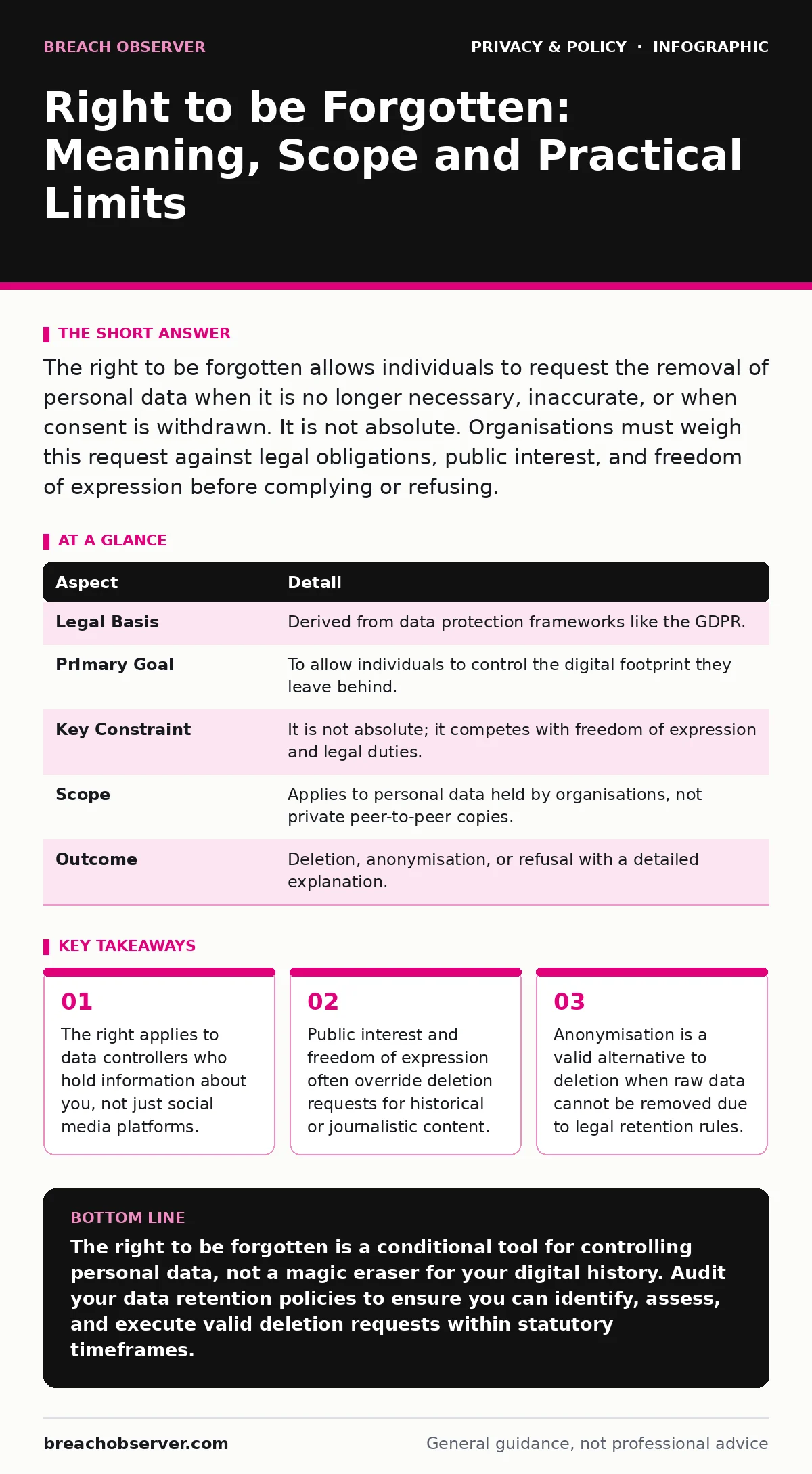
The right to be forgotten allows individuals to request the removal of personal data when it is no longer necessary, inaccurate, or when consent is withdrawn. It is not absolute. Organisations must weigh this request against legal obligations, public interest, and freedom of expression before complying or refusing.
The Library Analogy
Imagine a public library that keeps a record of every book you have ever borrowed. You decide you want this history erased from their system. The librarian cannot simply burn the ledger because it serves as a record of library activity. Instead, they must check if your name is still required for current operations. If the record is old, irrelevant, or stored without your permission, they may remove your name. This balance between your desire for privacy and the institution’s need for records is the core mechanic of the right to be forgotten.
| Aspect | Detail |
|---|---|
| Legal Basis | Derived from data protection frameworks like the GDPR. |
| Primary Goal | To allow individuals to control the digital footprint they leave behind. |
| Key Constraint | It is not absolute; it competes with freedom of expression and legal duties. |
| Scope | Applies to personal data held by organisations, not private peer-to-peer copies. |
| Outcome | Deletion, anonymisation, or refusal with a detailed explanation. |
Where the Term Comes From
The phrase gained prominence through legal challenges against search engines. Courts ruled that search results linking to outdated or irrelevant personal information could infringe on privacy rights. This established that intermediaries, not just original publishers, have a duty to consider deletion requests. The mechanism forces organisations to review the necessity of holding data. It shifts the burden from the individual proving harm to the organisation proving necessity. This change in burden is a significant operational shift for any entity processing personal information.
Day-to-Day Application
In practice, this right is exercised through formal requests. You submit a claim to the organisation holding your data. They must verify your identity to prevent fraudulent deletions. Then they assess whether the data serves a legitimate purpose. If you withdraw consent for marketing emails, they must stop using that data. If you request removal from a customer database after ending a service, they must delete the record unless a law requires retention. The process is administrative but legally binding. Organisations that ignore valid requests face significant penalties.
What People Usually Get Wrong
Many assume this right grants total erasure of their digital presence. This is incorrect. The right applies to specific data controllers, not the entire internet. If a news outlet published an article about a public event involving you, they are not required to delete it. The publication serves the public interest. Search engines may de-index the link in certain contexts, but the source content remains. Another common error is believing that deletion is immediate. Organisations have a statutory period to respond. During this time, they may consult legal teams or assess technical feasibility.
The right also does not apply to data that is anonymous. If your data has been stripped of identifiers so that you cannot be singled out, the right does not trigger. This connects closely to the principles of anonymization, where data is transformed to prevent re-identification. Once data is truly anonymous, it falls outside the scope of privacy laws governing personal data.
The Search Engine Exception
Search engines operate differently from data hosts. They do not create the content; they index it. When you request deletion, the search engine evaluates whether the link to the page is disproportionately harmful to your privacy. Factors include the nature of the information, your public profile, and the time elapsed. If the information is outdated and no longer relevant to current public discourse, the link may be removed from search results. The original website remains live. This distinction is vital for understanding the limits of the right. It affects discoverability, not existence.
This nuance is often missed by those seeking online anonymity. Removing a search result reduces visibility but does not erase the data from the web. For true invisibility, one must address the source directly. Search engines act as gatekeepers of attention, not archives of truth.
See also: What is CCPA request: rights, process and business impact · Employee Data Breaches: How Insider Access Compromises Your Organisation
Balancing Public Interest
The right to be forgotten is frequently denied when the data serves a public interest. Historical records, criminal convictions, and political reporting are protected. The logic is that society has a right to access accurate historical information. If a person was involved in a significant public event, their association with that event is part of the public record. Deleting this data would rewrite history. Organisations must document this balancing test. They cannot simply claim "public interest" without specific justification. The justification must link the data to a specific public need.
This balance also protects freedom of expression. Journalists and researchers rely on the permanence of records. If data could be erased at will, investigative work would become impossible. The law protects the integrity of information that contributes to public debate. However, this protection is not unlimited. If the data is inaccurate or excessive, the privacy right may still prevail. The assessment is case-by-case.
Technical and Operational Challenges
Implementing deletion requests is technically difficult. Data is often replicated across backups, archives, and third-party systems. Complete erasure requires mapping data flows. Many organisations lack visibility into where their data resides. This leads to partial deletions or delays. Some systems use data subject access requests to help users understand what is held, which aids in identifying what needs deletion. However, access does not guarantee removal.
Another challenge is the distinction between deletion and anonymisation. In some cases, organisations can meet the spirit of the request by anonymising data. This removes the link to the individual while preserving the dataset for statistical use. This approach is often more feasible than physical deletion. It requires careful technical implementation to ensure that the data cannot be re-identified. The risk of re-identification must be negligible.
The Role of Legitimate Interests
Organisations may refuse deletion if they have a legitimate interest under the GDPR that overrides the individual’s rights. This interest must be specific, documented, and necessary. For example, retaining transaction records for fraud prevention is a legitimate interest. Retaining them for marketing after consent is withdrawn is not. The organisation must demonstrate that the interest is not overridden by the individual’s fundamental rights. This is a high bar. Vague business interests do not suffice. The decision must be defensible in court.
This framework ensures that data protection does not paralyse business operations. It allows for necessary data retention while curbing excessive collection. The key is transparency. Organisations must explain why they are keeping the data. This explanation must be clear and accessible. It cannot rely on legal jargon. The individual must understand the reason for refusal.
What Happens Next
The right to be forgotten is an ongoing process, not a one-time fix. Data flows change, and new records are created. Individuals must monitor their digital footprint. Organisations must build processes to handle requests efficiently. This includes technical capabilities for deletion and legal frameworks for assessment. The goal is a fair balance between privacy and information flow.
Ignoring this right carries significant risk. Regulatory fines are substantial, and reputational damage is severe. Compliance is not optional. It is a core component of modern data management. Organisations that integrate this right into their design are better positioned to handle future regulatory changes. Privacy by design is the most effective strategy.
Key takeaways
- The right applies to data controllers who hold information about you, not just social media platforms.
- Public interest and freedom of expression often override deletion requests for historical or journalistic content.
- Anonymisation is a valid alternative to deletion when raw data cannot be removed due to legal retention rules.
- Refusals must be justified with specific legal grounds, not generic statements about data utility.
The right to be forgotten is a conditional tool for controlling personal data, not a magic eraser for your digital history. Audit your data retention policies to ensure you can identify, assess, and execute valid deletion requests within statutory timeframes.
Frequently asked questions
Does the right to be forgotten apply to social media posts?
It applies to the platform hosting the data. You can request deletion of your posts and profile data from the service provider. However, if others have shared or saved your content, the platform cannot delete those copies.
Can I force a news website to remove an old article?
Generally no. If the article is accurate and of public interest, the website is not required to delete it. You may request that search engines de-index the link, but the source content remains accessible.
How long does an organisation have to respond?
Most frameworks require a response within one month of receiving a valid request. This period may be extended for complex cases, but the individual must be informed of the delay and the reasons for it.
What if my request is refused?
You can appeal the decision internally. If the refusal is unjustified, you can lodge a complaint with the relevant data protection authority. They can investigate and impose fines if the organisation is found to be in violation.
How this guide was produced: written by the Breach Observer editorial team with AI assistance, checked against the public references listed below, and reviewed when the facts change. See our editorial policy or report an error.