
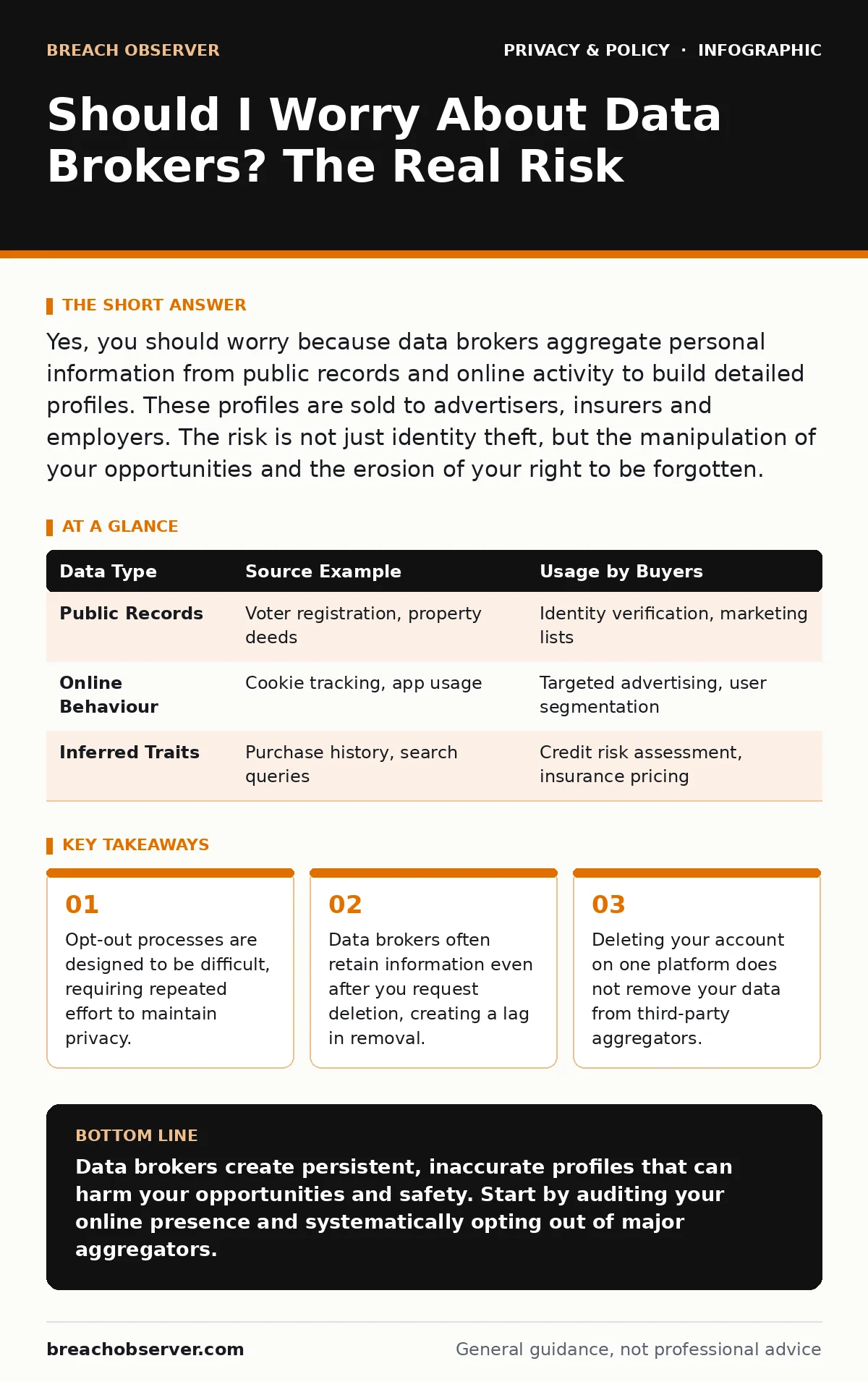
Yes, you should worry because data brokers aggregate personal information from public records and online activity to build detailed profiles. These profiles are sold to advertisers, insurers and employers. The risk is not just identity theft, but the manipulation of your opportunities and the erosion of your right to be forgotten.
Should I worry about data brokers?
Yes, you should worry about data brokers because they operate outside the direct relationship you have with the services you use. These companies collect data from public records, social media, purchase histories and device identifiers. They combine these fragments to create a comprehensive dossier on your life. This dossier is then sold to third parties who may use it for targeted advertising, credit scoring or background checks. The primary concern is the lack of transparency and the difficulty of controlling this distributed data.
What kind of data do they collect?
Data brokers collect both explicit and implicit information about your daily habits and preferences. Explicit data includes your name, address, phone number and date of birth, often sourced from public voter rolls or property records. Implicit data involves inferred attributes such as your political leanings, health conditions, financial status and family planning intentions. This inference happens through algorithms that analyse your browsing patterns, location history and purchase receipts. The result is a profile that knows you better than your neighbours do.
| Data Type | Source Example | Usage by Buyers |
|---|---|---|
| Public Records | Voter registration, property deeds | Identity verification, marketing lists |
| Online Behaviour | Cookie tracking, app usage | Targeted advertising, user segmentation |
| Inferred Traits | Purchase history, search queries | Credit risk assessment, insurance pricing |
How do data brokers make money?
Data brokers make money by selling access to their aggregated databases rather than individual records. They package data into lists based on specific criteria, such as "new parents in suburban areas" or "recent home buyers". Advertisers, political campaigns and financial institutions purchase these lists to target their messages or assess risk. The business model relies on the volume and freshness of the data. The more accurately they can predict your behaviour, the more valuable their product becomes to buyers seeking to maximise conversion rates.
Can I opt out of data broker sales?
You can opt out of data broker sales, but the process is fragmented and labour-intensive. Each broker maintains its own opt-out portal, often requiring you to submit proof of identity and wait for confirmation. Some jurisdictions, like those covered by the California Consumer Privacy Act (CCPA), mandate easier opt-out mechanisms, but global coverage is inconsistent. Even after opting out, brokers may re-collect your data if you interact with their partners again. The effort required to maintain privacy is a significant hidden cost for individuals.
Why is opt-out not enough?
Opt-out is not enough because data brokers often share information with each other, creating a redundant network. When you remove your data from one broker, another broker may already possess a copy or receive it from a new source. Additionally, some brokers do not distinguish between opt-out requests and general data deletions, leading to incomplete removal. The lack of a central registry means you must chase each entity individually. This decentralisation ensures that your digital shadow persists even after active removal efforts.
See also: What is CCPA request: rights, process and business impact · Employee Data Breaches: How Insider Access Compromises Your Organisation
What are the risks of exposure?
The risks of exposure extend beyond simple privacy invasion to tangible harms in your personal and professional life. Detailed profiles can be used to discriminate in hiring, lending or insurance decisions. If a broker incorrectly infers a health condition or financial instability, you may face higher premiums or denied applications. Furthermore, leaked databases from brokers can expose sensitive information such as home addresses and family details, increasing the risk of physical stalking or harassment. The permanence of this data means errors or outdated information can affect you for years.
How do regulations like GDPR help?
Regulations like GDPR help by granting individuals the right to access, correct and delete their personal data held by brokers. The General Data Protection Regulation requires companies to have a lawful basis for processing data, which often excludes covert aggregation. It also mandates transparency, forcing brokers to disclose what data they hold and how it is used. However, enforcement varies by region, and many brokers operate in jurisdictions with weaker protections. Compliance is often minimal, relying on individuals to exercise their rights proactively.
What technical measures reduce exposure?
Technical measures reduce exposure by limiting the initial collection of your data. Using privacy-focused browsers and disabling third-party cookies prevents many tracking scripts from building your profile. Virtual Private Networks (VPNs) hide your IP address, making it harder to link online activity to your physical location. However, brokers also use device fingerprinting, which identifies you based on your browser configuration and screen resolution. To counter this, you may need to standardise your browser settings across devices. Understanding browser fingerprinting is key to recognising that anonymity is not absolute.
How to manage your digital footprint long-term?
Managing your digital footprint long-term requires a systematic approach to data minimisation. Regularly audit your online accounts and remove unnecessary permissions. Use unique email addresses for different services to prevent correlation of your activities. Consider using privacy by design principles when choosing new tools, prioritising those that do not sell user data. Finally, stay informed about changes in privacy laws and broker practices. The landscape of data collection evolves rapidly, requiring continuous adaptation to maintain control over your personal information.
Key takeaways
- Opt-out processes are designed to be difficult, requiring repeated effort to maintain privacy.
- Data brokers often retain information even after you request deletion, creating a lag in removal.
- Deleting your account on one platform does not remove your data from third-party aggregators.
Data brokers create persistent, inaccurate profiles that can harm your opportunities and safety. Start by auditing your online presence and systematically opting out of major aggregators.
Frequently asked questions
Do data brokers sell my data to criminals?
Data brokers typically sell data to legitimate businesses, but breaches of their databases can expose this information to criminals. The risk lies in the security of the broker's infrastructure, not their primary business model.
Can data brokers track me if I use incognito mode?
Incognito mode prevents local storage of history but does not hide your IP address or prevent server-side tracking. Brokers can still collect data through network-level identifiers and device fingerprinting techniques.
Is my biometric data sold by data brokers?
Biometric data is rarely sold directly by traditional brokers due to its sensitivity and regulatory restrictions. However, if leaked from other services, it can be aggregated into broader profiles, increasing the severity of potential breaches.
How do parental controls help with data brokers?
Parental controls can limit the data children share online, reducing the initial collection of their profiles. This is crucial as children's data is often more vulnerable and subject to stricter legal protections in many regions.
How this guide was produced: written by the Breach Observer editorial team with AI assistance, checked against the public references listed below, and reviewed when the facts change. See our editorial policy or report an error.