
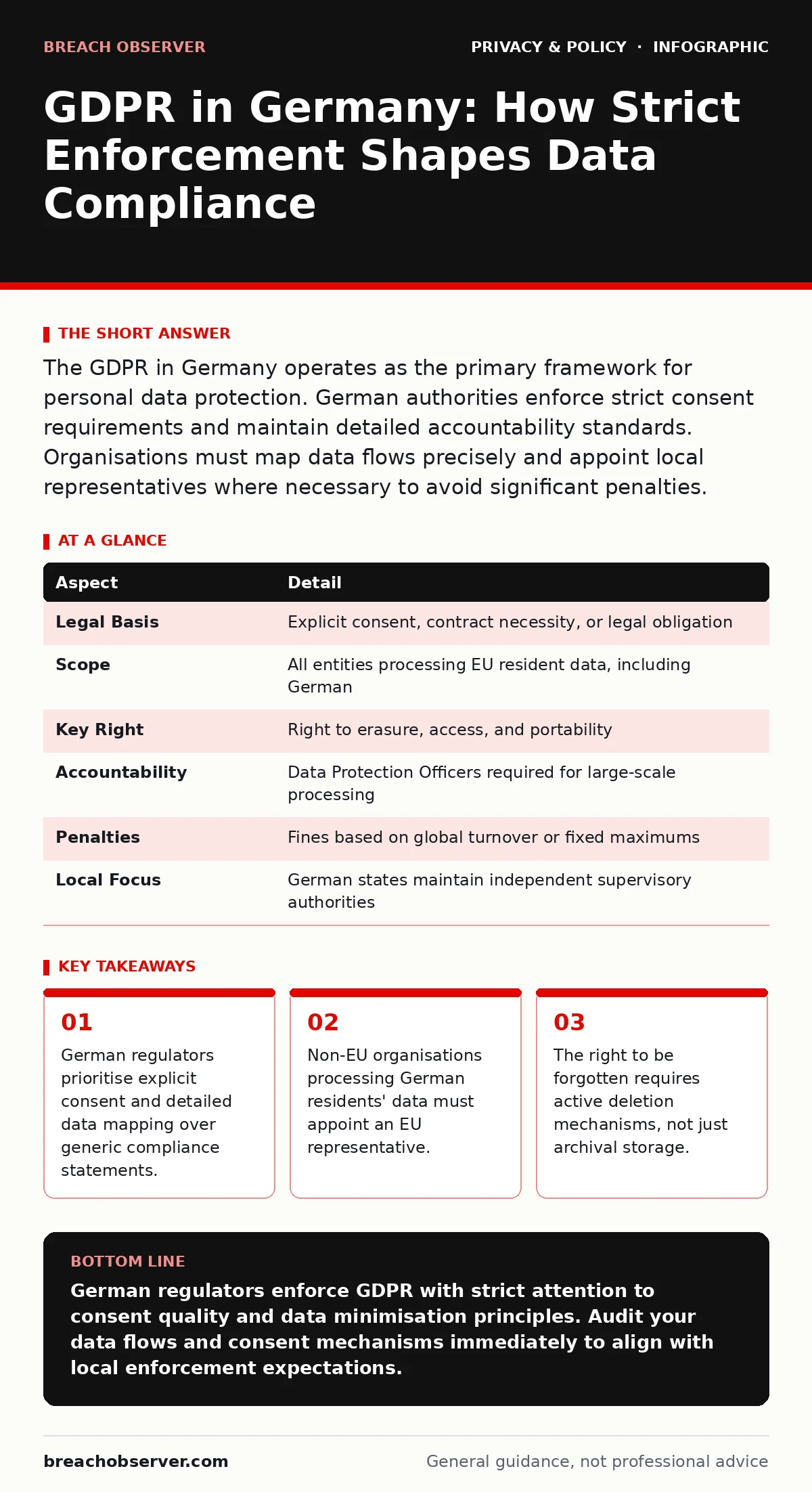
The GDPR in Germany operates as the primary framework for personal data protection. German authorities enforce strict consent requirements and maintain detailed accountability standards. Organisations must map data flows precisely and appoint local representatives where necessary to avoid significant penalties.
Everyday Analogy: The Digital Lease Agreement
Imagine renting an apartment. The landlord cannot enter your room without notice, nor can they show your belongings to neighbours. You control who visits and what stays in your space. The General Data Protection Regulation functions similarly for digital information. Your data belongs to you. Organisations holding it are merely tenants. They must prove they have permission to store it, explain exactly why they keep it, and return or destroy it when you move out. This analogy clarifies why consent matters. It is not a marketing tool. It is a legal boundary.
At a Glance: Core Requirements
| Aspect | Detail |
|---|---|
| Legal Basis | Explicit consent, contract necessity, or legal obligation |
| Scope | All entities processing EU resident data, including German |
| Key Right | Right to erasure, access, and portability |
| Accountability | Data Protection Officers required for large-scale processing |
| Penalties | Fines based on global turnover or fixed maximums |
| Local Focus | German states maintain independent supervisory authorities |
How the GDPR in Germany Works
The GDPR in Germany applies strict standards to how personal information is collected, stored, and shared. German authorities interpret the regulation with particular attention to consent quality. Pre-ticked boxes are invalid. Silence is not agreement. You must take a clear affirmative action to agree to data processing. This means clicking an unchecked box or toggling a switch. Bundling consent for multiple purposes into one click is prohibited. Each purpose requires separate permission.
Organisations must maintain a record of processing activities. This document details what data is held, why it is held, and who receives it. German regulators frequently audit these records during inspections. They look for gaps between stated purposes and actual usage. If you collect email addresses for newsletters, you cannot use them for market research without new consent. The burden of proof lies with the data controller. You must demonstrate compliance, not just claim it.
German law also emphasises data minimisation. Collecting only what is strictly necessary reduces risk. Storing extra data creates liability. If you ask for a phone number but do not need it for service delivery, you should not collect it. This principle applies to every field on a form. Every cookie on a website. Every log entry in a server. Less data means less exposure. It also simplifies compliance audits.
Who Is Affected by German Enforcement
Any organisation processing personal data of individuals in Germany falls under this framework. This includes German companies, EU-based firms, and non-EU entities. If you sell products to German residents, you are subject to these rules. If you track visitors from Germany via online tracking cookies, you must comply. The location of your servers is irrelevant. The location of the data subject is what matters.
Non-EU organisations without an establishment in the EU must appoint a representative in one of the member states. For German residents, this often means appointing a representative in Germany. This representative acts as a contact point for regulators and data subjects. They do not assume liability but facilitate communication. Failure to appoint one is a separate violation. It can result in immediate fines before any data breach occurs.
Public sector bodies in Germany face additional scrutiny. State-level supervisory authorities operate independently. Each German state has its own data protection commissioner. They may issue specific guidelines that refine GDPR requirements. For example, some states have stricter rules on employee monitoring. Organisations must check both federal and state-level expectations. Ignoring local nuances leads to compliance failures.
What To Do About Compliance
Start by mapping your data flows. Identify every point where personal data enters your systems. Note where it moves internally and where it leaves. Determine the legal basis for each processing activity. If consent is the basis, ensure your consent mechanisms meet German standards. Separate consent for different purposes. Provide clear withdrawal options. Make withdrawing consent as easy as giving it.
Appoint a Data Protection Officer if required. This is mandatory for public authorities, large-scale systematic monitoring, or large-scale processing of special category data. The DPO must have expert knowledge of data protection law. They must report directly to the highest management level. They cannot hold conflicting roles, such as Head of Marketing. Independence is key to effective oversight.
Review your privacy policies regularly. They must be transparent, concise, and written in plain language. Avoid legal jargon. Explain who you are, why you process data, and how long you keep it. Link to detailed information where necessary, but keep the main summary accessible. Regular updates reflect changes in processing activities. Outdated policies erode trust and invite scrutiny.
See also: Data Exfiltration: How Attackers Steal Information and How to Stop It
Common Misconceptions About German GDPR
Many organisations believe that complying with the GDPR automatically satisfies all local requirements. This is incorrect. German states may impose additional rules. For instance, some states require specific consent for employee video surveillance. Others have stricter guidelines on data retention periods. Ignoring these local variations exposes you to enforcement actions. Compliance is not a one-size-fits-all process. It requires local adaptation.
Another common error is assuming that anonymised data is outside the scope. True anonymisation removes all possibility of re-identification. If you can reverse the process, even with extra effort, the data remains personal. German regulators are skilled at assessing re-identification risks. They look at the combination of datasets, not just single records. Aggregating data does not guarantee safety. You must test anonymisation techniques rigorously.
Some teams think that deleting data upon request is sufficient. The right to be forgotten requires more than just removing records from active databases. You must also purge backups, logs, and third-party copies. If you share data with processors, you must ensure they delete it too. Documenting this deletion is part of accountability. Simply saying "we deleted it" is not enough. You must prove it. This often requires technical adjustments to backup retention policies.
Related Privacy Frameworks
Understanding the GDPR in Germany helps contextualise other privacy regulations. The California Consumer Privacy Act shares similarities but differs in enforcement mechanisms and consumer rights. Cross-border data transfers require specific safeguards when moving data outside the EU. These mechanisms ensure equivalent protection levels. Ignoring transfer rules can invalidate your compliance efforts.
The right to be forgotten is a core GDPR principle, but its application varies. In Germany, it intersects with public interest exceptions. Historical data or journalistic content may be exempt. Children's online privacy risks require heightened protections. Organisations targeting minors must implement additional safeguards. Facial recognition risks are particularly sensitive in Germany. Many public spaces restrict its use due to privacy concerns.
Encrypted messaging apps offer strong protection for communications. However, metadata may still be subject to processing rules. Privacy policies must clearly explain what metadata is collected and why. Transparency builds trust. It also reduces the likelihood of complaints. Regular audits ensure that your practices align with your stated policies. Discrepancies between policy and practice are a primary trigger for investigations.
Bottom Line for Operations
The GDPR in Germany demands precision, not just presence. You must demonstrate control over every piece of personal data you handle. Document your processes. Validate your consent mechanisms. Keep your records accurate.
Review your data mapping quarterly. Verify that your consent tools meet current standards. Ensure your third-party processors sign updated data processing agreements.
Key takeaways
- German regulators prioritise explicit consent and detailed data mapping over generic compliance statements.
- Non-EU organisations processing German residents' data must appoint an EU representative.
- The right to be forgotten requires active deletion mechanisms, not just archival storage.
German regulators enforce GDPR with strict attention to consent quality and data minimisation principles. Audit your data flows and consent mechanisms immediately to align with local enforcement expectations.
Frequently asked questions
Does GDPR apply to small businesses in Germany?
Yes, GDPR applies to all organisations processing personal data, regardless of size. Small businesses must still comply with core principles like consent and data security. Exemptions are limited and specific to certain administrative tasks.
Do I need a Data Protection Officer?
You need a DPO if you are a public authority, process large amounts of special category data, or engage in large-scale systematic monitoring. Many German companies appoint one voluntarily to ensure compliance.
How long must I keep consent records?
You must keep consent records as long as the data is processed. This proves the legal basis for processing. When data is deleted, consent records can also be removed, provided no legal retention obligation exists.
How this guide was produced: written by the Breach Observer editorial team with AI assistance, checked against the public references listed below, and reviewed when the facts change. See our editorial policy or report an error.