
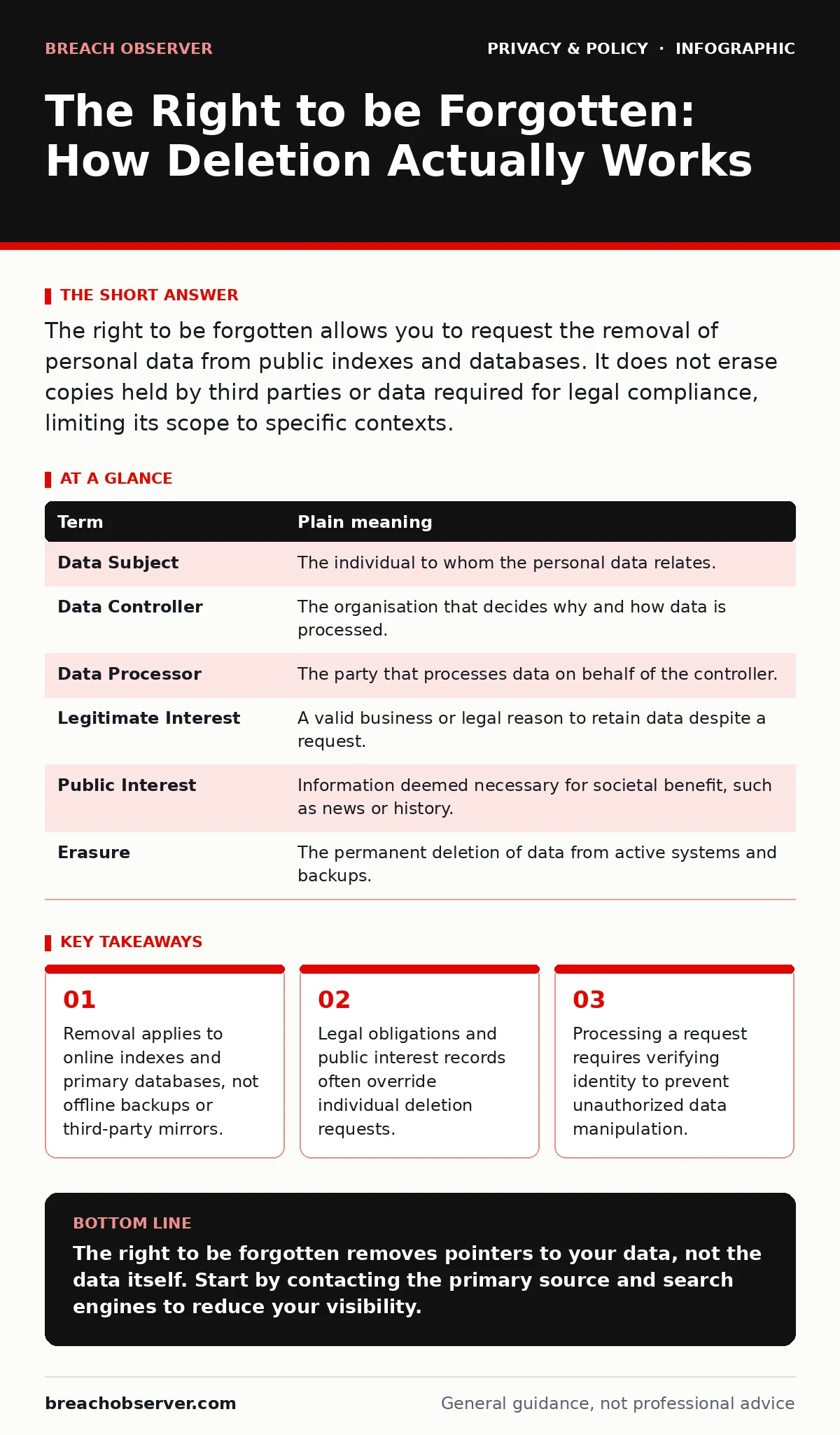
The right to be forgotten allows you to request the removal of personal data from public indexes and databases. It does not erase copies held by third parties or data required for legal compliance, limiting its scope to specific contexts.
The Library Index Analogy
Imagine a vast public library. The catalogue card is like a search engine result. It tells people where to find a book, but it is not the book itself. When you exercise your right to be forgotten, you are asking the librarian to destroy the catalogue entry. The book may still exist on the shelf, in another library, or in someone’s personal collection. Removing the pointer does not remove the content.
This distinction is vital for managing expectations. You are removing the path to the data, not the data itself. This mechanism reduces visibility rather than achieving total erasure. Understanding this limits frustration when you find your information persisting elsewhere.
Key Terms Defined
| Term | Plain meaning |
|---|---|
| Data Subject | The individual to whom the personal data relates. |
| Data Controller | The organisation that decides why and how data is processed. |
| Data Processor | The party that processes data on behalf of the controller. |
| Legitimate Interest | A valid business or legal reason to retain data despite a request. |
| Public Interest | Information deemed necessary for societal benefit, such as news or history. |
| Erasure | The permanent deletion of data from active systems and backups. |
The Scope of Deletion
The right to be forgotten applies primarily to online indexes and public databases. It does not grant the power to rewrite history or remove information from physical records. If a newspaper published an article years ago, that physical copy remains. However, the digital link to that article can be delisted.
Search engines are often the first line of defence. They act as the index. When they remove a link, the source page may still be live. This creates a gap between visibility and existence. You must distinguish between being unseen and being gone.
Common Points of Confusion
Many believe this right allows them to remove any mention of their name from the internet. This is incorrect. The right balances privacy against freedom of expression. If the data is accurate and relevant to a public debate, it may stay.
Another confusion involves third-party data brokers. These companies collect data from public sources and resell it. They are separate entities from the original publisher. You must request deletion from each broker individually. There is no single switch to turn off all data collection.
The Verification Bottleneck
Before any data is removed, the controller must verify your identity. This step prevents malicious actors from deleting data about others. It creates a paradox: to prove who you are, you often must provide personal data.
This verification process can be slow. Manual reviews are common. Automated systems struggle to distinguish between a legitimate request and a fraudulent one. Delays are frequent. You should expect a waiting period of several weeks for a response.
See also: What is CCPA request: rights, process and business impact · Employee Data Breaches: How Insider Access Compromises Your Organisation
Exceptions and Legal Retention
Not all data can be deleted. Financial records, tax information, and certain criminal records have statutory retention periods. These laws override privacy requests. The controller must keep the data for audit or legal reasons.
Journalistic freedom also provides an exception. Historical records and news archives are often protected. The public interest in accurate history outweighs individual privacy in these cases. You cannot force the deletion of factual, public interest content.
Try This Now
- Identify the primary source of the data. Contact the original publisher first. Request deletion from their privacy portal or via email.
- Submit a de-listing request to major search engines. Use their specific forms for personal data removal. Include proof of identity if required.
- Monitor the results. Check for cached versions and third-party mirrors. Repeat the process with any new aggregators that appear.
The Limits of Anonymity
Removing your name from public indexes does not make you invisible. Data brokers and analytics firms still track behaviour. They use identifiers like cookies and device fingerprints. These methods bypass name-based deletion requests.
For deeper protection, you must look beyond simple deletion. Understanding how data flows helps you manage exposure. Reading about online anonymity can provide strategies for reducing your digital footprint further. Similarly, privacy policies often detail how data is shared with partners, revealing hidden exposure points.
Key takeaways
- Removal applies to online indexes and primary databases, not offline backups or third-party mirrors.
- Legal obligations and public interest records often override individual deletion requests.
- Processing a request requires verifying identity to prevent unauthorized data manipulation.
The right to be forgotten removes pointers to your data, not the data itself. Start by contacting the primary source and search engines to reduce your visibility.
Frequently asked questions
Can I force a website to delete a negative review?
No, if the review is factual and not defamatory, the site can refuse deletion based on freedom of expression and legitimacy.
Does this right apply outside Europe?
No, it is specific to EU law, though some regions have similar but weaker provisions for data deletion.
What if the company ignores my request?
You can escalate the complaint to your local data protection authority, which can investigate and impose fines.
How long does the process take?
Controllers typically have one month to respond, though complex cases may extend this period by two additional months.
How this guide was produced: written by the Breach Observer editorial team with AI assistance, checked against the public references listed below, and reviewed when the facts change. See our editorial policy or report an error.