
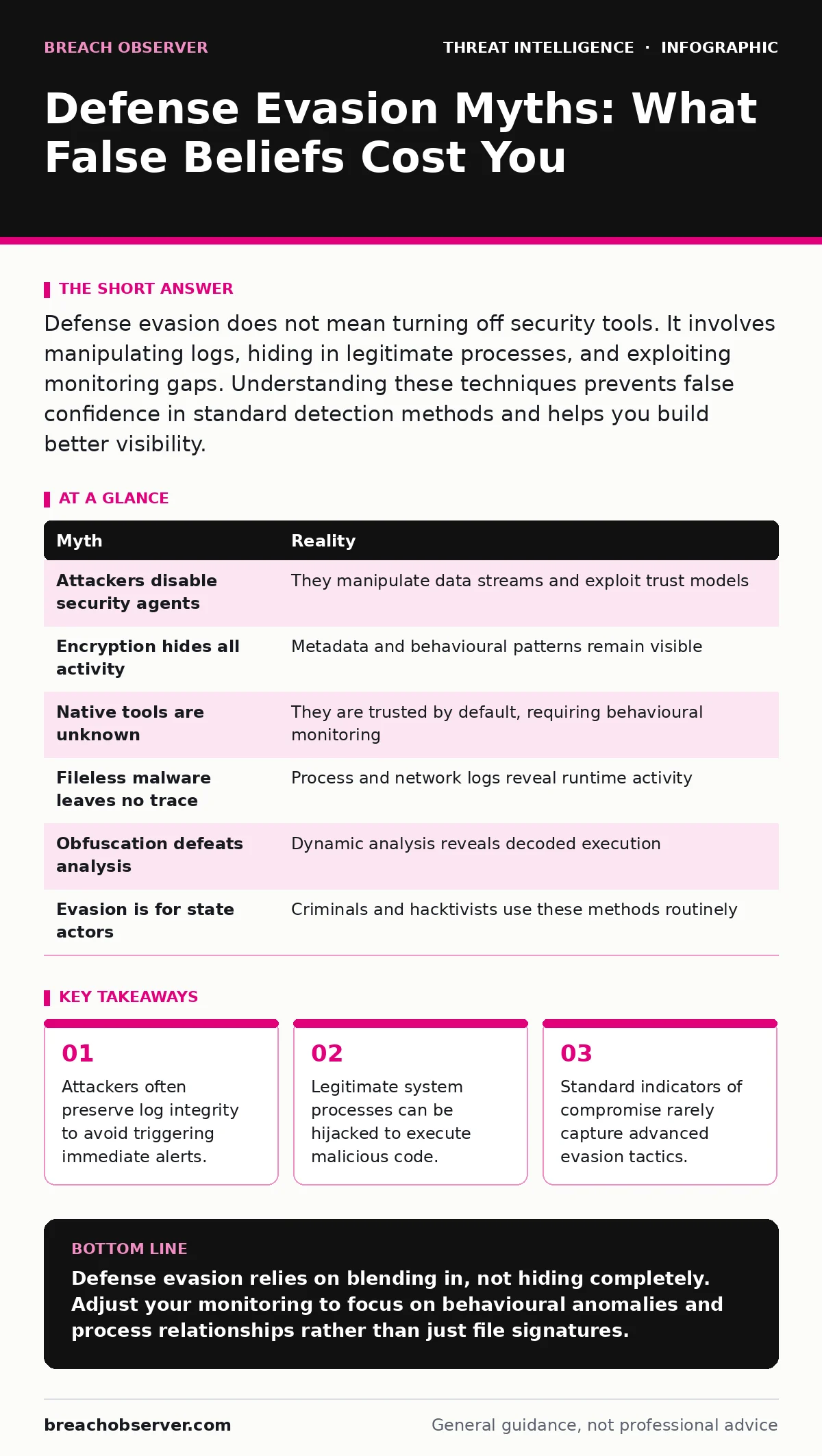
Defense evasion does not mean turning off security tools. It involves manipulating logs, hiding in legitimate processes, and exploiting monitoring gaps. Understanding these techniques prevents false confidence in standard detection methods and helps you build better visibility.
Myth: Attackers Always Disable Security Agents
Reality: Disabling security software creates immediate noise that skilled operators avoid. Most modern endpoints have heartbeat mechanisms that alert central servers when an agent stops communicating. If you assume evasion means silence, you will miss activity that looks normal but is actually malicious.
Imagine an operator who carefully preserves the integrity of your logging infrastructure. They do not want to trigger a "service stopped" alert. Instead, they inject their commands into existing processes. This technique, known as process injection, allows malicious code to run within the memory of a trusted application. The security agent sees a legitimate process, such as a web browser or system service, and records it as benign. The malicious activity remains hidden inside the legitimate container, bypassing signature-based detection entirely.
This approach requires understanding the internal structure of the operating system. It is not about breaking the tool; it is about using the tool’s trust model against it. When you rely solely on the presence of an active agent, you create a false sense of security. The agent is running, but it is being fed false information by the compromised process.
Myth: Encryption Means No Visibility Into Traffic
Reality: You do not need to decrypt traffic to detect anomalies. While encryption hides the payload, it does not hide the metadata. Network detection and response solutions analyse connection patterns, timing, and volume. Large data transfers to unusual destinations or connections at odd hours stand out regardless of the protocol used.
Suppose an attacker uses encrypted channels to exfiltrate data. The content is unreadable to your network sensors, but the behaviour is not. If a single workstation suddenly sends gigabytes of data to a server in a different geographic region, the pattern itself is the signal. This is where security telemetry becomes valuable. You are not looking for a specific file; you are looking for a deviation from the baseline behaviour of that host.
Many teams focus on decryption capabilities, believing they must read the content to find threats. This is a resource-heavy approach that often fails against modern protocols. Instead, focus on behavioural analytics. The structure of the communication, not its content, reveals the intent. Encryption protects privacy, but it does not protect against behavioural analysis.
Myth: Living Off the Land Tools Are Unknown to Defenders
Reality: These tools are native to the operating system, making them invisible to traditional signature scanners. Living off the land refers to using legitimate system utilities, such as PowerShell or Windows Management Instrumentation, to perform malicious tasks. Because these tools are signed by the vendor, they are trusted by default.
Imagine an operator using a standard scripting language to download a payload. The script is written in plain text and executed by a built-in interpreter. No external malware is downloaded. No new binary is created. The activity looks like routine system administration. This is why indicators of compromise are often useless here. The file hash is valid, and the digital signature is authentic.
To detect this, you must monitor command-line arguments and script block logging. You need to know what normal administrative tasks look like in your environment. If a user account that usually runs email clients suddenly executes complex system queries, that is the anomaly. The tool is not the threat; the context of its use is.
Myth: Fileless Malware Leaves No Trace
Reality: Fileless malware resides in memory, but it still interacts with the disk and network. These attacks do not write executable files to the hard drive, which bypasses traditional file integrity monitoring. However, they must still load libraries, make network connections, and modify system settings.
Suppose an attacker uses a script to download a malicious module directly into RAM. There is no file to scan. However, the process that hosts this module must open network sockets. It must allocate memory. These actions generate events in the system logs. If you only look for new files, you will miss the attack. You must look for process creation events that involve unusual parent-child relationships.
For example, a web browser spawning a command shell is rare in most environments. This parent-child relationship is a strong indicator of compromise. The absence of a file on disk does not mean the absence of evidence. It means the evidence is in the process tree and network logs, not in the file system.
Myth: Obfuscation Hides Code From All Analysis
Reality: Obfuscation makes code difficult for humans to read, but not for machines to analyse. Attackers often encode their payloads or use complex variable names to bypass static analysis. However, dynamic analysis can reveal the true intent. When the code runs, it must eventually decode itself to execute.
Imagine a script that uses multiple layers of encoding. A static scan might not recognise the malicious pattern. But when the script executes, it must decode the payload in memory. This decoding process creates specific memory writes and API calls. These runtime behaviours are consistent, regardless of how the code is obfuscated.
Relying on static signatures is insufficient for obfuscated threats. You need behavioural monitoring that watches what the code does, not what it looks like. The obfuscation layer is stripped away during execution, revealing the underlying malicious actions.
See also: Threat Actors in Cybersecurity: Tactics, Profiles and Detection Strategies
Myth: Defense Evasion Is Only Used by State Actors
Reality: Criminal groups and hacktivism cells use these techniques extensively. The tools and methods are widely available in open-source repositories. Any operator with basic technical skills can use living off the land tools and process injection.
Suppose a ransomware group uses standard system tools to move laterally within a network. They do not need custom malware. They use built-in features to disable backups and encrypt files. This is not sophisticated espionage; it is efficient criminal activity. The Diamond Model of intrusion analysis shows that capability is not limited by resource level when leveraging existing system features.
Assuming evasion is reserved for high-end threats leads to gaps in your monitoring. You may ignore suspicious activity from low-level actors, believing they lack the sophistication to evade detection. This is a dangerous assumption. The barrier to entry for these techniques is low.
Summary of Myths and Realities
| Myth | Reality |
|---|---|
| Attackers disable security agents | They manipulate data streams and exploit trust models |
| Encryption hides all activity | Metadata and behavioural patterns remain visible |
| Native tools are unknown | They are trusted by default, requiring behavioural monitoring |
| Fileless malware leaves no trace | Process and network logs reveal runtime activity |
| Obfuscation defeats analysis | Dynamic analysis reveals decoded execution |
| Evasion is for state actors | Criminals and hacktivists use these methods routinely |
Key takeaways
- Attackers often preserve log integrity to avoid triggering immediate alerts.
- Legitimate system processes can be hijacked to execute malicious code.
- Standard indicators of compromise rarely capture advanced evasion tactics.
Defense evasion relies on blending in, not hiding completely. Adjust your monitoring to focus on behavioural anomalies and process relationships rather than just file signatures.
Frequently asked questions
How do I detect process injection without slowing down my systems?
Focus on high-fidelity events like process creation and module loading. Use sampling techniques for lower-risk events to balance performance and visibility.
Are native scripts like PowerShell always malicious?
No. They are standard administration tools. Context matters. Look for unusual parent processes, complex command-line arguments, or execution during non-business hours.
Does network scanning help with defense evasion?
Network scanning identifies assets and open ports, which helps define your baseline. It does not detect evasion directly but supports the context needed for behavioural analysis.
Can I rely on threat actor naming conventions to predict tactics?
Naming conventions help track groups, but tactics evolve. Focus on the techniques used, such as those described in public frameworks, rather than the group identity.
How this guide was produced: written by the Breach Observer editorial team with AI assistance, checked against the public references listed below, and reviewed when the facts change. See our editorial policy or report an error.