
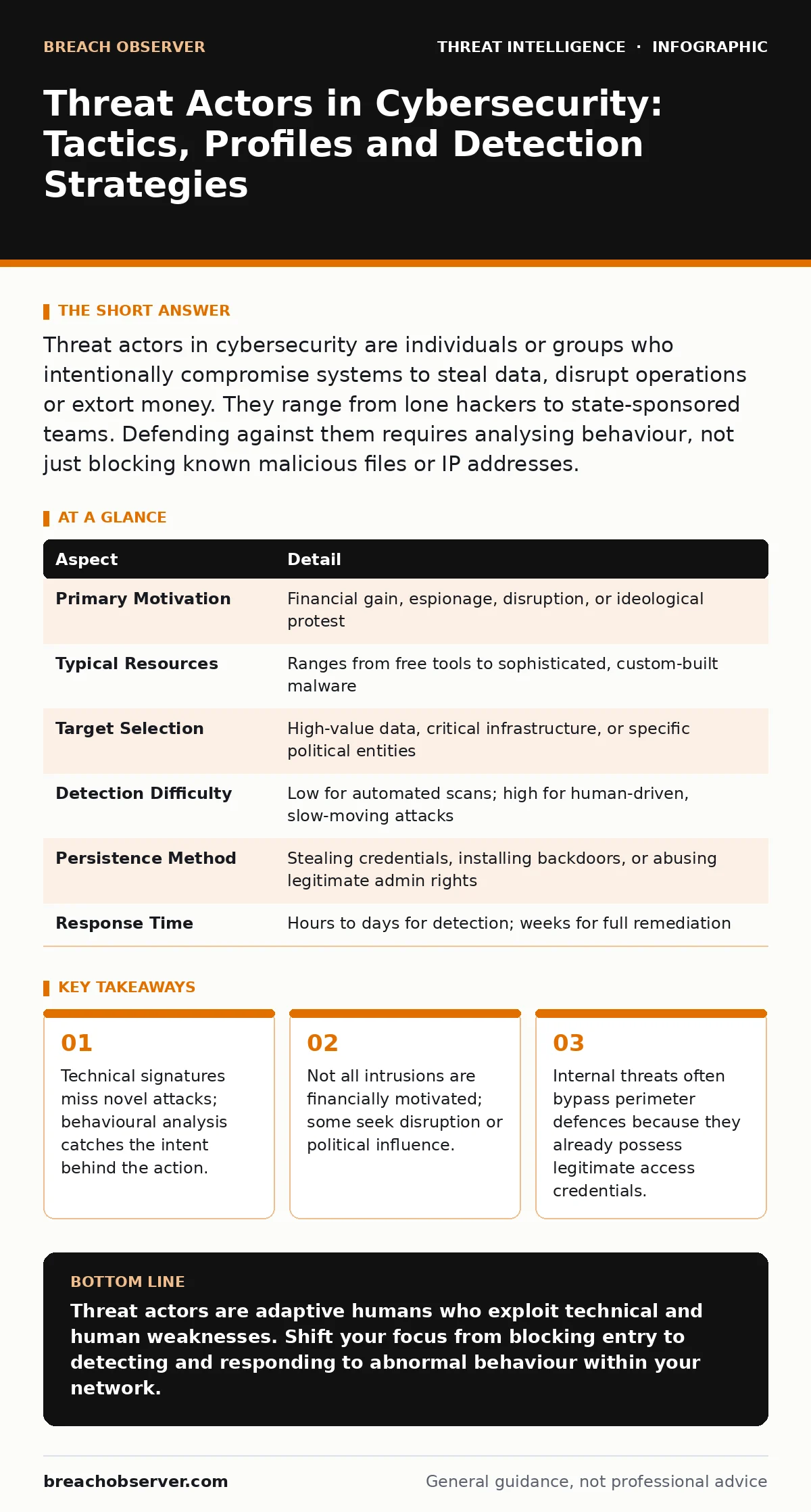
Threat actors in cybersecurity are individuals or groups who intentionally compromise systems to steal data, disrupt operations or extort money. They range from lone hackers to state-sponsored teams. Defending against them requires analysing behaviour, not just blocking known malicious files or IP addresses.
Why the Human Element Matters in Cyber Intrusions
Imagine a burglar who leaves the front door unlocked after entering. Most security systems assume the threat comes from outside the walls. Cybersecurity often makes the same mistake. You focus on firewalls and antivirus software, assuming the enemy is external. This mindset leaves you blind to the reality of threat actors in cybersecurity. These are not faceless viruses. They are people with goals, constraints and methods.
The term defines any entity that initiates an attack. This includes criminal syndicates, state intelligence agencies, disgruntled employees and political activists. Each group has different resources and objectives. A criminal group wants money. A state actor wants secrets or disruption. An activist wants attention. Your defence strategy changes completely depending on who you are facing. You cannot block a determined human with a static list of bad IP addresses. They will simply use a new one.
You must shift from preventing entry to detecting presence. This approach acknowledges that breaches will happen. The goal becomes limiting damage and expelling the intruder quickly. This requires understanding the tactics used by these groups. You need to know how they move laterally and how they hide. This knowledge forms the basis of strategic threat intelligence.
At a Glance: Threat Actor Profiles
| Aspect | Detail |
|---|---|
| Primary Motivation | Financial gain, espionage, disruption, or ideological protest |
| Typical Resources | Ranges from free tools to sophisticated, custom-built malware |
| Target Selection | High-value data, critical infrastructure, or specific political entities |
| Detection Difficulty | Low for automated scans; high for human-driven, slow-moving attacks |
| Persistence Method | Stealing credentials, installing backdoors, or abusing legitimate admin rights |
| Response Time | Hours to days for detection; weeks for full remediation |
How Adversaries Operate Inside Your Network
Threat actors follow a structured process. They do not guess randomly. They reconnoitre, exploit, install, command and exfiltrate. This lifecycle is standard across most attacks. The initial access often comes from a phishing email or a vulnerable remote service. Once inside, they need to maintain access. This is where defense evasion techniques come into play.
They delete logs to hide their tracks. They use legitimate system tools to look like normal activity. This is known as living off the land. For example, an attacker might use PowerShell to scan your network. This tool is part of Windows. Your antivirus software trusts it. The attacker relies on this trust to move unseen. They steal credentials to access other systems. This is often done via pass-the-hash attacks, where they reuse captured password hashes instead of cracking the passwords.
You cannot stop this by blocking every unknown program. You must monitor for unusual behaviour. A server contacting a web server at 3am is suspicious. A user downloading terabytes of data is abnormal. You need user and entity behavior analytics to spot these deviations. This technology learns what is normal for your environment. It flags actions that break the pattern. This is how you catch actors who use clean tools.
Who Bears the Risk of Intrusion
Every organisation with data is a target. Small businesses often believe they are too small to matter. This is a dangerous assumption. Criminal groups automate their attacks. They scan the entire internet for vulnerabilities. If your system has a flaw, they will exploit it. They do not care about your industry. They care about your connectivity.
Large enterprises face targeted attacks. State-sponsored groups focus on specific sectors like energy, healthcare or finance. These actors have unlimited resources. They can wait months for the right moment. They often target your supply chain. If your vendor is compromised, you are compromised. This indirect path is hard to defend against. You must verify the security posture of your partners.
Individuals are also affected. Identity theft and ransomware target personal devices. These attacks disrupt daily life and cause financial loss. The methods are the same as corporate attacks, just on a smaller scale. The difference is the scale of impact. A corporate breach affects thousands. A personal breach affects one family. Both require the same defensive principles: patching, updates and awareness.
Common Misconceptions About Cyber Threats
People usually get wrong the nature of the threat. They think a firewall is enough. It is not. Firewalls block unwanted traffic from outside. They do not stop an employee from emailing a file to themselves. They do not stop a compromised account from accessing internal resources. You need internal segmentation. This limits how far an attacker can move once inside.
Another mistake is assuming all malware is bad. Some tools are neutral. Hackers use standard administrative tools to attack. Blocking these tools breaks your business. You must monitor their use, not block them entirely. This is a key concept in detection engineering. You build rules that catch the abuse of good tools. You do not ban the tools themselves.
You might also think that encryption solves everything. It protects data at rest and in transit. It does not prevent an attacker from accessing the system while it is running. If they steal the encryption key, the data is useless to you. They can also encrypt your files for ransom. Encryption is a last line of defence, not a primary shield.
See also: What Is Threat Intelligence: How Data Becomes Defence
Practical Steps for Improved Detection
Start by mapping your crown jewels. Identify what data is most valuable. Protect these assets with stricter controls. Limit who can access them. Monitor all access attempts. This reduces the attack surface. It gives you fewer things to watch.
Implement multi-factor authentication everywhere. This stops stolen passwords from being useful. Even if a threat actor steals credentials, they cannot log in without the second factor. This blocks the most common initial access method. It is simple and highly effective.
Review your logs regularly. Most organisations collect logs but never read them. You need to analyse them for anomalies. Look for failed login spikes. Look for off-hours activity. Set up alerts for these events. Do not wait for an incident to start looking. Use YARA rules to scan memory for known malware patterns. These rules allow you to detect threats that hide in running processes, not just on disk.
Understanding Motives and Naming Conventions
Knowing who attacks you helps you defend better. Threat actor naming conventions help track these groups. Researchers assign names based on tactics or origin. These names appear in reports. They help you correlate incidents. If you see a technique associated with a specific group, you can anticipate their next move.
Hacktivism is a distinct motive. These actors want to make a political statement. They often deface websites or leak data. They are less concerned with stealth. They want to be seen. Your defence against them is different. You need strong web application firewalls and rapid patching. You need to restore services quickly.
Financial criminals are different. They want to remain hidden. They move money quickly. They use complex networks of accounts. Your defence here is transaction monitoring. You need to spot unusual financial flows. You need to work with your bank to freeze accounts.
Building a Resilient Defence Posture
Resilience means recovering quickly. Assume you will be breached. Plan for it. Have backups that are offline. If ransomware encrypts your live systems, you can restore from backup. Test these backups regularly. Ensure they are clean and complete.
Train your staff. Humans are the first line of defence. They open the emails. They click the links. They need to recognise social engineering. Teach them to verify requests. Teach them to report suspicious activity. Create a culture of security. Make it easy to report mistakes.
Update your systems. Patch vulnerabilities. This closes the doors attackers use to enter. Automate this process where possible. Manual patching is slow and error-prone. Keep your software current. Old software has known flaws. Attackers exploit these flaws automatically.
Key takeaways
- Technical signatures miss novel attacks; behavioural analysis catches the intent behind the action.
- Not all intrusions are financially motivated; some seek disruption or political influence.
- Internal threats often bypass perimeter defences because they already possess legitimate access credentials.
Threat actors are adaptive humans who exploit technical and human weaknesses. Shift your focus from blocking entry to detecting and responding to abnormal behaviour within your network.
Frequently asked questions
How do I know if a threat actor is in my network?
Look for anomalies in user behaviour, unusual network traffic patterns and unexpected changes to system files. Standard tools may not catch them, so specialised monitoring is required.
Are threat actors only foreign entities?
No. Threat actors include domestic criminals, disgruntled employees and local hacktivists. The location of the actor is less relevant than their access and intent.
Can I stop all threat actors with a firewall?
No. Firewalls block external traffic but cannot stop insider threats or attacks that use legitimate protocols. You need layered defences including behavioural analysis.
What is the difference between a threat actor and a vulnerability?
A vulnerability is a weakness in your system. A threat actor is the entity that exploits that weakness to cause harm. One is a condition; the other is an agent.
How this guide was produced: written by the Breach Observer editorial team with AI assistance, checked against the public references listed below, and reviewed when the facts change. See our editorial policy or report an error.