
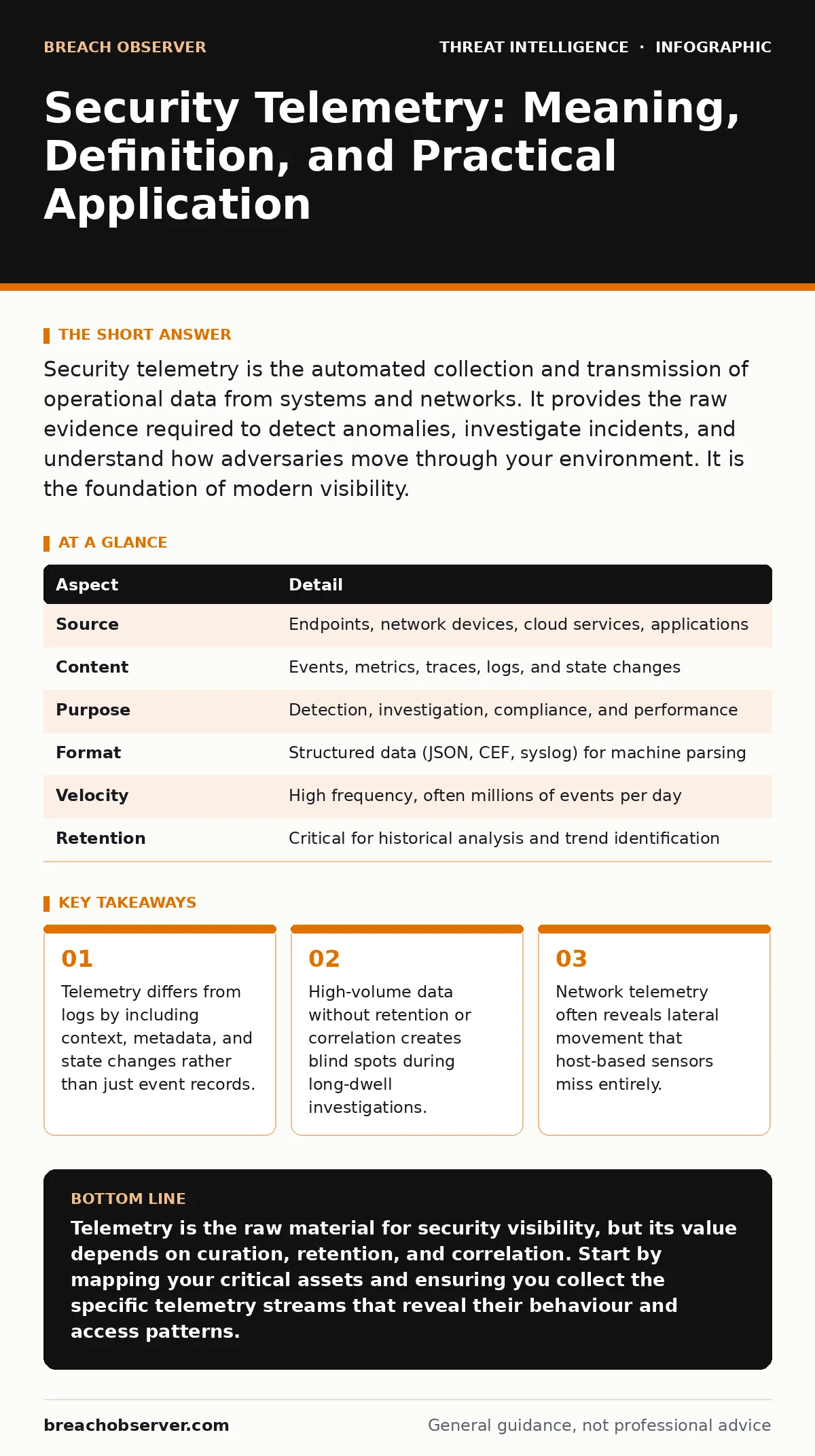
Security telemetry is the automated collection and transmission of operational data from systems and networks. It provides the raw evidence required to detect anomalies, investigate incidents, and understand how adversaries move through your environment. It is the foundation of modern visibility.
The Radio Signal Analogy
Imagine a car driving on a highway. The dashboard shows the speed, fuel level, and engine temperature. If the car breaks down, the dashboard tells you what is wrong right now. Telemetry is like a black box that records every turn, every brake application, and every signal change, sending that data to a central station in real time.
This distinction matters in security. Logs are the dashboard: they show discrete events. Telemetry is the continuous stream of state data that reveals the journey. You cannot reconstruct a trip from a single speedometer reading. You need the sequence of events, the timestamps, and the context of where the vehicle was when the signal changed.
What Security Telemetry Actually Is
Security telemetry is the automated measurement and transmission of data from computing assets to a central analysis point. It captures the behaviour of users, processes, and network traffic. Unlike static configuration files, telemetry is dynamic. It changes as the system operates.
The term originates from remote measurement, used originally in rocketry and aviation. In cybersecurity, it has evolved to mean any data point that indicates the health or behaviour of a system. This includes process creation, file access, registry changes, and network connections.
| Aspect | Detail |
|---|---|
| Source | Endpoints, network devices, cloud services, applications |
| Content | Events, metrics, traces, logs, and state changes |
| Purpose | Detection, investigation, compliance, and performance |
| Format | Structured data (JSON, CEF, syslog) for machine parsing |
| Velocity | High frequency, often millions of events per day |
| Retention | Critical for historical analysis and trend identification |
Where Telemetry Comes From in Practice
Telemetry does not appear from nowhere. It is generated by the operating system, applications, and network infrastructure. When a user opens a file, the kernel records the action. When a server responds to a query, the web server logs the request. These are the raw inputs.
In practice, you collect this data from several layers. Host-based telemetry comes from agents installed on servers and workstations. These agents monitor process activity and file system changes. Network-based telemetry comes from packet captures or flow data. This shows how devices talk to each other, regardless of what is happening inside them.
Cloud environments provide their own telemetry streams. These include API calls, identity events, and storage access logs. Each source has blind spots. Host agents miss network-level lateral movement. Network sensors miss activity that happens entirely within a single machine, such as local privilege escalation. You need both to see the full picture.
How Teams Use Telemetry Day to Day
Security operations teams use telemetry to answer three questions: Is something wrong? What is it? How do we stop it? Detection rules parse telemetry to find known bad patterns. For example, a rule might alert if a process executes a script from a temporary folder. This is a common defense evasion technique.
Investigation relies on correlating multiple telemetry sources. If a user account logs in from an unusual location, you check the network telemetry to see where the connection originated. You then check host telemetry to see what that user did once inside. This correlation reduces false positives. A login from a new country is suspicious. A login from a new country that immediately runs a known malware binary is an incident.
Long-term analysis uses telemetry to establish baselines. You learn what normal traffic looks like. Deviations from this baseline trigger alerts. This is how you catch novel threats that do not match known signatures. Without historical telemetry, you have no baseline. You are flying blind.
What People Usually Get Wrong
Many teams confuse volume with visibility. Collecting every log possible is not the same as collecting useful telemetry. High-volume, low-context data creates noise. It overwhelms analysts and hides true signals. You must curate what you collect. Prioritise data that shows identity, action, and target.
Another common mistake is ignoring retention. Telemetry is only useful if you can look back. Attackers often dwell in environments for months before detection. If you delete telemetry after thirty days, you lose the trail. You cannot investigate what you do not keep. Retention policies must align with investigation needs, not just storage costs.
A third error is treating all telemetry as equal. Not all data sources provide the same insight. Network flow data is cheaper to collect than full packet captures. Endpoint telemetry is richer but more resource-intensive. You must balance cost, performance, and coverage. A threat intelligence program helps prioritise which sources matter most for your specific risk profile.
See also: Detecting Data Extortion: Signals in Logs, Systems and User Behaviour · Cyber Kill Chain Lockheed Martin: Stages, Weaknesses, and Defence
The Hidden Costs of Telemetry
Telemetry is not free. It consumes storage, bandwidth, and processing power. More importantly, it consumes analyst attention. Every alert generated from telemetry requires triage. If your rules are poorly tuned, you generate fatigue. Analysts stop looking at alerts. This is a hidden cost that erodes security posture over time.
There is also a privacy cost. Telemetry often contains personal data. You must handle this data with care. Anonymise where possible. Restrict access. Ensure compliance with data protection regulations. Failure to do so can lead to legal and reputational damage. The value of telemetry is diminished if you cannot trust its handling.
Integrating Telemetry with Analysis Frameworks
Telemetry becomes powerful when mapped to structured frameworks. The Diamond Model of intrusion analysis provides a way to organise telemetry into adversary, infrastructure, capability, and victim. This structure helps analysts see the bigger picture. It moves the focus from individual alerts to the campaign.
For instance, network telemetry might reveal the infrastructure used by an attacker. Host telemetry might reveal the capability, such as a specific exploit. Identity telemetry reveals the victim. By linking these, you can attribute activity to a specific threat actor naming conventions or group. This attribution helps predict future targets and tactics.
Telemetry also supports network detection and response by providing the context needed to automate containment. When a threat is confirmed, you can use telemetry to identify all affected hosts. You can then isolate them automatically. This reduces the time to remediate. Speed is critical in stopping the spread of an incident.
Beyond Basic Detection
Telemetry allows for proactive hunting. Instead of waiting for alerts, analysts query telemetry to find hidden threats. This is particularly useful against cyber espionage groups that operate slowly and quietly. They may not trigger standard alerts. Hunting uses telemetry to look for subtle anomalies, such as unusual DNS queries or rare process executions.
It also helps in understanding indicators of compromise in context. A file hash might be known to be malicious. But telemetry shows how it was delivered, who executed it, and what it did. This context turns a simple indicator into a rich intelligence product. It helps you understand the attack chain.
Key takeaways
- Telemetry differs from logs by including context, metadata, and state changes rather than just event records.
- High-volume data without retention or correlation creates blind spots during long-dwell investigations.
- Network telemetry often reveals lateral movement that host-based sensors miss entirely.
Telemetry is the raw material for security visibility, but its value depends on curation, retention, and correlation. Start by mapping your critical assets and ensuring you collect the specific telemetry streams that reveal their behaviour and access patterns.
Frequently asked questions
What is the difference between logs and telemetry?
Logs are discrete records of events, such as a login attempt. Telemetry is a broader term that includes logs, metrics, and traces, providing a continuous stream of state data and context.
How much telemetry data should we collect?
Collect enough to answer your detection and investigation requirements. Focus on high-fidelity data that shows identity, action, and target. Avoid collecting low-value noise that overwhelms analysts.
Can telemetry detect advanced persistent threats?
Yes, but only if you retain data long-term and use it for proactive hunting. APTs operate slowly and quietly, often evading standard signature-based detection. Telemetry allows you to find subtle anomalies over time.
Is network telemetry enough for detection?
No. Network telemetry misses activity that occurs entirely within a host, such as local privilege escalation or file encryption. You need host-based telemetry to complement network data for full visibility.
How this guide was produced: written by the Breach Observer editorial team with AI assistance, checked against the public references listed below, and reviewed when the facts change. See our editorial policy or report an error.