
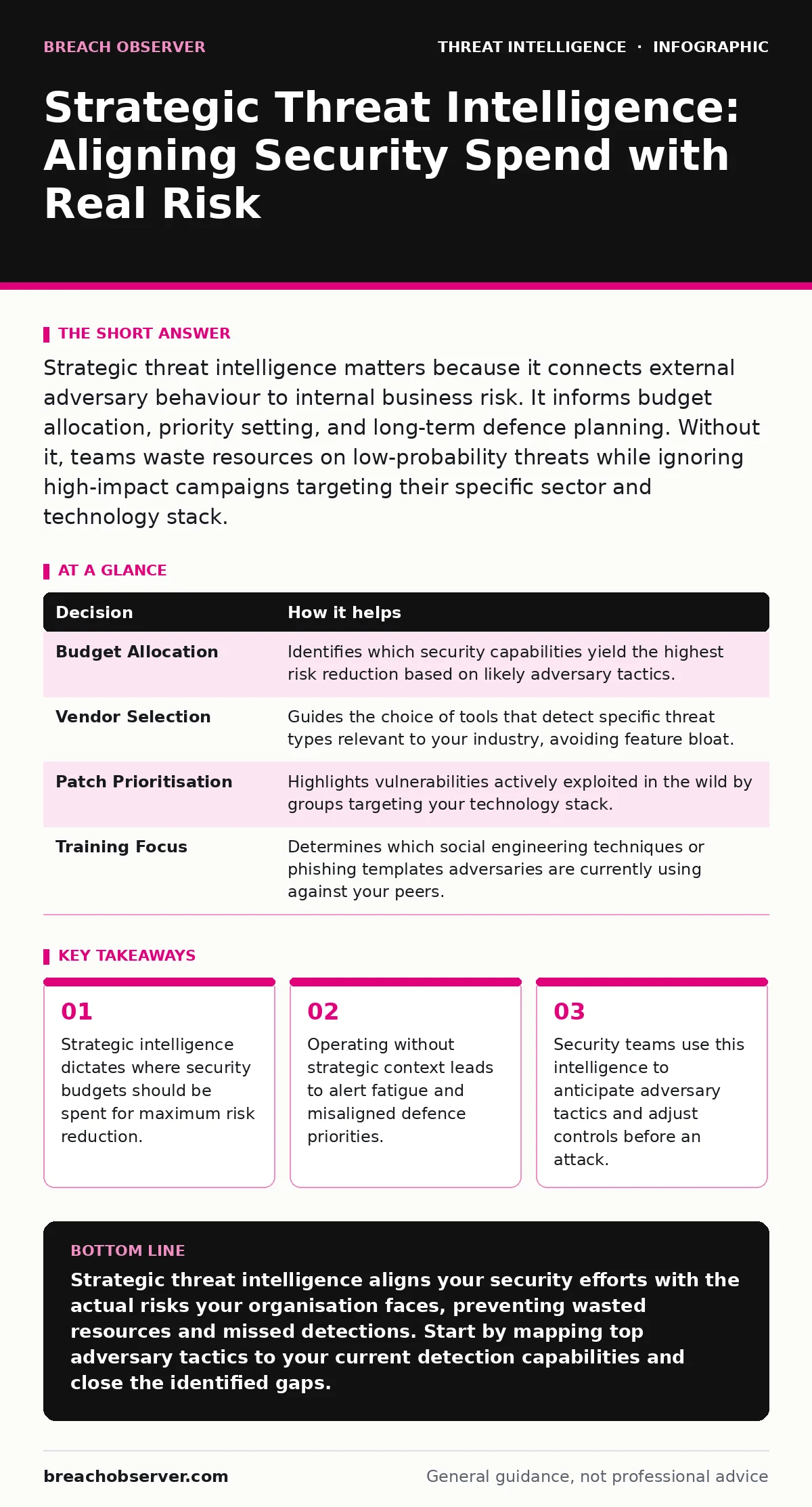
Strategic threat intelligence matters because it connects external adversary behaviour to internal business risk. It informs budget allocation, priority setting, and long-term defence planning. Without it, teams waste resources on low-probability threats while ignoring high-impact campaigns targeting their specific sector and technology stack.
The Gap Between Data and Decision
Technical security teams often drown in noise. They receive thousands of alerts daily regarding suspicious network activity or unusual login attempts. Most of these alerts are false positives or low-risk events. Without strategic context, you cannot distinguish between a curious scanner and a targeted adversary. Strategic threat intelligence provides that context. It translates raw data into actionable business risk. This translation allows you to align your security posture with the actual threats that matter to your organisation.
Imagine a security team monitoring a financial institution. They see an increase in login failures from a specific IP range. Without strategic intelligence, they might block the IP and move on. With strategic intelligence, they know a specific criminal group is targeting banking APIs using credential stuffing. They adjust their detection engineering to look for the specific API abuse pattern, not just the failed logins. This shift changes the outcome from a blocked IP to a prevented breach.
Decisions Informed by Strategic Context
Strategic intelligence does not tell you how to configure a firewall. It tells you why certain configurations matter more than others. It informs high-level decisions that shape your security programme for years. These decisions require understanding the motivation, capability, and resources of adversaries who target your sector. You use this understanding to prioritise which vulnerabilities to patch first and which controls to strengthen.
| Decision | How it helps |
|---|---|
| Budget Allocation | Identifies which security capabilities yield the highest risk reduction based on likely adversary tactics. |
| Vendor Selection | Guides the choice of tools that detect specific threat types relevant to your industry, avoiding feature bloat. |
| Patch Prioritisation | Highlights vulnerabilities actively exploited in the wild by groups targeting your technology stack. |
| Training Focus | Determines which social engineering techniques or phishing templates adversaries are currently using against your peers. |
The Cost of Ignoring Strategy
Operating without strategic intelligence creates a blind spot. Your team reacts to every alert with equal urgency. This approach exhausts your analysts and dilutes your focus. You might spend weeks investigating a benign anomaly while a sophisticated campaign targeting your specific software stack goes unnoticed. This misalignment occurs because you lack the map of the adversarial environment. You do not know who is hunting you, what they want, or how they operate.
Suppose a retail organisation ignores strategic intelligence about supply chain attacks. They focus heavily on endpoint protection, assuming that is their primary risk. Meanwhile, an adversary compromises a third-party logistics provider. The retailer’s robust endpoint controls do nothing to stop the breach because the attack vector was external and trusted. The lack of strategic foresight meant they did not monitor their supply chain partners for compromise indicators.
How Teams Operationalise Strategy
Security teams use strategic intelligence to tune their detection capabilities. They do not just read reports; they integrate insights into their security telemetry. Analysts map adversary tactics to their own environment. This mapping helps them understand if their current controls can detect the described behaviour. If a report mentions a new defence evasion technique, the team checks if their existing YARA rules or behavioural analytics can spot it.
This process requires collaboration between intelligence analysts and engineers. Intelligence analysts provide the narrative of the adversary. Engineers translate that narrative into technical checks. For example, if a group is known to use pass-the-hash attacks to move laterally, the engineering team ensures their identity logs capture the necessary data. They might update their incident response runbooks to include specific steps for containing credential-based lateral movement. This integration turns abstract threats into concrete detection logic.
Integrating with Operational Defences
Strategic intelligence must flow down to operational levels. It informs the creation of specific detection rules and monitoring policies. When you understand the broader campaign, you can look for subtle indicators that would otherwise seem normal. For instance, a single failed login is harmless. A pattern of failed logins followed by a successful login from a new country, aligned with a known adversary’s origin, is suspicious. This context comes from strategic intelligence.
Teams also use this intelligence to validate their security telemetry. If your sensors cannot capture the traffic patterns described in intelligence reports, you have a visibility gap. You might need to adjust your network monitoring to capture encrypted traffic metadata or enhance your endpoint logging. This ensures that when an attack occurs, you have the data needed to detect it. Without this alignment, your tools are collecting data that is irrelevant to the threats you face.
See also: What Is Threat Intelligence: How Data Becomes Defence
The Role of Behavioral Analysis
Advanced adversaries often blend in with normal traffic. They use legitimate tools and slow their attacks to avoid detection. Strategic intelligence helps you anticipate these behaviours. It highlights the specific techniques adversaries use to achieve defence evasion. With this knowledge, you can configure user and entity behavior analytics to flag deviations from the norm.
For example, if intelligence indicates a group is exfiltrating data via DNS queries, you can tune your behavioural analytics to detect unusual DNS volume or entropy. This proactive approach is more effective than waiting for a signature-based alert. It allows you to catch novel attacks that do not match known patterns. By understanding the adversary’s intent, you can define what "normal" looks like for your organisation and spot the outliers that indicate compromise.
Building a Sustainable Intelligence Function
A sustainable intelligence function does not require a massive budget. It requires discipline and focus. Start by identifying the adversaries that matter most to your business. Ignore the rest. Focus your resources on understanding their tactics, techniques, and procedures. Map these to your own assets and vulnerabilities. This focused approach yields higher quality insights than trying to monitor everything.
Regularly review your detection coverage against these prioritised threats. Update your incident response runbooks to address the specific challenges posed by these adversaries. Engage with industry peers to share observations, but maintain strict confidentiality about your own internal data. This community engagement helps you stay ahead of emerging trends. Strategic intelligence is not a one-time project. It is a continuous cycle of learning, adapting, and improving your defence posture.
Key takeaways
- Strategic intelligence dictates where security budgets should be spent for maximum risk reduction.
- Operating without strategic context leads to alert fatigue and misaligned defence priorities.
- Security teams use this intelligence to anticipate adversary tactics and adjust controls before an attack.
Strategic threat intelligence aligns your security efforts with the actual risks your organisation faces, preventing wasted resources and missed detections. Start by mapping top adversary tactics to your current detection capabilities and close the identified gaps.
Frequently asked questions
How does strategic threat intelligence differ from tactical intelligence?
Strategic intelligence focuses on long-term trends, adversary motivations, and high-level risk. Tactical intelligence provides specific indicators of compromise, such as IP addresses or file hashes, for immediate blocking.
Can small teams benefit from strategic threat intelligence?
Yes. Small teams benefit most by focusing on a narrow set of relevant threats. This focus allows them to allocate limited resources effectively and build targeted defences rather than trying to monitor everything.
What is the first step in implementing strategic intelligence?
Identify your most valuable assets and the adversaries likely to target them. Map these threats to your current security controls to find coverage gaps. This mapping provides a clear starting point for improvement.
How often should strategic intelligence be updated?
Regular updates are necessary as adversary tactics evolve. Review your threat model quarterly and update detection rules immediately when new high-confidence information about relevant adversaries emerges.
How this guide was produced: written by the Breach Observer editorial team with AI assistance, checked against the public references listed below, and reviewed when the facts change. See our editorial policy or report an error.