
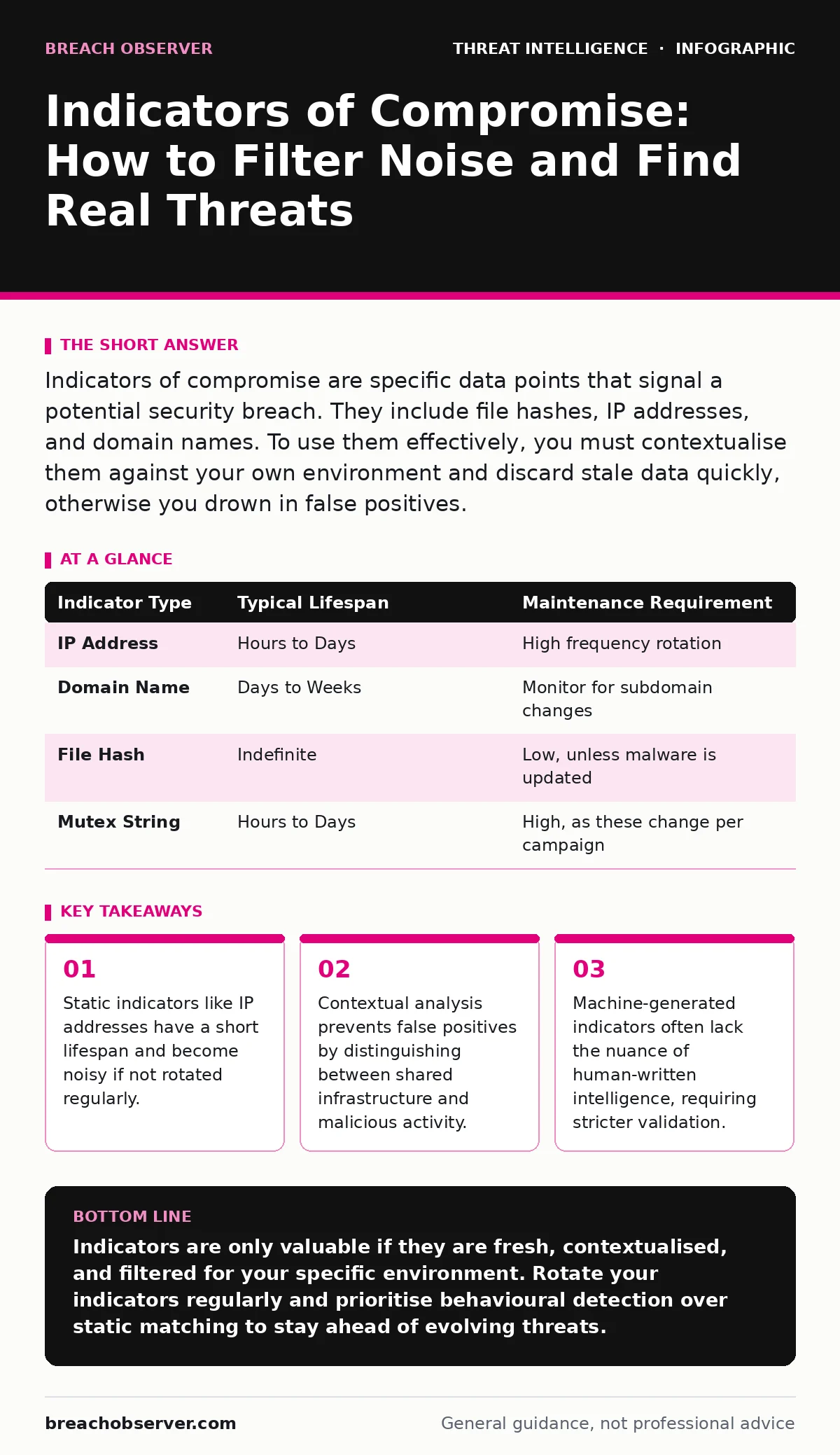
Indicators of compromise are specific data points that signal a potential security breach. They include file hashes, IP addresses, and domain names. To use them effectively, you must contextualise them against your own environment and discard stale data quickly, otherwise you drown in false positives.
What exactly is an indicator of compromise?
An indicator of compromise is a forensic artifact that suggests a computer system has been breached. These artifacts take many forms, including file hashes, IP addresses, domain names, and registry keys. They serve as the raw material for detection rules in your security tools. You treat them as evidence, not proof, because a single match rarely confirms an intrusion on its own.
How do I distinguish between different types of indicators?
Indicators fall into two main categories: static and behavioural. Static indicators are fixed values, such as a specific file hash or a known malicious IP address. These are easy to automate but degrade quickly as attackers change their tactics. Behavioural indicators describe actions, such as a process injecting code into another process. These are harder to define but remain valid longer because they capture the attacker’s method rather than their specific tools.
Why do my indicators generate so many false positives?
False positives occur when an indicator matches benign activity within your network. An IP address might be flagged as malicious because it was used in an attack elsewhere, but it could also be a shared cloud resource your organisation uses legitimately. Domain names often suffer from this issue due to dynamic DNS services. If you ingest every indicator without filtering, your detection systems become useless due to noise.
How long should I keep an indicator active?
You must treat indicators as perishable assets. An IP address is often reused by internet service providers within days or weeks. A file hash becomes irrelevant once the attacker updates their malware. Keeping stale indicators active creates a backlog of irrelevant alerts. Establish a decay model where indicators are automatically reviewed and removed after a set period unless they are tied to a persistent threat.
| Indicator Type | Typical Lifespan | Maintenance Requirement |
|---|---|---|
| IP Address | Hours to Days | High frequency rotation |
| Domain Name | Days to Weeks | Monitor for subdomain changes |
| File Hash | Indefinite | Low, unless malware is updated |
| Mutex String | Hours to Days | High, as these change per campaign |
Can I trust indicators from open-source feeds?
Open-source feeds provide volume, but they often lack context. Many feeds aggregate data from automated scanners that cannot distinguish between a compromised server and a honeypot. If you ingest these feeds directly, you risk chasing ghosts. You must validate open-source indicators against your own security telemetry before acting on them. Cross-referencing with a threat intelligence program adds necessary depth to raw data.
See also: Cyber Kill Chain Lockheed Martin: Stages, Weaknesses, and Defence
How do I handle indicators that change frequently?
Attackers often use fast-flux DNS to rotate IP addresses associated with a domain. In this scenario, tracking the IP is futile because it changes before you can block it. Instead, focus on the domain name or the certificate details. Some attackers also use fileless techniques, leaving no static hashes behind. In these cases, you must rely on behavioural analytics and network detection and response capabilities to spot anomalies.
What is the role of context in indicator analysis?
An indicator without context is just a string of characters. Context includes the source of the intelligence, the time of the observed activity, and the target sector. For example, an indicator linked to hacktivism may have different implications than one linked to state-sponsored espionage. Understanding the Diamond Model of intrusion analysis helps you map indicators to the adversary, capability, infrastructure, and victim. This mapping reveals whether the threat is relevant to your specific environment.
How do I automate indicator ingestion safely?
Automation allows you to process large volumes of data, but it requires strict filtering. You cannot simply push every indicator into your firewall or endpoint protection platform. Use a threat intelligence platform to normalise and enrich the data first. Check for overlaps with your internal assets to prevent self-harm. Ensure your automation includes a feedback loop where analysts can flag bad indicators for removal.
How do I measure the effectiveness of my indicators?
Effectiveness is measured by the ratio of true positives to false positives. If your team spends more time investigating false alerts than real threats, your indicators are failing. Track the dwell time—the period between the initial compromise and detection. Effective indicators reduce this time by catching known patterns early. Regularly review your detection rules to ensure they align with current threat actor naming conventions and tactics.
What happens when indicators are not enough?
Indicators of compromise are reactive; they tell you what has happened, not what is about to happen. They rely on prior knowledge of the attack. For novel threats, you need indicators of attack, which focus on behaviour rather than specific artifacts. Combining these with network enumeration data helps you understand the scope of an intrusion. This holistic view moves you from simple matching to actual understanding.
Key takeaways
- Static indicators like IP addresses have a short lifespan and become noisy if not rotated regularly.
- Contextual analysis prevents false positives by distinguishing between shared infrastructure and malicious activity.
- Machine-generated indicators often lack the nuance of human-written intelligence, requiring stricter validation.
Indicators are only valuable if they are fresh, contextualised, and filtered for your specific environment. Rotate your indicators regularly and prioritise behavioural detection over static matching to stay ahead of evolving threats.
Frequently asked questions
Should I block all malicious IP addresses automatically?
No, automatic blocking can disrupt legitimate services if the IP is shared or dynamic. Always verify the IP against your own traffic logs before applying a block rule.
How do I find indicators for zero-day exploits?
Zero-day exploits lack known static indicators. You must rely on behavioural analysis and anomaly detection to spot unusual activity that deviates from baseline norms.
Can I use indicators from social media?
Social media posts often lack verification. Treat them as unconfirmed rumours until they are corroborated by trusted intelligence sources or observed in your own network.
What is the difference between an indicator and a signature?
An indicator is a piece of evidence, while a signature is a rule used by a tool to detect that evidence. Indicators inform the creation of signatures, but they are not the same thing.
How this guide was produced: written by the Breach Observer editorial team with AI assistance, checked against the public references listed below, and reviewed when the facts change. See our editorial policy or report an error.