
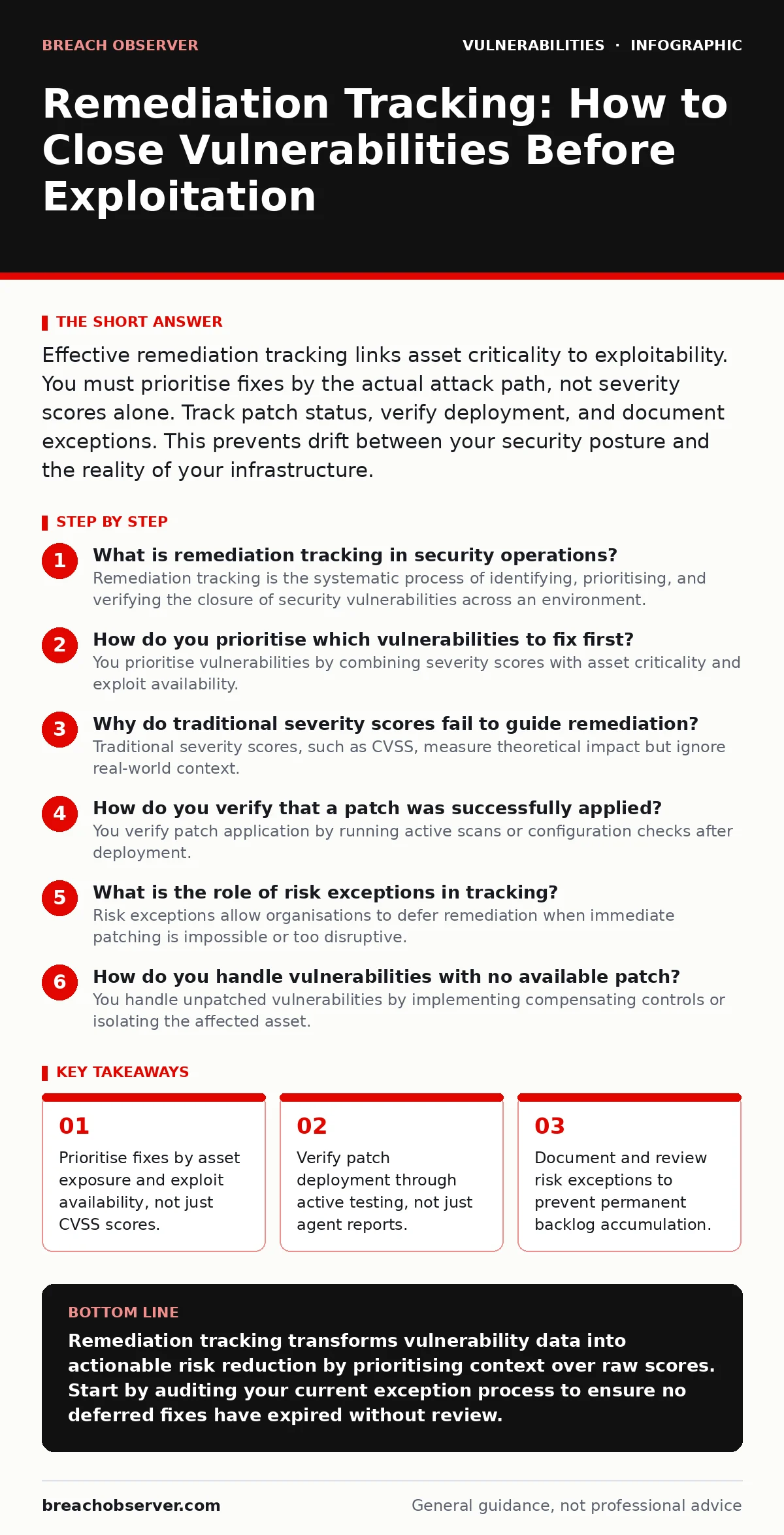
Effective remediation tracking links asset criticality to exploitability. You must prioritise fixes by the actual attack path, not severity scores alone. Track patch status, verify deployment, and document exceptions. This prevents drift between your security posture and the reality of your infrastructure.
What is remediation tracking in security operations?
Remediation tracking is the systematic process of identifying, prioritising, and verifying the closure of security vulnerabilities across an environment. It moves beyond simple detection to ensure that identified weaknesses are actively addressed within a defined timeframe. This process bridges the gap between vulnerability scanning and actual risk reduction. Without structured tracking, organisations accumulate technical debt that attackers can exploit with minimal effort.
How do you prioritise which vulnerabilities to fix first?
You prioritise vulnerabilities by combining severity scores with asset criticality and exploit availability. A high-severity flaw on an isolated, air-gapped system poses less immediate risk than a medium-severity issue on a public-facing web server. Consider the context of type confusion vulnerabilities, which can allow attackers to bypass type safety checks in complex applications. Fixing the most exploitable issues on the most exposed assets yields the highest return on security investment.
Why do traditional severity scores fail to guide remediation?
Traditional severity scores, such as CVSS, measure theoretical impact but ignore real-world context. They do not account for network segmentation, compensating controls, or the actual presence of an exploit. A score of 9.8 might be irrelevant if the vulnerable service is not reachable from the internet. Conversely, a lower score might be critical if it exists in a component targeted by widespread exploit kits. Contextual risk assessment provides a more accurate picture than raw numbers alone.
| Priority Level | Asset Type | Exploit Status | Action Required |
|---|---|---|---|
| Critical | Internet-facing | Public PoC available | Immediate patching or mitigation |
| High | Internal network | No public exploit | Patch within 7 days |
| Medium | Isolated system | No public exploit | Patch within 30 days |
| Low | Decommissioned asset | N/A | Document for decommissioning |
How do you verify that a patch was successfully applied?
You verify patch application by running active scans or configuration checks after deployment. Relying solely on agent-based reporting can lead to false positives, as agents may report success even if the patch failed to install correctly. For complex systems, manual verification or automated configuration compliance checks provide greater assurance. This step is vital when addressing VPN appliance vulnerabilities, where partial updates can leave backdoors open. Verification closes the loop between intention and reality.
What is the role of risk exceptions in tracking?
Risk exceptions allow organisations to defer remediation when immediate patching is impossible or too disruptive. These exceptions must be documented, approved by risk owners, and assigned a strict expiry date. An exception is not a permanent solution; it is a temporary acceptance of risk. Without expiry dates, exceptions become permanent backlog items that erode security posture. Regular reviews ensure that deferred fixes are eventually addressed or that compensating controls remain effective.
See also: Why Vulnerability Embargoes Matter for Security Operations · Dependency Scanning Misconceptions That Leave Code Exposed
How do you handle vulnerabilities with no available patch?
You handle unpatched vulnerabilities by implementing compensating controls or isolating the affected asset. If a vendor has not released a fix, you must reduce the attack surface by restricting access or disabling unnecessary features. For example, if browser extension vulnerabilities cannot be patched, you might restrict which extensions users can install. Documenting these controls as part of the remediation plan ensures that the risk is managed, even if the root cause remains.
Why does remediation tracking often fail in large environments?
Remediation tracking fails in large environments due to alert fatigue and lack of clear ownership. When security teams are overwhelmed by thousands of findings, they prioritise the loudest alerts rather than the most dangerous. Without clear assignment of responsibility, tasks fall through the cracks. Integrating tracking with asset management systems ensures that every vulnerability is linked to a specific owner. This clarity prevents ambiguity and ensures accountability across departments.
How do you measure the effectiveness of your tracking process?
These metrics reveal bottlenecks in your workflow and highlight areas for improvement. A declining MTTR indicates that your processes are becoming more efficient. Conversely, a rising backlog suggests that your current resources are insufficient for the volume of findings. Regular analysis of these metrics drives continuous improvement in your security operations.
What is the long-term cost of poor remediation tracking?
The long-term cost of poor remediation tracking is increased exposure to sophisticated attacks and regulatory penalties. Unpatched systems become easy targets for attackers who use automated tools to scan for known weaknesses. This can lead to data breaches, service disruptions, and loss of customer trust. Addressing vulnerabilities promptly reduces the attack surface and demonstrates due diligence. Effective tracking is an investment in resilience, not just a compliance checkbox.
Key takeaways
- Prioritise fixes by asset exposure and exploit availability, not just CVSS scores.
- Verify patch deployment through active testing, not just agent reports.
- Document and review risk exceptions to prevent permanent backlog accumulation.
Remediation tracking transforms vulnerability data into actionable risk reduction by prioritising context over raw scores. Start by auditing your current exception process to ensure no deferred fixes have expired without review.
Frequently asked questions
How often should I review my remediation backlog?
Review your backlog weekly to ensure priorities align with current threat intelligence and operational changes.
Can automation replace manual verification of patches?
Automation can speed up verification but should be supplemented with random manual checks to ensure accuracy.
What is the difference between a vulnerability and a risk?
A vulnerability is a weakness in a system; risk is the potential for loss resulting from the exploitation of that weakness.
How do I handle end-of-life software in tracking?
Treat end-of-life software as a high-risk asset and plan for immediate replacement or strict isolation from the network.
How this guide was produced: written by the Breach Observer editorial team with AI assistance, checked against the public references listed below, and reviewed when the facts change. See our editorial policy or report an error.