
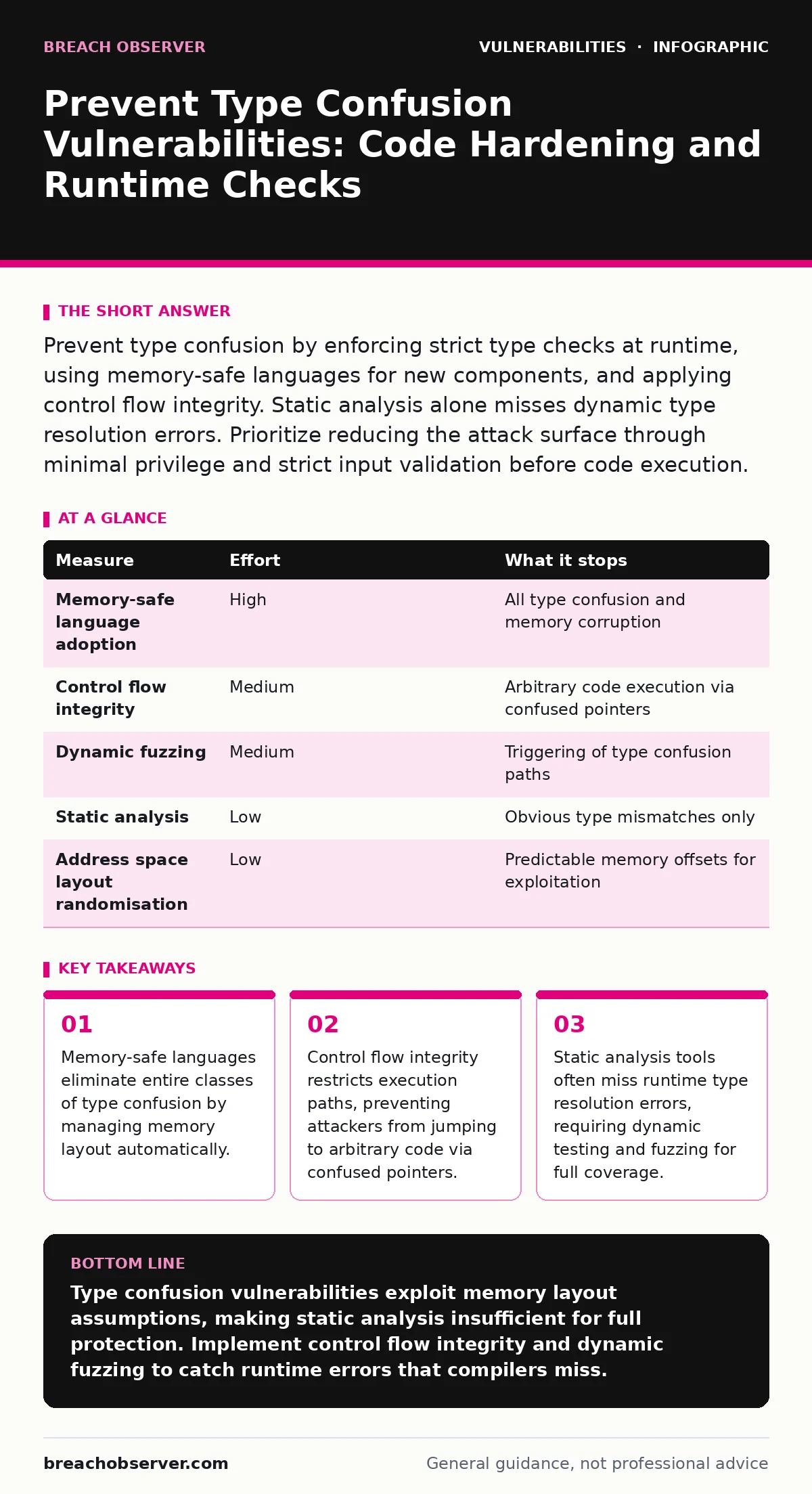
Prevent type confusion by enforcing strict type checks at runtime, using memory-safe languages for new components, and applying control flow integrity. Static analysis alone misses dynamic type resolution errors. Prioritize reducing the attack surface through minimal privilege and strict input validation before code execution.
Understanding the Mechanics of Type Confusion
Type confusion vulnerabilities arise when a program interprets a data object as a different type than intended. This error typically occurs in languages with complex memory management, such as C or C++. The system allocates memory for one object structure but later accesses it using the layout rules of another structure. The attacker supplies crafted input that forces this misinterpretation. The program then reads or writes memory offsets that do not exist for the actual object type. This leads to out-of-bounds memory access or arbitrary code execution.
The danger lies in the unpredictability of memory layout. Different versions of a library or compiler may place fields in different orders. An exploit that works on one build may fail on another, but the underlying vulnerability remains. Security teams often focus on buffer overflows, overlooking type confusion because it requires deeper knowledge of the target’s internal state. You must treat type confusion with the same urgency as memory corruption flaws.
Why Static Analysis Falls Short
Many development teams rely on static application security testing to catch memory errors. These tools analyse code without executing it. They can detect obvious mismatches in function signatures or explicit type casts. However, they struggle with dynamic type resolution. In object-oriented programming, the actual type of an object may only be known at runtime. A static analyser sees a pointer to a base class and cannot determine if it points to a derived class with a different memory layout.
Suppose a function accepts a generic interface pointer. The static tool assumes the pointer is valid. It does not simulate the runtime environment where the pointer might actually reference a smaller object. When the function accesses a field present only in the larger object, the static tool reports no error. The vulnerability exists, but the tool misses it. You need dynamic analysis to catch these discrepancies.
Prioritising Prevention Measures by Risk Reduction
Not all mitigation strategies offer equal protection. Some measures stop the exploit entirely, while others merely raise the cost for an attacker. You should rank your efforts by how much risk they remove from your attack surface. Memory-safe languages provide the highest assurance because they prevent the underlying condition. Control flow integrity adds a second layer of defence. Input validation reduces the chance of triggering the confusion state.
The table below ranks common measures by their effectiveness and implementation effort.
| Measure | Effort | What it stops |
|---|---|---|
| Memory-safe language adoption | High | All type confusion and memory corruption |
| Control flow integrity | Medium | Arbitrary code execution via confused pointers |
| Dynamic fuzzing | Medium | Triggering of type confusion paths |
| Static analysis | Low | Obvious type mismatches only |
| Address space layout randomisation | Low | Predictable memory offsets for exploitation |
Implementing Memory-Safe Alternatives
The most effective way to prevent type confusion is to avoid languages that allow manual memory management. Modern languages like Rust, Go, or Java manage memory automatically. They enforce type safety at compile time and runtime. The compiler prevents casting between incompatible types without explicit, checked conversions. At runtime, the garbage collector or borrow checker ensures that objects are accessed only within their defined boundaries.
Imagine a network parser written in C. It reads a header to determine the packet type. It then casts the buffer to a structure matching that type. If the header is forged, the cast is incorrect. In Rust, the compiler would require an enum or trait object to handle different packet types. The memory layout is managed by the type system. You cannot accidentally interpret a small packet as a large one. This eliminates the vulnerability class entirely.
Applying Control Flow Integrity
When you cannot rewrite legacy code in a memory-safe language, you must restrict how the program executes. Control flow integrity ensures that the program only follows valid execution paths. It inserts checks at indirect branch points, such as function pointer calls or virtual method dispatches. If the target address is not in the set of allowed targets, the program terminates.
Type confusion exploits often rely on overwriting a function pointer or a virtual table pointer. The attacker tricks the program into calling a function through a confused pointer. Control flow integrity detects this deviation. The pointer value points to an address that is not a valid function entry point. The check fails, and the exploit is blocked. This measure does not prevent the type confusion itself, but it prevents the exploitation of the resulting memory corruption.
See also: Pre-authentication vulnerabilities: detection, exploitation and mitigation · Vendor Patch Cycles: Why Timing Dictates Your Security Posture
Dynamic Testing and Fuzzing
Since static analysis misses dynamic errors, you must test the code under execution. Fuzzing involves feeding random or mutated inputs to the program. The goal is to trigger unexpected code paths. A fuzzer can craft inputs that cause the program to interpret data as the wrong type. When the program crashes or behaves unexpectedly, the fuzzer records the input.
You should use coverage-guided fuzzing. This technique prioritises inputs that exercise new code paths. It increases the likelihood of finding type confusion vulnerabilities. Combine fuzzing with memory sanitizers. Tools like AddressSanitizer detect out-of-bounds accesses and use-after-free errors. These errors often accompany type confusion. The sanitizer identifies the exact line of code where the type mismatch caused an invalid memory access.
Input Validation and Canonicalisation
Type confusion often stems from trusting untrusted input to determine object types. An attacker provides a header that specifies a type, but the payload does not match. You must validate input strictly. Check that the data length matches the expected type. Verify that fields are within valid ranges. Reject any input that does not conform to the schema.
Canonicalisation is also critical. Normalise input before processing. Convert character encodings, remove whitespace, and resolve aliases. An attacker might use a different encoding to hide the true type of the data. The parser sees one type, but the security check sees another. Canonicalisation ensures that the data is in a consistent format before type resolution occurs. This reduces the ambiguity that leads to confusion.
Managing Legacy Code Risks
Legacy code written in C or C++ remains vulnerable to type confusion. You cannot always rewrite it. You must isolate these components. Run legacy code in a sandboxed environment with limited privileges. Use containerisation to restrict access to system resources. If the code is exploited, the damage is contained.
Additionally, keep libraries updated. Vendor patch cycles often address known type confusion flaws. Subscribe to vulnerability advisories. Apply patches promptly. Do not wait for scheduled maintenance windows. Out-of-band patches may be necessary for critical flaws. Coordinate with your security team to test patches quickly. Delaying updates leaves the system exposed to known exploits.
Closing Checklist for Immediate Action
You can take three steps today to reduce the risk of type confusion vulnerabilities. First, audit your codebase for manual type casts and pointer arithmetic. Identify high-risk functions that handle untrusted input. Second, integrate dynamic fuzzing into your continuous integration pipeline. Run fuzzers nightly to catch new vulnerabilities before deployment. Third, review your language choices for new projects. Prefer memory-safe languages for components that handle network input or complex data structures.
- Audit code for unsafe type casts and pointer arithmetic.
- Integrate dynamic fuzzing into the CI/CD pipeline.
- Adopt memory-safe languages for new high-risk components.
Key takeaways
- Memory-safe languages eliminate entire classes of type confusion by managing memory layout automatically.
- Control flow integrity restricts execution paths, preventing attackers from jumping to arbitrary code via confused pointers.
- Static analysis tools often miss runtime type resolution errors, requiring dynamic testing and fuzzing for full coverage.
Type confusion vulnerabilities exploit memory layout assumptions, making static analysis insufficient for full protection. Implement control flow integrity and dynamic fuzzing to catch runtime errors that compilers miss.
Frequently asked questions
Can static analysis tools detect all type confusion vulnerabilities?
No, static analysis tools often miss dynamic type resolution errors. They cannot simulate runtime behaviour, so they fail to detect vulnerabilities that depend on runtime data structures.
How does control flow integrity stop type confusion exploits?
Control flow integrity restricts indirect branches to valid targets. It prevents attackers from jumping to arbitrary code via confused pointers, blocking the exploitation phase even if the confusion occurs.
Is rewriting code in Rust the only solution?
No, rewriting is the most effective long-term solution. However, you can mitigate risks in legacy code using control flow integrity, input validation, and sandboxing while planning a gradual migration.
What is the role of fuzzing in finding type confusion?
Fuzzing generates random inputs to trigger unexpected code paths. It helps identify type confusion vulnerabilities by causing the program to crash or behave incorrectly when processing malformed data.
How this guide was produced: written by the Breach Observer editorial team with AI assistance, checked against the public references listed below, and reviewed when the facts change. See our editorial policy or report an error.