
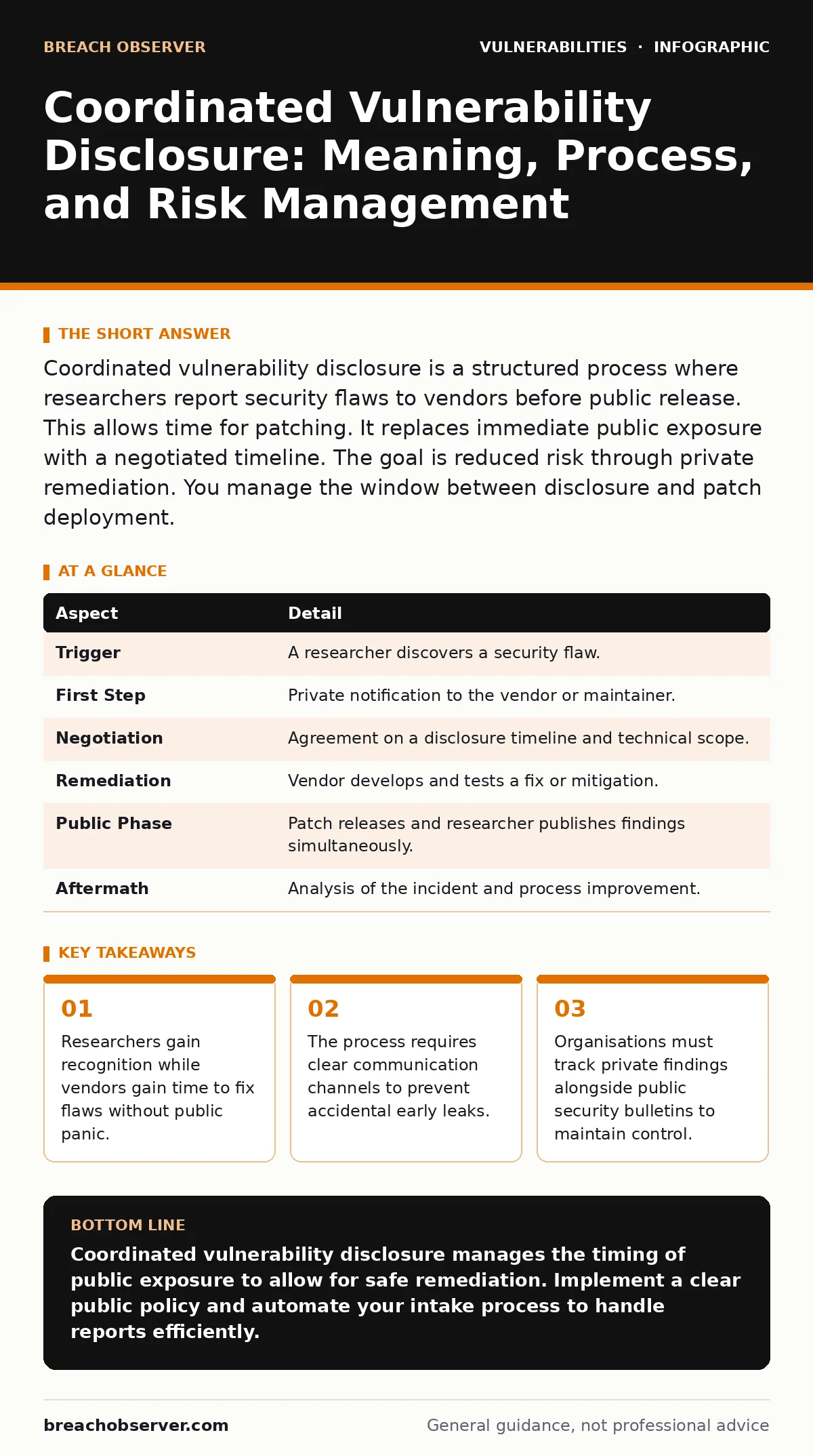
Coordinated vulnerability disclosure is a structured process where researchers report security flaws to vendors before public release. This allows time for patching. It replaces immediate public exposure with a negotiated timeline. The goal is reduced risk through private remediation. You manage the window between disclosure and patch deployment.
The Library Analogy for Shared Risk
Imagine you find a hole in the library wall. You could shout it to the street. Everyone rushes in. Chaos ensues. Or, you whisper it to the librarian. They board it up. Then you publish your finding. The public learns the wall was weak. The library remains safe. Coordinated vulnerability disclosure follows the second path. It balances transparency with safety. You share the flaw. The vendor fixes it. Then the story goes public. This protects users from exploitation during the fix period. It also rewards the researcher for responsible behaviour. The trade-off is time. The vendor needs days or weeks. The researcher wants credit now. The process negotiates this tension.
Defining the Mechanism and Its Origins
Coordinated vulnerability disclosure is a formal agreement on timing. It defines how a security flaw moves from private knowledge to public record. The term emerged from ethical hacking communities. Early hackers often published exploits immediately. This helped attackers. It hurt users. The industry realised this was unsustainable. Vendors needed time to react. Researchers needed recognition.
The compromise became coordination. You agree on a deadline. You share technical details privately. You wait for a patch. Then you speak. This is now the standard for major technology providers. It is not a legal requirement. It is a social contract enforced by reputation. Breaking it damages trust. Following it builds credibility. The mechanism relies on mutual respect. It requires both parties to act in good faith.
Day-to-Day Workflow in Security Operations
The daily work involves tracking, triage, and communication. You receive a report. You verify it. You assign priority. You contact the researcher. You agree on a timeline. You develop a fix. You test it. You release it. You notify the researcher. They publish their advisory. Each step requires documentation. You log the receipt. You log the verification. You log the patch release. You log the public disclosure. This paper trail proves you acted responsibly.
It also helps you spot patterns. If one researcher finds five flaws, they are skilled. If one component fails often, it is weak. You use this data to improve your product. You also manage the risk of the gap. The time between report and patch is dangerous. Attackers may be watching. You must monitor for signs of exploitation. You may need to release out-of-band patches if the risk is high. Speed matters, but accuracy matters more.
| Aspect | Detail |
|---|---|
| Trigger | A researcher discovers a security flaw. |
| First Step | Private notification to the vendor or maintainer. |
| Negotiation | Agreement on a disclosure timeline and technical scope. |
| Remediation | Vendor develops and tests a fix or mitigation. |
| Public Phase | Patch releases and researcher publishes findings simultaneously. |
| Aftermath | Analysis of the incident and process improvement. |
The Hidden Cost of Coordination
Coordination looks efficient. It hides real costs. The biggest cost is cognitive load. Your team must manage external relationships. You answer questions. You send updates. You defend your timeline. This distracts from development. You also face the risk of disagreement. The researcher may disagree with your priority. They may feel ignored. They may leak early. You cannot control them. You can only communicate clearly. Another cost is the backlog.
You may receive many reports at once. You must triage them. Low-priority items sit in queues. They become stale. Fixing them later is harder. You must set expectations early. Tell researchers how long you need. Be honest. If you miss the deadline, explain why. Silence breeds suspicion. Transparency builds patience. Even when you are busy, you must respond. A simple "received, reviewing" is better than nothing.
Common Misunderstandings and Pitfalls
People often confuse coordination with secrecy. It is not about hiding flaws. It is about timing the reveal. Another mistake is assuming the researcher is an enemy. They are usually allies. They want to help. Treat them as partners. Do not threaten legal action. This scares them away. It also signals weakness. Strong vendors welcome reports. Weak vendors fear them. A third error is ignoring low-severity reports. Even small flaws can be chained.
A minor issue in one module might enable a major breach in another. You must assess every report. You cannot dismiss anything. Also, do not assume the researcher knows your system. They found a flaw. They may not understand your architecture. Explain your constraints. Help them see why a quick fix is hard. This builds empathy. It also improves the quality of their future reports. They learn your system better. You become a better target for good research.
See also: Pre-authentication vulnerabilities: detection, exploitation and mitigation · Why Vulnerability Embargoes Matter for Security Operations
Integrating with Broader Security Practices
Coordinated disclosure does not exist in a vacuum. It connects to other security practices. You use penetration testing to find flaws internally. Coordination handles the external findings. You use exposure management to know what you are exposing. This helps you prioritise reports. If a flaw is in a hidden service, it is lower risk. If it is on the public internet, it is higher risk. You also manage default credentials and weak password policies. These are common entry points.
Researchers often report these. You must fix them quickly. They are low-hanging fruit for attackers. When you release a fix, you publish security bulletins. These bulletins must be clear. They must tell users what changed. They must tell users how to update. If you use out-of-band patches, you must communicate urgently. These patches skip the normal release cycle. Users need to know why. Clarity prevents confusion. Confusion leads to delayed updates. Delayed updates lead to breaches.
Managing the Public Narrative
When the patch drops, the story goes public. The researcher publishes their analysis. You publish your bulletin. These must align. If they contradict, you look incompetent. If the researcher says "critical" and you say "low", users are confused. You must agree on severity before publication. Use standard scoring systems. This removes opinion. It adds objectivity. You also control the technical depth. The researcher may reveal more detail than you want.
You can ask them to redact sensitive info. They may agree. They may not. You cannot force them. You can only persuade. Explain why certain details help attackers. Show them the risk. Most ethical researchers will comply. They do not want to harm users. They want to highlight the issue. Respect their goal. Match it with your goal. Safety first. Credit second. This order matters. If you prioritise credit, you rush. If you rush, you break things.
Building a Sustainable Process
Sustainability requires automation. Manual tracking fails at scale. You need tools to manage reports. You need templates for responses. You need a public page for disclosure policies. This page tells researchers how to reach you. It lists your preferred contact methods. It states your typical response time. It lists your supported platforms. If a researcher follows your process, you reward them. Recognition helps.
Swag helps. Bug bounties help. Money motivates many. It also funds their work. They spend time testing your product. You pay for that time. It is a fair exchange. You get security. They get income. The system works when both sides win. You must also review your process regularly. What worked last year may fail this year. Technology changes. Threats change. Your process must adapt. Keep it simple. Keep it clear. Keep it human.
Key takeaways
- Researchers gain recognition while vendors gain time to fix flaws without public panic.
- The process requires clear communication channels to prevent accidental early leaks.
- Organisations must track private findings alongside public security bulletins to maintain control.
Coordinated vulnerability disclosure manages the timing of public exposure to allow for safe remediation. Implement a clear public policy and automate your intake process to handle reports efficiently.
Frequently asked questions
What happens if a vendor ignores a vulnerability report?
The researcher may escalate by contacting media or publishing the details publicly. This forces action through reputational pressure. The vendor loses control of the narrative. It also damages trust with the security community. Future researchers may be less willing to engage privately.
How long is a reasonable disclosure timeline?
Typical timelines range from 90 days for complex issues to 30 days for critical flaws. The exact time depends on the severity and the complexity of the fix. Vendors should communicate expected timelines upfront. Researchers can then decide if they accept the wait.
Do I need a legal agreement for coordinated disclosure?
No, most coordination is based on trust and public policy. However, non-disclosure agreements can be used for highly sensitive information. These must be signed before sharing details. Many researchers refuse NDAs that restrict future discussion. Keep legal barriers low to encourage reporting.
How does this relate to WordPress plugin update policies?
WordPress plugins often follow strict update cycles. Coordinated disclosure ensures plugins are patched before public exploit release. This protects millions of sites. Maintainers must coordinate with the WordPress security team. They release updates simultaneously. This prevents a window where users are exposed to known flaws without a fix available.
How this guide was produced: written by the Breach Observer editorial team with AI assistance, checked against the public references listed below, and reviewed when the facts change. See our editorial policy or report an error.