
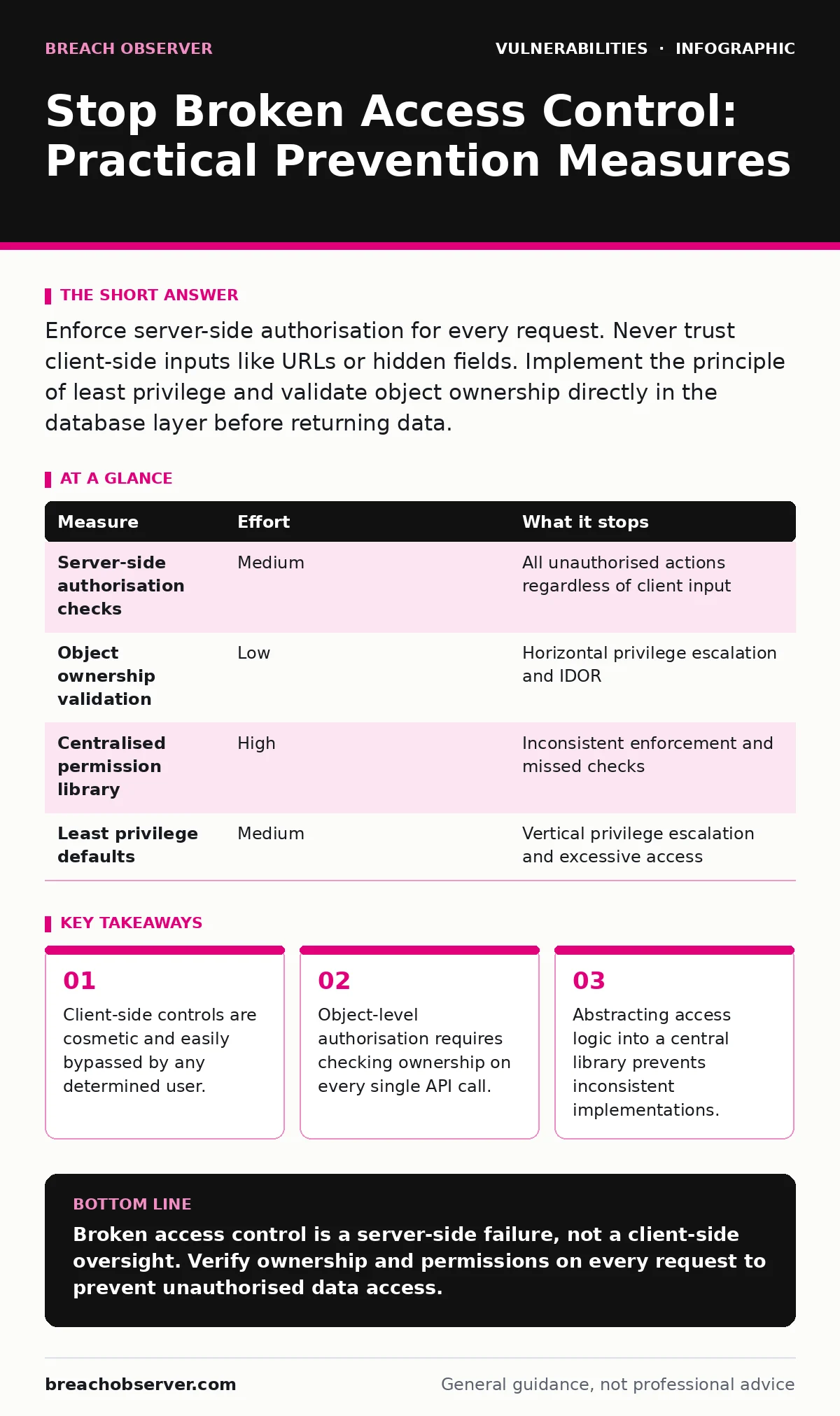
Enforce server-side authorisation for every request. Never trust client-side inputs like URLs or hidden fields. Implement the principle of least privilege and validate object ownership directly in the database layer before returning data.
The Illusion of Client-Side Security
Many development teams assume that hiding buttons or removing links from the user interface prevents unauthorised access. This assumption is dangerously wrong. When a user removes a "Delete" button from a web page, the underlying API endpoint remains active and accessible.
An attacker simply reconstructs the request using a browser developer tool or a command-line utility. The server receives the request and, if it lacks proper checks, processes it regardless of who initiated it. This is the core mechanism behind broken access control.
You must never rely on the presentation layer to enforce security. The server must independently verify that the user has permission to perform the specific action on the specific resource. This verification must happen before any business logic executes.
Enforce Server-Side Authorisation
The most effective measure is to implement strict authorisation checks on the server for every single request. This means that every endpoint must verify the user's identity and their specific rights.
Authentication confirms who the user is. Authorisation confirms what they are allowed to do. These are distinct processes. A user may be authenticated but still lack the authority to view another user's profile or modify system settings.
Build this logic into a reusable library or middleware. Hard-coding checks in every function leads to inconsistencies. If you update the permission model, you must update every single function that references it. A centralised approach ensures uniform enforcement across the entire application.
Validate Object Ownership Explicitly
Horizontal privilege escalation occurs when a user accesses resources belonging to another user of the same role. This often happens when API endpoints use predictable identifiers, such as sequential integers, to reference data.
Imagine an endpoint that returns user details based on an ID parameter. If the server does not check whether the authenticated user owns that ID, an attacker can iterate through numbers to access every account. This is known as Insecure Direct Object Reference (IDOR).
The fix is simple but often overlooked. When a request arrives for a specific object, the server must query the database to confirm that the object belongs to the requesting user. If the ownership check fails, the server must return a forbidden error. This check must happen before the data is retrieved or modified.
Implement Least Privilege by Default
The principle of least privilege dictates that users and processes should only have the minimum access necessary to perform their tasks. In the context of web applications, this means defaulting to denial.
If a permission is not explicitly granted, it should be denied. This approach reduces the attack surface significantly. Even if an attacker gains access to a low-privilege account, they cannot escalate to administrative functions unless those specific checks are also bypassed.
Review your role-based access control (RBAC) models regularly. Ensure that roles are defined by function, not by seniority. A junior developer should not have the same access rights as a senior engineer if their tasks do not require it.
| Measure | Effort | What it stops |
|---|---|---|
| Server-side authorisation checks | Medium | All unauthorised actions regardless of client input |
| Object ownership validation | Low | Horizontal privilege escalation and IDOR |
| Centralised permission library | High | Inconsistent enforcement and missed checks |
| Least privilege defaults | Medium | Vertical privilege escalation and excessive access |
Avoid Hard-Coded Permissions
Hard-coding permissions within the application code creates rigid security boundaries that are difficult to maintain. When business requirements change, developers must modify the code, test it, and redeploy the application.
This process introduces human error. A developer might forget to update a permission check in one module while updating another. This inconsistency creates gaps that attackers can exploit.
Instead, store permission rules in a configuration file or a database. This allows you to adjust access rights without changing the application code. It also enables dynamic updates based on user roles or group memberships. This flexibility is critical for complex applications with many user types.
See also: What Is Token Theft: How Stealing Access Tokens Bypasses Authentication · Data Inventory and Mapping: A Technical Checklist for Visibility
Test with Automated Scanning
Manual testing for access control flaws is time-consuming and prone to error. Automated security scanning tools can identify common patterns of broken access control, such as missing authorisation headers or predictable IDs.
Integrate these scans into your continuous integration and continuous deployment (CI/CD) pipeline. This ensures that new code is checked for access control vulnerabilities before it reaches production.
However, automated tools have limitations. They cannot understand business logic or complex permission hierarchies. They may miss nuanced flaws where the technical implementation is correct but the business rule is flawed. Combine automated scanning with manual penetration testing for thorough coverage.
Review Related Vulnerability Classes
Broken access control often intersects with other vulnerability types. For example, if an application allows file uploads without proper permission checks, it can lead to file upload vulnerabilities where malicious scripts are executed.
Similarly, poor access controls can expose endpoints that are susceptible to command injection if the application passes user input to system shells. Ensuring that only authorised users can access these endpoints reduces the risk of such attacks.
Keep an eye on exposure management practices. Knowing what assets are exposed to the internet helps you prioritise where to enforce strict access controls. Unnecessary exposure increases the likelihood of an attacker finding a broken access control flaw.
Immediate Action Checklist
You can reduce your risk significantly by taking three specific actions today. These steps address the most common causes of broken access control.
- Audit your API endpoints to ensure every request includes a server-side check for user permissions.
- Verify that object-level access is validated by checking ownership in the database before returning data.
- Review your role definitions to ensure they follow the principle of least privilege, removing any excessive permissions.
Key takeaways
- Client-side controls are cosmetic and easily bypassed by any determined user.
- Object-level authorisation requires checking ownership on every single API call.
- Abstracting access logic into a central library prevents inconsistent implementations.
Broken access control is a server-side failure, not a client-side oversight. Verify ownership and permissions on every request to prevent unauthorised data access.
Frequently asked questions
Does using HTTPS prevent broken access control?
No, HTTPS encrypts data in transit but does not verify if the user has permission to access the data. You still need server-side authorisation checks.
Can a firewall stop broken access control attacks?
Firewalls control network traffic but cannot inspect the application logic to determine if a user is authorised to access a specific resource.
Is multi-factor authentication enough to prevent this?
MFA strengthens authentication but does not replace authorisation. A user with valid MFA credentials can still access data they are not permitted to see if checks are missing.
How do I test for IDOR vulnerabilities?
Try accessing resources with different IDs while logged in as a different user. If you can see data belonging to another user, you have an IDOR flaw.
How this guide was produced: written by the Breach Observer editorial team with AI assistance, checked against the public references listed below, and reviewed when the facts change. See our editorial policy or report an error.