
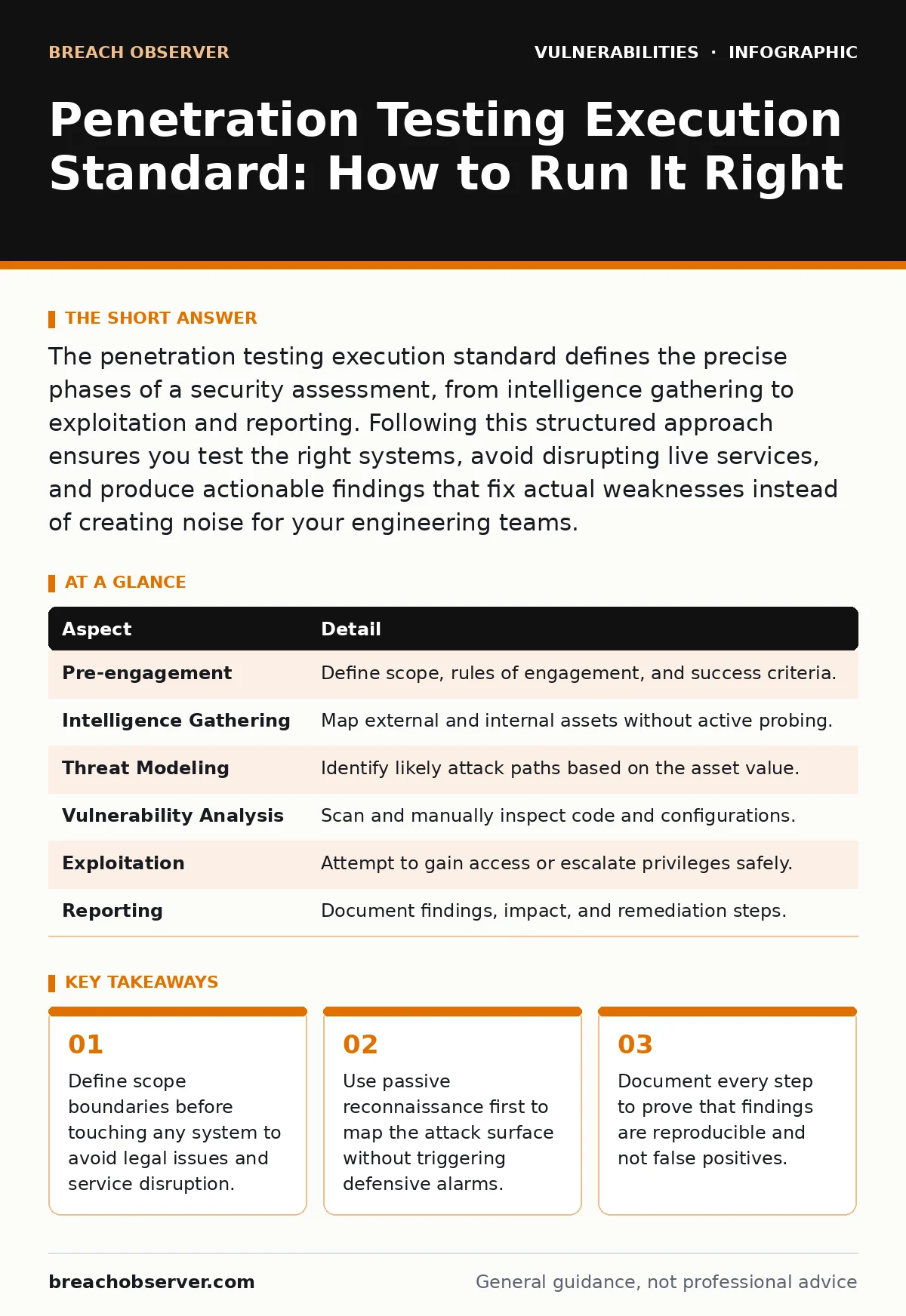
The penetration testing execution standard defines the precise phases of a security assessment, from intelligence gathering to exploitation and reporting. Following this structured approach ensures you test the right systems, avoid disrupting live services, and produce actionable findings that fix actual weaknesses instead of creating noise for your engineering teams.
The Anatomy of a Controlled Break-In
Imagine a locksmith testing a bank vault. They do not simply smash the door open with a hammer. They inspect the hinges, test the locking mechanism, and attempt to pick the lock using specific tools. If they succeed, they note exactly which pin tumbled allowed entry. This controlled, methodical approach mirrors how security professionals assess digital infrastructure.
Penetration testing is the practice of simulating real-world cyber attacks against your own systems to find weaknesses before malicious actors do. It differs from automated vulnerability scanning because it requires human creativity and context to chain multiple small issues into a significant breach. The penetration testing execution standard provides the roadmap for this process, ensuring consistency and depth. Without this framework, tests become chaotic, miss critical vectors, or cause accidental outages.
At a Glance: The Testing Lifecycle
| Aspect | Detail |
|---|---|
| Pre-engagement | Define scope, rules of engagement, and success criteria. |
| Intelligence Gathering | Map external and internal assets without active probing. |
| Threat Modeling | Identify likely attack paths based on the asset value. |
| Vulnerability Analysis | Scan and manually inspect code and configurations. |
| Exploitation | Attempt to gain access or escalate privileges safely. |
| Reporting | Document findings, impact, and remediation steps. |
The Penetration Testing Execution Standard in Practice
When you search for the penetration testing execution standard, you are looking for a structured methodology. Most frameworks follow the same core logic: you must understand the target before you try to break it. The first phase is intelligence gathering. Here, you collect public data, such as DNS records, employee names from social media, and technology stacks. This is passive. You do not touch the network.
The next phase is threat modeling. You decide how an attacker would approach your specific environment. A public-facing web application requires a different approach than an internal database server. You identify the most likely entry points. For example, if your team uses exposure management tools, you already have a map of your external assets. This map tells you where to focus your manual testing efforts. You prioritize high-value targets over low-hanging fruit that automated scanners already flag.
Common Misconceptions About Scope and Safety
Many teams believe that a penetration test is a one-time event. This is a dangerous assumption. Software changes daily, and new features introduce new risks. A test performed last year tells you nothing about today's security posture. Another common error is testing without clear rules of engagement. If a tester accidentally triggers a denial-of-service condition, the impact can be severe. You must agree on which systems are off-limits and what actions are permitted.
People also confuse penetration testing with vulnerability management. Scanners find missing patches and misconfigurations. They cannot determine if a misconfiguration allows an attacker to execute code. Only a human tester can verify the true impact. This distinction matters when you are dealing with complex issues like broken access control. A scanner sees that a URL exists. A tester proves that a regular user can access admin data. This proof is what drives remediation.
Execution Phases: From Recon to Report
The exploitation phase is where the standard becomes critical. You do not simply run every exploit available. You select exploits that match the technology stack you identified earlier. You test for command injection flaws by sending crafted inputs to application endpoints. You check for buffer overflow vulnerabilities in legacy services that handle raw data. Each attempt is logged. If an exploit fails, you note why. This negative data is valuable. It tells you that a specific mitigation is working.
After exploitation, you move to post-exploitation. Here, you determine what an attacker can do once inside. Can they move laterally to other servers? Can they escalate privileges to gain administrative rights? This phase reveals the true business impact. A single web vulnerability is annoying. The ability to pivot to the financial database is catastrophic. You document every step taken to achieve this access. This documentation allows your development team to replicate the attack and understand the root cause.
See also: Prevent Type Confusion Vulnerabilities: Code Hardening and Runtime Checks · Zero-Click Exploit Warning Signs and Immediate Response Actions
What Teams Usually Get Wrong
The biggest failure in penetration testing is poor reporting. A list of CVEs (Common Vulnerabilities and Exposures) is useless to a developer. You must provide context. Explain why the finding matters. If you find a weak password policy, explain how an attacker could use it to brute-force an account. If you discover VPN appliance vulnerabilities, describe how an attacker could bypass the perimeter entirely.
Another mistake is ignoring the remediation phase. The test is not complete until you verify the fixes. Attackers will return. If you patch the hole but leave the door ajar, the next test will show the same result. You should schedule a re-test for critical findings. This closes the loop. It ensures that the effort spent finding the issue translates into actual security improvement. Do not leave your teams guessing about whether their fixes worked.
Integrating Testing With Broader Security
Penetration testing fits into a larger security strategy. It is not a standalone solution. You should combine it with continuous monitoring and secure development practices. When you find a pattern of similar issues, such as multiple instances of subdomain takeover risks, you address the underlying process failure. Perhaps your team is not retiring old DNS records properly. Fixing the process prevents future issues.
Consider how coordinated vulnerability disclosure interacts with your testing. If a third party reports a flaw before your test does, you need a process to handle it. Your internal tests should uncover these issues first. This builds trust with the community and prevents public embarrassment. By following a standard execution model, you ensure that your tests are thorough, repeatable, and aligned with business risk.
Key takeaways
- Define scope boundaries before touching any system to avoid legal issues and service disruption.
- Use passive reconnaissance first to map the attack surface without triggering defensive alarms.
- Document every step to prove that findings are reproducible and not false positives.
Frequently asked questions
How often should we perform penetration testing?
You should test after every major infrastructure change or new feature release. Annual testing is the minimum, but critical systems require more frequent assessments to catch newly introduced risks.
Do we need external testers or can we use internal staff?
Internal staff provide deep knowledge of your systems but may miss outsider perspectives. External testers bring fresh eyes and specialized skills. Many teams use both to balance depth with unbiased discovery.
What is the difference between black box and white box testing?
Black box testing simulates an outsider with no knowledge of your systems. White box testing provides testers with source code and architecture details. White box is faster and more thorough, while black box tests your defensive visibility.
How do we measure the success of a penetration test?
Success is not defined by the number of vulnerabilities found. It is measured by the quality of the findings, the accuracy of the risk assessment, and the speed with which your team can remediate the issues identified. BOTTOM LINE: A structured execution standard turns chaotic hacking attempts into reliable security data that your engineering teams can actually use. Define your scope clearly, document every step, and prioritize findings based on real business impact rather than generic severity
How this guide was produced: written by the Breach Observer editorial team with AI assistance, checked against the public references listed below, and reviewed when the facts change. See our editorial policy or report an error.