
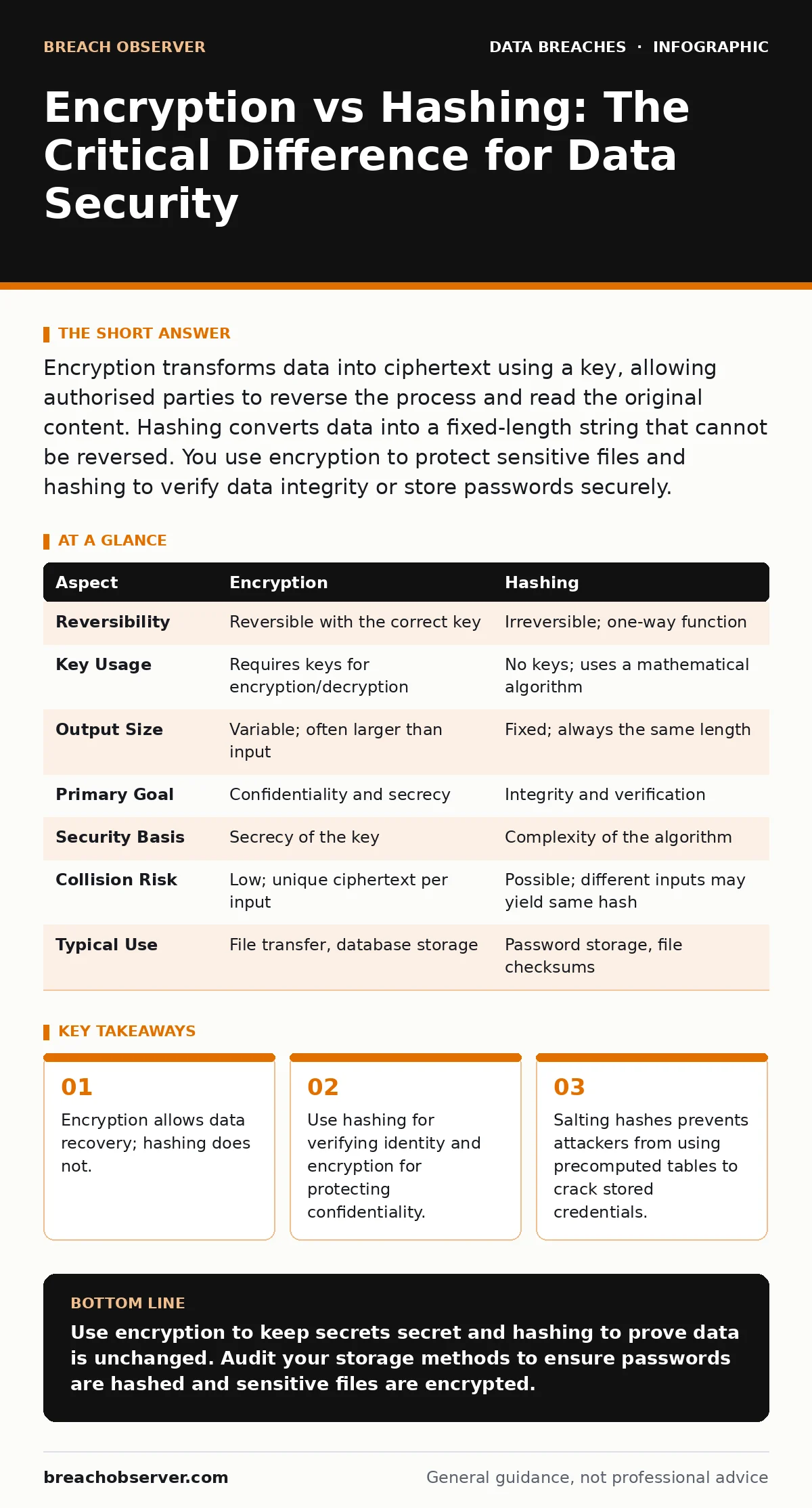
Encryption transforms data into ciphertext using a key, allowing authorised parties to reverse the process and read the original content. Hashing converts data into a fixed-length string that cannot be reversed. You use encryption to protect sensitive files and hashing to verify data integrity or store passwords securely.
The Fundamental Distinction Between Reversibility and Integrity
Encryption and hashing serve entirely different purposes in information security, despite both transforming readable data into obscure strings. Encryption is a two-way process. You apply a key to scramble data into ciphertext, and the same or a paired key unscrambles it back to plaintext. The goal is confidentiality. Hashing is a one-way process. You feed data into a mathematical function, and it outputs a fixed-length string called a digest. The goal is integrity. You cannot turn a hash back into the original data. This distinction dictates how you protect assets. If you need to read the data later, you must encrypt it. If you only need to prove the data has not changed, you hash it.
How Encryption Protects Confidentiality
Encryption relies on algorithms and keys to secure information. Symmetric encryption uses one key for both locking and unlocking data. This method is fast and efficient for large volumes of data. Asymmetric encryption uses a public key to lock data and a private key to unlock it. This enables secure communication between parties who have never met. The security depends entirely on keeping the keys secret. If an attacker obtains the key, the ciphertext becomes readable plaintext. This is why key management is the most difficult aspect of encryption. You must protect the keys as rigorously as the data they protect.
How Hashing Verifies Data Integrity
Hashing takes input of any size and produces a unique, fixed-size output. Even a tiny change in the input, such as altering one letter in a sentence, results in a completely different hash. This property makes hashing ideal for detecting tampering. When you download a software update, you compare the hash of the downloaded file with the hash published by the developer. If they match, the file is identical. If they differ, the file has been altered or corrupted. Hashing also secures passwords. Systems store the hash of a password, not the password itself. When you log in, the system hashes your input and compares it to the stored hash.
Point-by-Point Comparison of Mechanisms
Understanding the technical differences helps you choose the correct tool for each scenario. The table below outlines the core characteristics of each method.
| Aspect | Encryption | Hashing |
|---|---|---|
| Reversibility | Reversible with the correct key | Irreversible; one-way function |
| Key Usage | Requires keys for encryption/decryption | No keys; uses a mathematical algorithm |
| Output Size | Variable; often larger than input | Fixed; always the same length |
| Primary Goal | Confidentiality and secrecy | Integrity and verification |
| Security Basis | Secrecy of the key | Complexity of the algorithm |
| Collision Risk | Low; unique ciphertext per input | Possible; different inputs may yield same hash |
| Typical Use | File transfer, database storage | Password storage, file checksums |
Choosing Encryption for Sensitive Data
Choose encryption when you need to maintain the original content for future use. This applies to emails, documents, and databases containing personal information. You must encrypt data at rest and in transit. At-rest encryption protects files on disks or in databases. In-transit encryption secures data moving across networks. This approach aligns with the CIA triad, specifically the confidentiality pillar.
Without encryption, any person who gains access to the storage medium can read the data. This is particularly critical for preventing data extortion scenarios where attackers threaten to release stolen information. If the data is encrypted and the keys are secure, the stolen data remains useless to the attacker.
- Encrypt backups stored offsite.
- Use strong key rotation policies.
- Protect keys in hardware security modules.
See also: Data Exfiltration: How Attackers Steal Information and How to Stop It · Stop Credential Leaks: 3 Immediate Actions to Secure Accounts
Choosing Hashing for Verification and Authentication
Choose hashing when you need to verify that data has not changed or when you need to authenticate a user without storing their secret. Passwords are the primary example. Storing passwords in plaintext is a catastrophic failure. If an attacker breaches the database, they obtain every user's password. This leads to immediate credential leaks and widespread account takeovers.
By storing only the hash, the attacker cannot recover the passwords directly. They must guess millions of passwords, hash them, and compare the results. This process is computationally expensive and slow. Hashing also prevents stolen session tokens from being easily forged if the token generation relies on hashed secrets.
- Always salt passwords before hashing.
- Use slow hashing algorithms for passwords.
- Verify file integrity using checksums.
Where Encryption and Hashing Overlap
These two techniques often work together to provide layered security. A common pattern is to encrypt a file and then hash the resulting ciphertext. The hash proves the file was not altered during transmission. Another overlap occurs in digital signatures. You hash the message and then encrypt the hash with a private key. The recipient decrypts the hash and compares it to a new hash of the message. This verifies both integrity and origin. Understanding this synergy is vital for designing secure systems. You rarely use one in isolation for high-value assets. The combination ensures that data remains confidential, unaltered, and authentic.
Practical Implementation Considerations
Implementing these controls requires attention to detail. For encryption, the algorithm is less important than the key management. A weak key undermines even the strongest algorithm. For hashing, the choice of algorithm matters significantly. Older algorithms are vulnerable to collision attacks, where two different inputs produce the same hash.
Modern systems use algorithms designed to resist these attacks. You must also consider performance. Encryption adds processing overhead, which can slow down database queries. Hashing is generally faster but must be deliberately slowed down for password storage to resist brute-force attacks. This trade-off between security and performance requires careful tuning.
Key takeaways
- Encryption allows data recovery; hashing does not.
- Use hashing for verifying identity and encryption for protecting confidentiality.
- Salting hashes prevents attackers from using precomputed tables to crack stored credentials.
Use encryption to keep secrets secret and hashing to prove data is unchanged. Audit your storage methods to ensure passwords are hashed and sensitive files are encrypted.
Frequently asked questions
Can I decrypt a hash to get the original data?
No, hashing is a one-way mathematical function. You cannot reverse a hash to retrieve the original input. You can only compare hashes to see if two inputs are identical.
Why do I need to salt my passwords if I am hashing them?
Salting adds random data to each password before hashing. This prevents attackers from using precomputed rainbow tables to crack multiple passwords simultaneously. Each password hash becomes unique.
Is encryption enough to protect my database?
Encryption protects the data at rest, but it does not prevent unauthorised access to the application layer. You still need strong authentication, access controls, and regular **breach notification** plans.
What happens if I lose my encryption key?
The encrypted data becomes permanently inaccessible. There is no way to recover it without the key. This is why **full disk encryption** keys must be backed up securely and separately.
How this guide was produced: written by the Breach Observer editorial team with AI assistance, checked against the public references listed below, and reviewed when the facts change. See our editorial policy or report an error.