
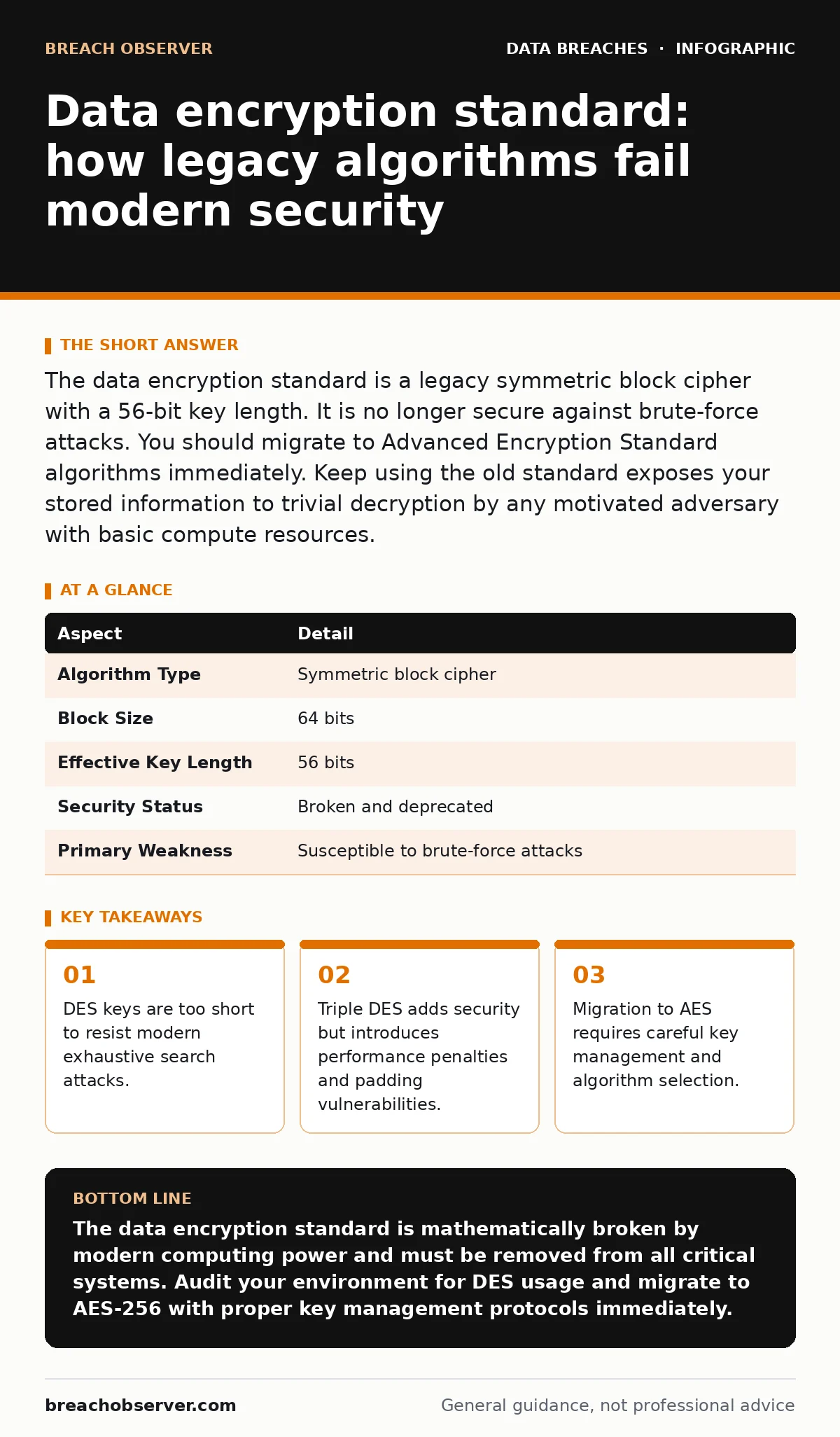
The data encryption standard is a legacy symmetric block cipher with a 56-bit key length. It is no longer secure against brute-force attacks. You should migrate to Advanced Encryption Standard algorithms immediately. Keep using the old standard exposes your stored information to trivial decryption by any motivated adversary with basic compute resources.
The mechanics of securing sensitive information
Imagine you have a diary that you lock with a simple tumbler padlock. Anyone with the right key can open it, but the lock has only 56 possible combinations. A determined thief can try every combination in a short time. The data encryption standard works exactly like this padlock. It takes plain text, breaks it into 64-bit blocks, and scrambles each block using a 56-bit key. The scrambling process involves 16 rounds of substitution and permutation operations.
The algorithm is symmetric, meaning the same key encrypts and decrypts the data. This symmetry is efficient for processing large volumes of data quickly. However, the security relies entirely on the secrecy and length of the key. This number sounds large, but it is small enough for modern computers to test every single key in a matter of hours. The mechanism itself has no mathematical weaknesses that make it easier to break than brute force, but the brute force is now trivial.
| Aspect | Detail |
|---|---|
| Algorithm Type | Symmetric block cipher |
| Block Size | 64 bits |
| Effective Key Length | 56 bits |
| Security Status | Broken and deprecated |
| Primary Weakness | Susceptible to brute-force attacks |
Why the data encryption standard fails today
The core issue is not the algorithm's logic but the key size. When the standard was designed, computers were slow. Testing billions of keys took years. Today, specialised hardware can test billions of keys per second. This means an attacker does not need a clever mathematical trick to break the cipher. They simply need time and electricity. The cost of breaking a single DES key is negligible.
This failure affects any system that still relies on the original standard for protecting data at rest or in transit. You might find it in legacy financial systems, old database exports, or proprietary protocols that have not been updated in decades. Even if the data seems obscure, the low cost of decryption makes it a target for automated scraping bots. These bots scan for unencrypted or weakly encrypted storage and dump the contents for later analysis.
The transition to stronger algorithms
You must replace the data encryption standard with a modern alternative. The Advanced Encryption Standard, commonly known as AES, is the current global benchmark. AES supports key lengths of 128, 192, and 256 bits. The universe would end before the search completed.
Migration involves more than swapping the algorithm. You must manage the new keys securely. If you generate weak keys for AES, you gain no security benefit. You also need to choose the correct mode of operation. Electronic Codebook mode is insecure because identical plaintext blocks produce identical ciphertext blocks. Use Galois/Counter Mode for authenticated encryption, which ensures both confidentiality and integrity.
Common misconceptions about legacy cryptography
Many teams believe that Triple DES provides adequate security. Triple DES applies the DES algorithm three times with different keys. This increases the effective key length and makes brute-forcing significantly harder. However, Triple DES is slow. It requires three times the computational effort of a single pass. More importantly, it suffers from padding oracle vulnerabilities if implemented incorrectly. It is a stop-gap measure, not a long-term solution.
Another common error is assuming that encrypting the database solves all exposure. Encryption at rest protects data if the storage media is stolen. It does not protect data while it is being processed in memory or transmitted over the network. You need a holistic approach that includes encryption in transit and strict access controls. Refer to our guide on encryption at rest for details on protecting static storage.
The hidden costs of algorithmic debt
Maintaining legacy cryptography creates technical debt that grows over time. Security patches for old systems often do not include updates for cryptographic modules. When a new vulnerability is discovered in the underlying protocol, you may find that the vendor no longer supports the fix. You are left with an unsupported system that cannot meet compliance requirements.
This forces you into a corner. You can either keep the insecure system and accept the risk, or you can rewrite large portions of your application to support modern standards. The second option is expensive and time-consuming. It often reveals other architectural flaws. The cost of inaction is higher. A breach involving legacy systems can lead to significant regulatory penalties and reputational damage. Check our article on data extortion to understand the financial impact of compromised systems.
See also: Stop Credential Leaks: 3 Immediate Actions to Secure Accounts · Prevent Stolen Session Tokens: Technical Controls and Detection
Implementing a secure migration path
Start by identifying all instances of weak cryptography. Use automated scanning tools to detect protocols and algorithms in use. Document each instance and assess the risk. Prioritise systems that handle sensitive personal information or financial data. These are the most attractive targets for attackers.
Next, plan the replacement. For each legacy system, determine if it can be patched to support AES. If not, consider encapsulating the legacy system behind a secure proxy that performs encryption and decryption. This allows you to keep the legacy application running while exposing only modern, secure interfaces to the outside world. Monitor the transition closely. Ensure that no data is lost or corrupted during the migration. Review our section on backup strategies to ensure you have recoverable copies before making changes.
Protecting against broader exposure vectors
Encryption is only one layer of defence. If an attacker obtains your encryption keys, the algorithm strength becomes irrelevant. You must protect keys using hardware security modules or secure key management services. Never store keys in plain text configuration files or source code repositories.
You must also address human factors. Employees often mishandle credentials, leading to unauthorized access. Our guide on employee data breaches highlights how insider threats can bypass technical controls. Combine strong encryption with multi-factor authentication and least-privilege access principles. This ensures that even if one layer fails, the attacker cannot proceed. Avoid password reuse across systems, as detailed in our password reuse guide, to prevent credential stuffing attacks from compromising key management consoles.
Key takeaways
- DES keys are too short to resist modern exhaustive search attacks.
- Triple DES adds security but introduces performance penalties and padding vulnerabilities.
- Migration to AES requires careful key management and algorithm selection.
The data encryption standard is mathematically broken by modern computing power and must be removed from all critical systems. Audit your environment for DES usage and migrate to AES-256 with proper key management protocols immediately.
Frequently asked questions
Is Triple DES safe for new projects?
No, Triple DES is deprecated for new designs. It offers marginal security gains over single DES but suffers from performance issues and known padding vulnerabilities. Use AES instead.
Can I use DES for non-sensitive data?
It is poor practice to use broken algorithms for any data. Non-sensitive data can still be used for reconnaissance or social engineering. Consistent security standards reduce complexity and risk.
How do I detect DES in my network?
Use network traffic analysis tools and configuration auditing scripts. Look for explicit references to DES in application settings, database configurations, and middleware protocols.
Does AES-256 slow down my application?
Modern CPUs have hardware acceleration for AES. The performance impact is negligible for most applications. The security benefit far outweighs the minimal computational cost.
How this guide was produced: written by the Breach Observer editorial team with AI assistance, checked against the public references listed below, and reviewed when the facts change. See our editorial policy or report an error.