
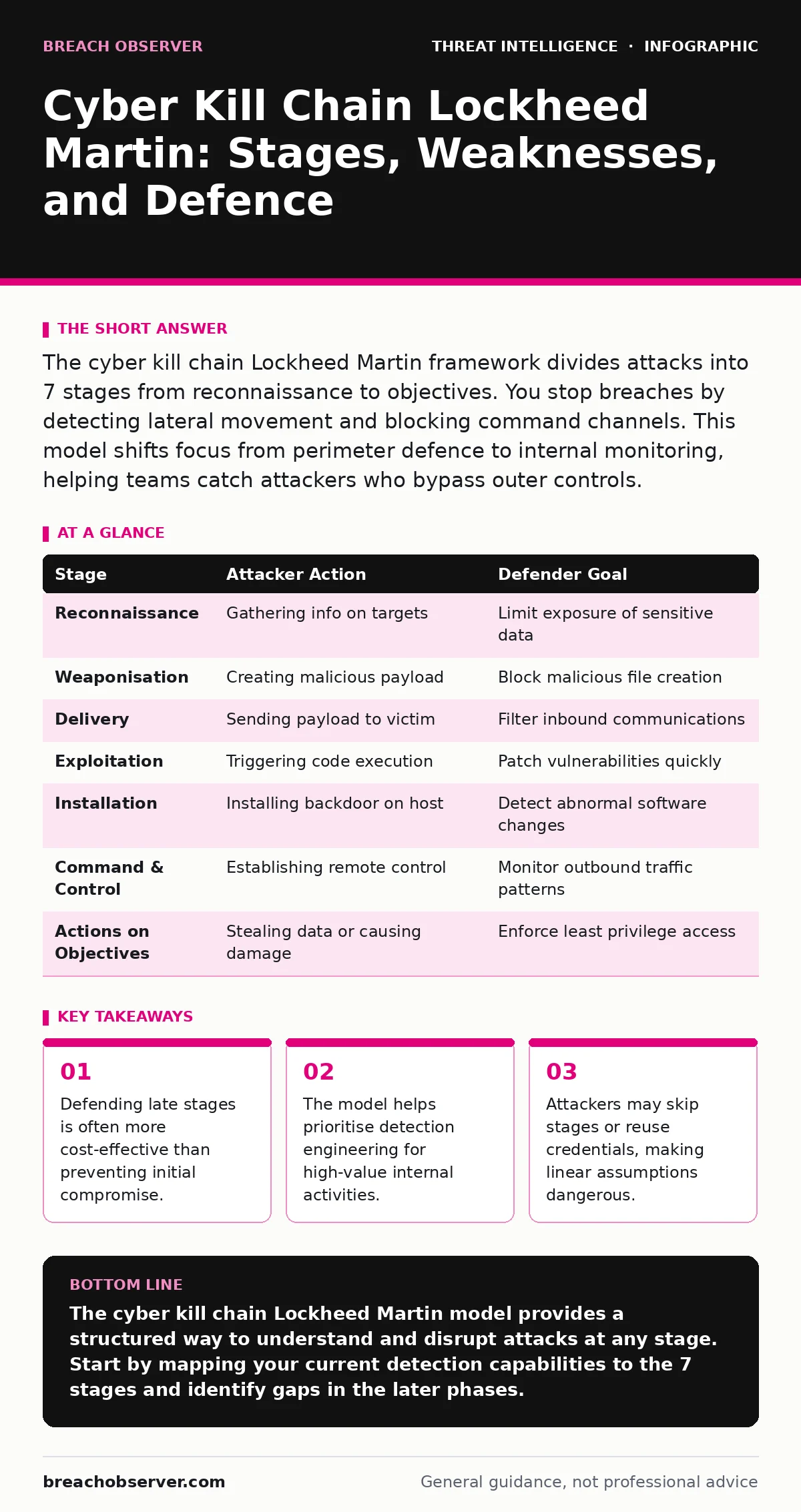
The cyber kill chain Lockheed Martin framework divides attacks into 7 stages from reconnaissance to objectives. You stop breaches by detecting lateral movement and blocking command channels. This model shifts focus from perimeter defence to internal monitoring, helping teams catch attackers who bypass outer controls.
Everyday Analogy: The Burglar and the House
Imagine a burglar planning a heist. They first scout the neighbourhood to find vulnerable homes. Then they pick a lock to enter through a side door. Inside, they search for valuables and disable the alarm system. Finally, they load their car and drive away. The cyber kill chain Lockheed Martin model applies this same logic to digital intrusions. It breaks down the complex process of hacking into discrete, manageable steps. This structure allows defenders to understand where an attacker is likely to be and how to stop them. You do not need to guard every window. You only need to disrupt the burglar’s plan at one point.
At a Glance: The 7 Stages
| Stage | Attacker Action | Defender Goal |
|---|---|---|
| Reconnaissance | Gathering info on targets | Limit exposure of sensitive data |
| Weaponisation | Creating malicious payload | Block malicious file creation |
| Delivery | Sending payload to victim | Filter inbound communications |
| Exploitation | Triggering code execution | Patch vulnerabilities quickly |
| Installation | Installing backdoor on host | Detect abnormal software changes |
| Command & Control | Establishing remote control | Monitor outbound traffic patterns |
| Actions on Objectives | Stealing data or causing damage | Enforce least privilege access |
How the Cyber Kill Chain Lockheed Martin Works
The cyber kill chain Lockheed Martin framework was originally designed for military planning but adapted for cybersecurity. It assumes an attacker must complete each stage to reach their goal. If you break the chain at any link, the attack fails. Reconnaissance involves the attacker collecting intelligence about your network, employees, or technology stack. They might search public records or scan your website for open ports. Weaponisation follows, where they craft a specific exploit, often bundling it with a payload like a document or executable. Delivery is the method used to get this weapon to the target, such as a phishing email or a compromised website.
Exploitation occurs when the victim interacts with the delivery mechanism, triggering the exploit code. This code takes advantage of a software vulnerability to run without permission. Installation happens next, where the attacker places malware on the system to maintain access even if the initial exploit is patched. Command and Control (C2) establishes a communication channel between the infected machine and the attacker’s server. This allows remote instruction. Finally, the attacker performs Actions on Objectives, which could mean stealing data, encrypting files, or destroying systems. Understanding this sequence helps you map your detection engineering to specific stages.
Who the Model Affects
This model affects every organisation that stores digital information. Small businesses face targeted attacks based on their financial data or customer lists. Large enterprises are hunted by advanced threat actors seeking intellectual property or strategic advantage. The model is particularly useful for security teams who feel overwhelmed by noise.
It provides a structured way to evaluate alerts. Instead of reacting to every anomaly, you categorise events by their stage in the chain. This helps in writing better incident response runbooks. You can assign specific actions to each stage. For example, a delivery stage alert might trigger email filtering updates, while a C2 alert triggers network isolation.
Common Mistakes in Application
Many teams misunderstand the cyber kill chain Lockheed Martin model as a strict linear process. Attackers do not always follow every step in order. An attacker might already have credentials from a previous breach and skip Reconnaissance and Weaponisation entirely. They might jump straight to Installation by using stolen tokens. This is why relying solely on perimeter defence is insufficient. Another mistake is assuming that blocking one stage stops all attacks. Attackers adapt. If you block phishing emails, they might use social engineering to call your staff. You must defend depth-wise, not just at the edge.
See also: What Is Threat Intelligence: How Data Becomes Defence
Strategic Intelligence and Detection
Using the cyber kill chain Lockheed Martin model improves your strategic threat intelligence. It helps you understand the capabilities of different threat actors. Some groups are skilled at custom weaponisation, while others rely on off-the-shelf malware. Knowing this helps you prioritise patches and controls. You can correlate external intelligence with internal telemetry. For instance, if you know a group favours pass-the-hash attacks, you can monitor for abnormal authentication patterns. This proactive stance reduces the time to detect and respond. It transforms your security operations from reactive to predictive. You are no longer just closing doors; you are watching the hallways.
Defending the Late Stages
Defending the late stages of the cyber kill chain Lockheed Martin model is often more practical. Preventing initial delivery is difficult because attackers have infinite ways to reach users. Blocking every possible vector is impossible. However, once an attacker is inside, they must communicate and move. This creates observable artefacts.
Monitoring for unusual outbound connections can reveal Command and Control activity. Detecting lateral movement can reveal Installation success. Implementing network segmentation limits the damage if an attacker reaches Actions on Objectives. You contain the breach to a small zone. This approach accepts that some compromises will happen but ensures they do not succeed.
Integrating with Other Frameworks
The cyber kill chain Lockheed Martin model works best when combined with other frameworks. It complements threat intelligence platforms that provide context on attacker tactics. It also aligns with detection engineering principles that focus on observability. You can use it to validate your incident response runbooks. Ensure your playbooks cover detection at each stage.
Do not ignore the human element. Training staff to recognise social engineering helps at the Delivery stage. Regularly updating your software helps at the Exploitation stage. Layered defence is key. No single control stops all attacks. You need a combination of technical controls, processes, and people. This holistic approach builds resilience against evolving threats.
Key takeaways
- Defending late stages is often more cost-effective than preventing initial compromise.
- The model helps prioritise detection engineering for high-value internal activities.
- Attackers may skip stages or reuse credentials, making linear assumptions dangerous.
The cyber kill chain Lockheed Martin model provides a structured way to understand and disrupt attacks at any stage. Start by mapping your current detection capabilities to the 7 stages and identify gaps in the later phases.
Frequently asked questions
Is the cyber kill chain still relevant for modern attacks?
Yes, but it must be adapted. Modern attacks may skip stages or use cloud-native techniques, requiring updated detection methods.
How does it differ from MITRE ATT&CK?
The kill chain is a high-level model of attacker progression, while MITRE ATT&CK is a detailed catalogue of specific tactics and techniques.
Can I use this model for cloud environments?
Absolutely. The stages apply to cloud infrastructure, with specific focus on API abuse and identity management in the later stages.
What is the biggest limitation of this model?
It assumes a linear progression, whereas attackers often move non-linearly or reuse access, making single-stage defence insufficient.
How this guide was produced: written by the Breach Observer editorial team with AI assistance, checked against the public references listed below, and reviewed when the facts change. See our editorial policy or report an error.