
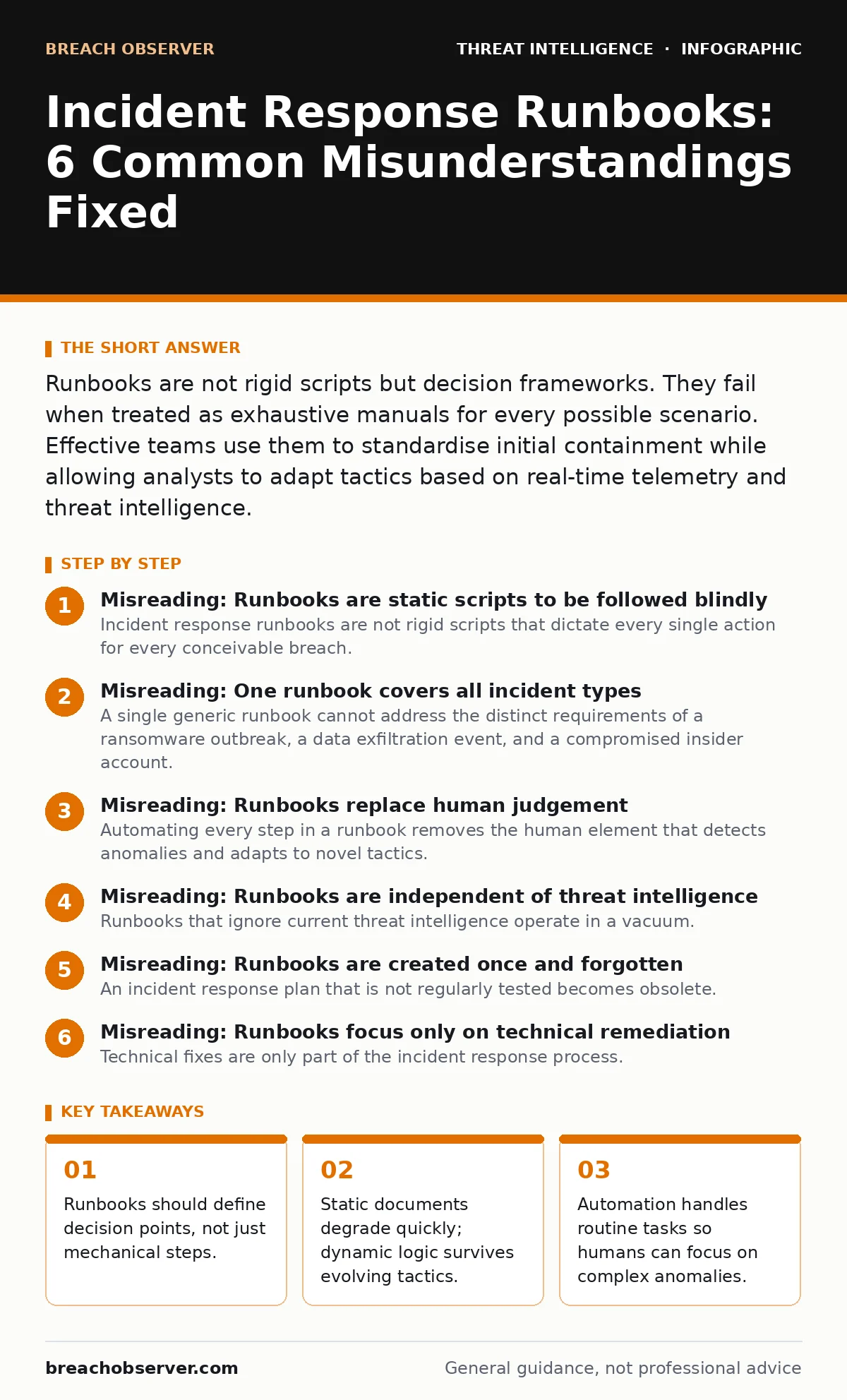
Runbooks are not rigid scripts but decision frameworks. They fail when treated as exhaustive manuals for every possible scenario. Effective teams use them to standardise initial containment while allowing analysts to adapt tactics based on real-time telemetry and threat intelligence.
Misreading: Runbooks are static scripts to be followed blindly
Incident response runbooks are not rigid scripts that dictate every single action for every conceivable breach. Treating them as immutable law creates a dangerous illusion of control. You cannot predict the exact sequence of events in a novel attack. A static script fails when the attacker deviates from the expected pattern. Analysts who follow a script without understanding the underlying mechanics often miss subtle indicators of compromise. The document should define the logic of the response, not the precise keystrokes. You need flexibility to adapt when the situation changes unexpectedly.
Correct reading: View runbooks as decision frameworks that standardise the initial reaction. They provide a consistent baseline for containment and evidence preservation. The framework guides the analyst through critical checks. It allows for deviation when the data suggests a different approach. This balance ensures consistency without sacrificing agility.
Misreading: One runbook covers all incident types
A single generic runbook cannot address the distinct requirements of a ransomware outbreak, a data exfiltration event, and a compromised insider account. Each threat vector demands different containment strategies and forensic priorities. Grouping all incidents into one document leads to vague advice that satisfies no one. You must separate procedures by incident category to ensure relevance. This separation allows for specific technical guidance tailored to the attack vector. It reduces cognitive load during high-stress situations.
Correct reading: Create separate runbooks for distinct incident classes. Align each document with the specific technical controls required for that class. Reference your security telemetry sources clearly in each. This ensures analysts know exactly which data streams to query. It prevents wasted time searching for irrelevant logs during a critical window.
Misreading: Runbooks replace human judgement
Automating every step in a runbook removes the human element that detects anomalies and adapts to novel tactics. Machines excel at repetitive tasks but struggle with context and nuance. Over-automation leads to false positives being treated as critical incidents. It also means that when an attacker changes their behaviour, the automated response may be ineffective or harmful. You need human analysts to interpret the output of automated tools. They must decide when to escalate or when to close the case.
Correct reading: Use automation for routine, well-defined tasks like isolating a host or blocking an IP. Reserve human judgement for complex decisions involving business impact assessment. Integrate your threat intelligence program to provide context for automated alerts. This hybrid approach speeds up response while maintaining accuracy. It ensures that critical decisions remain under human control.
Misreading: Runbooks are independent of threat intelligence
Runbooks that ignore current threat intelligence operate in a vacuum. They assume all attacks look the same, which is a dangerous misconception. Attackers constantly evolve their tactics, techniques, and procedures. A runbook based on last year's data may miss today's indicators. You must feed real-time intelligence into your response logic. This allows for dynamic adjustments based on the specific adversary's known behaviour. It turns a static document into a living tool.
Correct reading: Embed IOC enrichment steps directly into your runbooks. This ensures analysts automatically check indicators against global threat data. Use the Diamond Model of intrusion analysis to structure this intelligence gathering. This framework helps map the adversary's capabilities and infrastructure. It provides the context needed for effective containment and eradication.
Misreading: Runbooks are created once and forgotten
An incident response plan that is not regularly tested becomes obsolete. Technologies change, networks evolve, and new vulnerabilities emerge. A runbook that has not been updated in months may reference controls that no longer exist. It may describe procedures that conflict with current security policies. Regular testing reveals gaps and inconsistencies. It ensures that the documented steps actually work in practice. Neglecting maintenance turns a valuable asset into a liability.
Correct reading: Schedule regular table-top exercises to validate your runbooks. Simulate realistic scenarios to test the effectiveness of each step. Update the documents based on the lessons learned from these exercises. Incorporate feedback from analysts who used the runbooks in real incidents. This continuous improvement cycle keeps your response capabilities sharp. Reference your network detection and response tools to ensure they are integrated correctly.
See also: Implement a Threat Intelligence Program: Step-by-Step Execution · Command Injection Warning Signs: Detect Silent Backdoors
Misreading: Runbooks focus only on technical remediation
Technical fixes are only part of the incident response process. Runbooks that ignore communication, legal obligations, and business impact fail to address the full scope of an incident. You must coordinate with legal, human resources, and public relations teams. Delayed communication can exacerbate reputational damage. Ignoring legal requirements can lead to regulatory penalties. A holistic approach ensures that all aspects of the incident are managed effectively.
Correct reading: Include communication protocols and stakeholder notification steps in your runbooks. Define who needs to be informed and when. Outline the legal obligations for data breach reporting. Integrate business impact assessments to prioritise response actions. This ensures that the technical response aligns with organisational priorities. Consider how network enumeration findings might impact public disclosure statements.
Key takeaways
- Runbooks should define decision points, not just mechanical steps.
- Static documents degrade quickly; dynamic logic survives evolving tactics.
- Automation handles routine tasks so humans can focus on complex anomalies.
- Context from threat intelligence dictates the speed and scope of response.
Frequently asked questions
How often should incident response runbooks be updated?
Update runbooks after every significant incident, major infrastructure change, or quarterly review. Regular testing ensures they remain accurate and effective. Static documents quickly become outdated and misleading.
Can runbooks be fully automated?
No, full automation removes necessary human judgement. Automate routine tasks like log collection and initial containment. Keep complex decisions, such as business impact assessment, under human control to avoid errors.
How do I integrate threat intelligence into runbooks?
Embed specific steps for checking indicators against threat feeds. Use frameworks like the Diamond Model to structure this intelligence. This provides context for the incident and informs containment strategies.
What is the difference between a playbook and a runbook?
Playbooks are high-level guides for specific scenarios. Runbooks are detailed, step-by-step instructions for executing those playbooks. Runbooks focus on the technical actions required for response.
How this guide was produced: written by the Breach Observer editorial team with AI assistance, checked against the public references listed below, and reviewed when the facts change. See our editorial policy or report an error.