
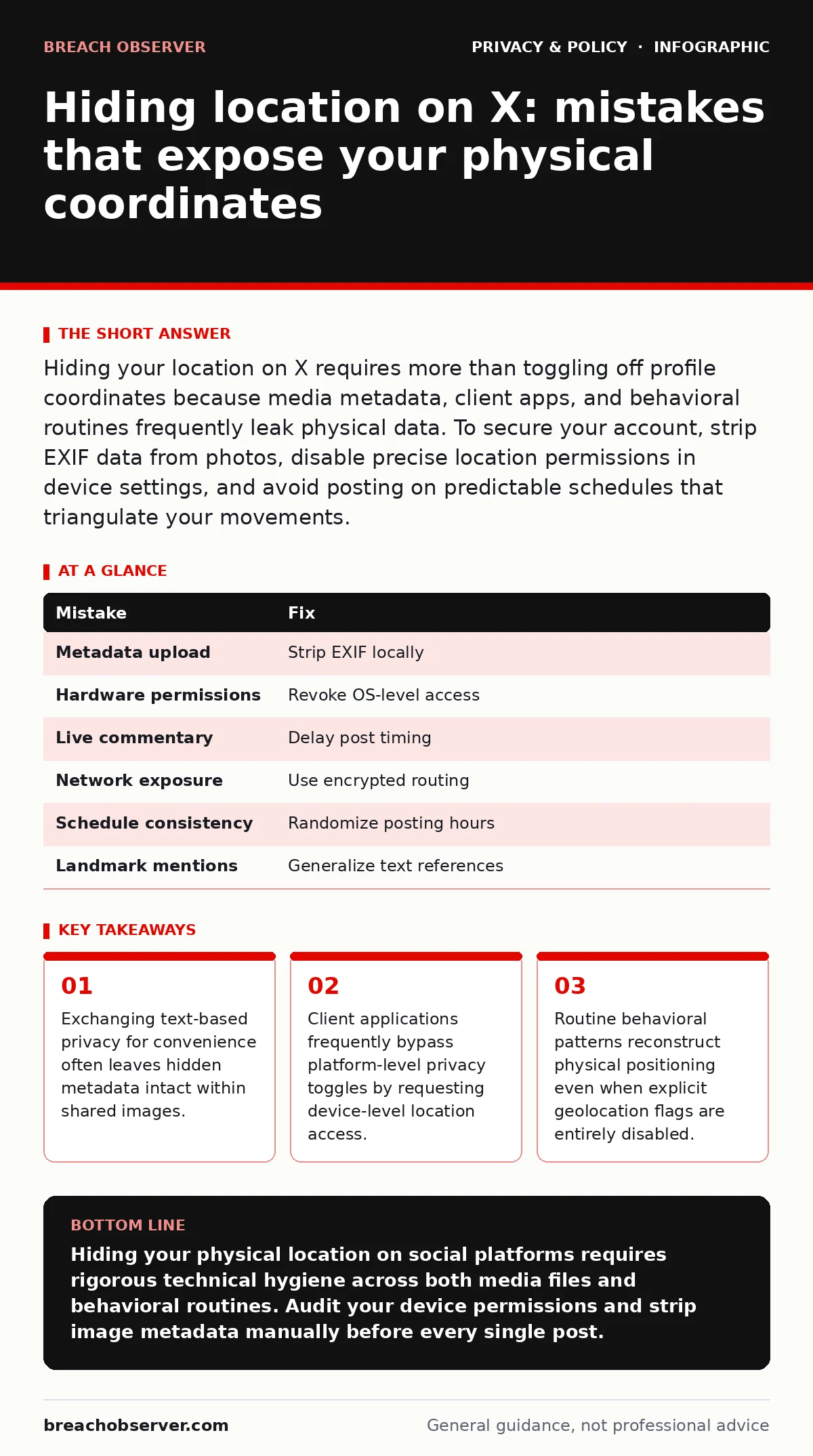
Hiding your location on X requires more than toggling off profile coordinates because media metadata, client apps, and behavioral routines frequently leak physical data. To secure your account, strip EXIF data from photos, disable precise location permissions in device settings, and avoid posting on predictable schedules that triangulate your movements.
Mistake 1: Uploading images containing raw exchange metadata
Why it hurts: Digital photographs carry embedded Exchangeable Image File format data containing precise GPS coordinates captured at the moment of shutter release. Platforms sometimes strip this information, but compression failures or direct uploads often preserve numerical latitude and longitude values for anyone inspecting the file header.
The fix: Strip all metadata locally using dedicated utility tools before attaching media files to your posts, ensuring no geographic markers survive the upload process. Permanent removal requires dedicated scrubbing software rather than relying on platform-side compression algorithms that frequently fail.
Mistake 2: Granting continuous device location permissions to client software
Why it hurts: Mobile operating systems allow applications to request hardware sensor access independently of web interface settings. Imagine you permit background synchronization, the software logs your transit vectors continuously, occasionally appending regional tags to check-ins or replies without explicit prompts.
The fix: Revoke hardware-level positioning permissions entirely within your operating system settings, forcing the application to rely solely on manual input for any regional context. Sometimes attackers correlate this data with browser fingerprinting techniques to track your hardware across sessions without consent.
Mistake 3: Publishing real-time commentary during local occurrences
Why it hurts: Temporal correlation destroys online anonymity much faster than visible geographic coordinates. Tweeting about a minor neighborhood incident the exact second it occurs anchors your physical presence to that specific radius, allowing automated scrapers to map your daily perimeter accurately.
The fix: Delay all updates regarding local events by several hours to break the temporal chain, ensuring your timeline reflects historical observation rather than live physical participation. Artificial delays destroy the real-time correlation vectors that automated scrapers rely upon for mapping your perimeter.
Mistake 4: Accessing accounts through unencrypted network pathways
Why it hurts: Public access points expose your IP address to local network administrators and passive observers monitoring wireless traffic. Internet protocol routing reveals your Internet Service Provider and regional exchange hub, bypassing application-level privacy settings entirely and exposing your approximate municipal coordinates.
The fix: Route your traffic securely through VPNs to obscure your origin point, or avoid untrusted access points altogether when posting sensitive commentary. Combining encrypted routing with tools focused on removing your data from people-search sites improves your baseline operational security significantly.
Mistake 5: Maintaining consistent posting schedules across time zones
Why it hurts: Circadian routines create reliable behavioral fingerprints that expose your physical timezone regardless of profile settings. Posting exclusively during specific local morning and evening hours constructs a schedule that narrows your actual geographic residence down to a tight longitudinal band.
The fix: Vary your publishing schedule artificially across different hours to disrupt automated profiling algorithms, making it impossible to determine your true sleep cycle or time zone from activity bursts alone. Randomizing interaction times defeats the statistical models used to pinpoint your municipal zone.
See also: Shared AI chat links in search results: how to stop leaks · Removing your data from people-search sites: permanent deletion reality
Mistake 6: Mentioning local landmarks in text fields
Why it hurts: Automated natural language processing scans text bodies for regional vernacular, specific street names, and local business references. Mentioning a neighborhood café or a regional transit stop provides absolute physical confirmation that invalidates broader efforts to mask your location.
The fix: Generalize all regional references to broad national or continental terms, removing any mention of localized infrastructure, weather anomalies unique to your city, or regional slang. Text scrubbing protects against natural language processing tools designed to extract geographical markers from conversational syntax.
| Mistake | Fix |
|---|---|
| Metadata upload | Strip EXIF locally |
| Hardware permissions | Revoke OS-level access |
| Live commentary | Delay post timing |
| Network exposure | Use encrypted routing |
| Schedule consistency | Randomize posting hours |
| Landmark mentions | Generalize text references |
Key takeaways
- Exchanging text-based privacy for convenience often leaves hidden metadata intact within shared images.
- Client applications frequently bypass platform-level privacy toggles by requesting device-level location access.
- Routine behavioral patterns reconstruct physical positioning even when explicit geolocation flags are entirely disabled.
Hiding your physical location on social platforms requires rigorous technical hygiene across both media files and behavioral routines. Audit your device permissions and strip image metadata manually before every single post.
Frequently asked questions
How does EXIF data leak my physical location through images?
Exchangeable Image File format data embeds hardware sensor readings, including exact GPS coordinates, directly into the binary header of digital photographs.
Can mobile applications track my position even when location services are disabled inside the app?
Operating systems grant apps broad sensor access unless you explicitly revoke hardware-level permissions within your device's core privacy settings.
Why do local time zone patterns matter for operational security?
Circadian publishing routines reveal your sleeping hours and active windows, allowing observers to calculate your longitudinal band with high precision.
What happens when I post about local weather anomalies?
Mentioning hyper-local weather conditions provides immediate verification of your physical radius to automated scrapers scanning regional timelines.
How this guide was produced: written by the Breach Observer editorial team with AI assistance, checked against the public references listed below, and reviewed when the facts change. See our editorial policy or report an error.