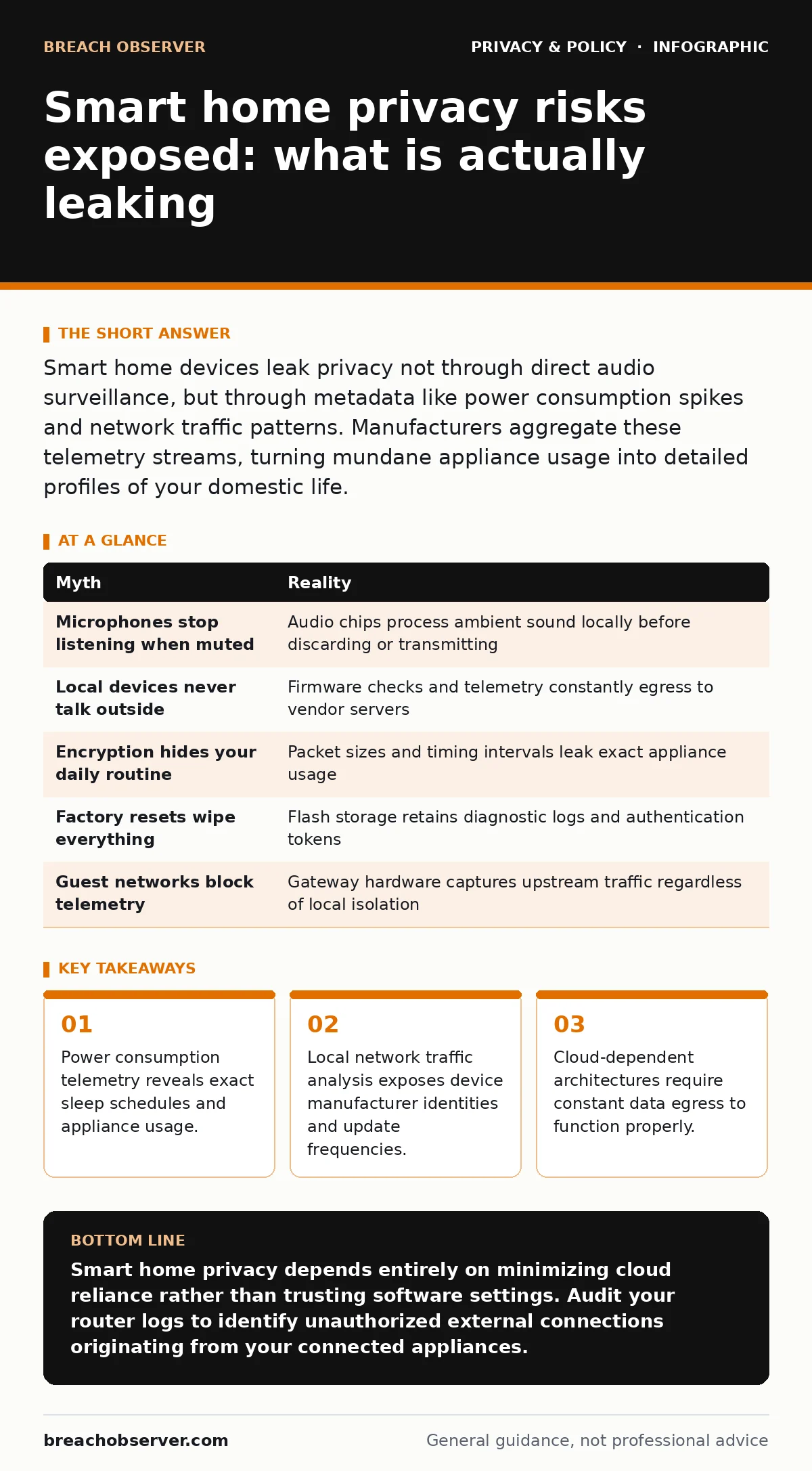
Smart home devices leak privacy not through direct audio surveillance, but through metadata like power consumption spikes and network traffic patterns. Manufacturers aggregate these telemetry streams, turning mundane appliance usage into detailed profiles of your domestic life.
Myth: Turning off the microphone stops all listening
Reality: Hardware mute buttons often disconnect only the physical transducer, leaving digital signal processors powered and processing ambient acoustic anomalies. Audio chips continuously sample acoustic environments to detect wake words locally, meaning raw sound waves reach local memory buffers constantly before being discarded or transmitted.
Motion sensors, smart thermostats, and connected lighting create behavioural footprints that map your presence more reliably than audio streams. Domestic telemetry aggregates these physical interactions, feeding cloud analytics engines that reconstruct your daily routines with startling accuracy while bypassing traditional surveillance detection.
Myth: Local devices never share data outside the house
Reality: Local execution still relies heavily on cloud-based telemetry servers for firmware updates, diagnostic logging, and time synchronization. Network packets routinely traverse public infrastructure to reach manufacturer endpoints, even when controlling local bulbs or switches without external triggers. Manufacturers design these fallback mechanisms to ensure uninterrupted operation, bypassing local network boundaries whenever connectivity flickers.
Smart bulbs and thermostats frequently broadcast device discovery packets across local subnets, leaking your exact hardware inventory to any compromised machine sharing the network. This internal reconnaissance mirrors how cross-border data transfers operate on a global scale, exposing local device configurations to ambient network sniffers.
Myth: Encrypted traffic hides what you do at home
Reality: Encryption secures the content of network packets while leaving packet sizes, timing intervals, and frequency patterns entirely exposed. Traffic analysis allows external observers to determine precisely when you turn on the television, brew coffee, or adjust heating controls based purely on the volume of data leaving your router.
Smart appliances generate distinctive packet bursts during specific operational cycles, creating unique digital signatures that bypass encryption layers entirely. Network observers correlate these timing fingerprints with public usage profiles, mapping your domestic habits without ever decrypting a single byte of payload data.
Myth: Factory resets completely erase your personal data
Reality: Standard reset procedures clear user configuration profiles stored in volatile memory spaces while leaving historical telemetry caches intact on embedded flash storage blocks. Manufacturers often preserve diagnostic logs and calibration parameters to assist with customer support, creating persistent data residues that survive multiple resets.
Discarded smart hardware routinely retains cached authentication tokens and network credentials that malicious buyers can extract using physical debugging interfaces. Hardware recycling practices require physical destruction of storage chips rather than software resets to prevent unauthorized access to sensitive domestic configurations.
See also: Data subject access requests: handle legal queries safely · Mobile App Permission Abuse: 7 Mistakes and Fixes
Myth: Guest networks protect your privacy from smart devices
Reality: Guest wireless configurations isolate client devices from your primary computers, but they still share the same physical internet connection and upstream gateway hardware. Internet service providers and network equipment manufacturers capture traffic metadata at the gateway level, recording every domain your smart appliances contact regardless of VLAN separation.
Partitioning traffic prevents lateral movement across local subnets, but it offers zero defense against telemetry harvesting performed by the devices themselves. Smart thermostats and locks continuously upload operational metrics directly to vendor cloud platforms, bypassing local routing restrictions entirely. When configuring complex guest environments, treat network segmentation with the same rigorous mindset you apply toward password managers for families.
| Myth | Reality |
|---|---|
| Microphones stop listening when muted | Audio chips process ambient sound locally before discarding or transmitting |
| Local devices never talk outside | Firmware checks and telemetry constantly egress to vendor servers |
| Encryption hides your daily routine | Packet sizes and timing intervals leak exact appliance usage |
| Factory resets wipe everything | Flash storage retains diagnostic logs and authentication tokens |
| Guest networks block telemetry | Gateway hardware captures upstream traffic regardless of local isolation |
Key takeaways
- Power consumption telemetry reveals exact sleep schedules and appliance usage.
- Local network traffic analysis exposes device manufacturer identities and update frequencies.
- Cloud-dependent architectures require constant data egress to function properly.
Smart home privacy depends entirely on minimizing cloud reliance rather than trusting software settings. Audit your router logs to identify unauthorized external connections originating from your connected appliances.
Frequently asked questions
Can local voice control eliminate smart home privacy risks?
Local processing keeps audio out of the cloud, but devices still broadcast hardware telemetry and network discovery packets. Complete privacy requires restricting internet access for appliances that do not strictly require cloud connectivity.
Do smart TVs pose different privacy risks than smart speakers?
Smart televisions capture visual and audio data for ad matching and content profiling rather than simple voice commands. This automated content recognition turns your viewing habits into continuous tracking feeds.
How do firmware updates affect smart home privacy?
Updates patch security vulnerabilities but frequently introduce new telemetry collection modules and modified data-sharing agreements. Manufacturers push these updates automatically, altering device behaviour without explicit user consent.
Is smart home data protected by privacy regulations?
Regulatory frameworks apply unevenly to consumer hardware, and enforcement mechanisms struggle with complex supply chains. Manufacturers often bypass local consent requirements through broad terms of service agreements.
How this guide was produced: written by the Breach Observer editorial team with AI assistance, checked against the public references listed below, and reviewed when the facts change. See our editorial policy or report an error.