
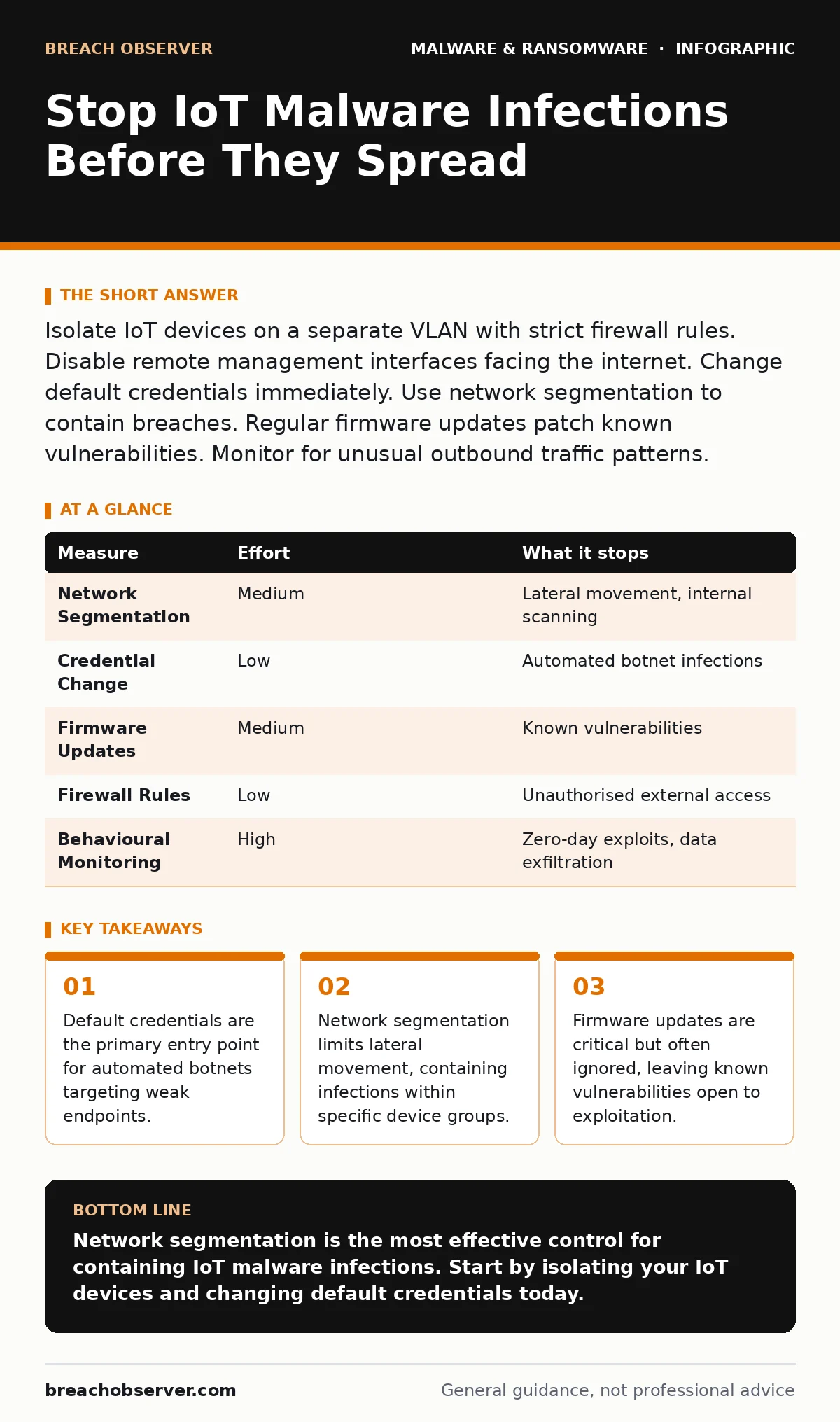
Isolate IoT devices on a separate VLAN with strict firewall rules. Disable remote management interfaces facing the internet. Change default credentials immediately. Use network segmentation to contain breaches. Regular firmware updates patch known vulnerabilities. Monitor for unusual outbound traffic patterns.
The Invisible Attack Surface
Internet of Things devices operate differently from standard computers. They often run lightweight operating systems with minimal security features. Many lack the ability to run traditional antivirus software. This creates a unique challenge for detection and prevention. These devices connect sensors, cameras, and controllers to your network. They provide convenience but introduce significant risk. An infected thermostat can serve as a foothold for attackers. Understanding this architecture is the first step toward mitigation. You must treat every connected device as a potential entry point.
Imagine a smart camera that receives a firmware update. The update contains a hidden backdoor. The device continues to function normally. However, it now listens for commands from a remote server. This scenario illustrates why standard endpoint protection fails. You cannot rely on signatures alone. You must observe behaviour and restrict access. The attack surface expands with every new device added.
Segmentation as the Primary Control
Network segmentation is the most effective defence against IoT malware. It divides your network into smaller, isolated zones. If one zone is compromised, the infection cannot spread freely. This limits the blast radius of any breach. You should place IoT devices on a dedicated VLAN. A virtual local area network (VLAN) separates traffic logically. Apply strict firewall rules between this VLAN and your core network. Allow only necessary communication paths.
This approach stops lateral movement. Attackers often use compromised IoT devices to scan internal networks. Segmentation blocks these internal scans. It forces attackers to move slowly and carefully. This buys you time for detection. You must define which services each device needs. Block everything else by default. This zero-trust approach reduces risk significantly. It is more effective than relying on perimeter defences alone.
For teams managing complex environments, consider how managed detection and response (MDR) services can monitor these segmented networks for anomalies that internal tools might miss.
Credential Hygiene and Interface Hardening
Default credentials are a widespread vulnerability. Manufacturers often ship devices with generic usernames and passwords. Automated bots scan the internet for these known combinations. They exploit them within minutes of deployment. You must change every default credential immediately. Use strong, unique passwords for each device. Disable any accounts you do not need.
Remote management interfaces expose devices to the internet. These interfaces are often poorly secured. They allow attackers to bypass local network controls. Disable remote access unless absolutely necessary. If you must use it, restrict access to specific IP addresses. Use multi-factor authentication where supported. This adds a layer of verification. It prevents simple credential theft from leading to full control.
Many teams focus on endpoint security but overlook the configuration of these interfaces. A secure endpoint means little if the management port is open to the world. Review your firewall rules regularly. Ensure that administrative ports are not exposed. This simple check can prevent entire classes of attacks.
Firmware Integrity and Update Processes
Firmware updates patch security vulnerabilities. Manufacturers release these updates to fix bugs and improve security. However, many IoT devices do not auto-update. Users often ignore manual update prompts. This leaves devices running known vulnerable code. You must establish a process for checking firmware versions. Subscribe to manufacturer security advisories. Apply updates promptly but verify their integrity first.
Malicious firmware updates are a growing threat. Attackers may compromise the update server. They distribute infected images to unsuspecting users. This bypasses many security controls. Verify checksums or digital signatures before applying updates. This ensures the update comes from a trusted source. Do not trust the update mechanism blindly. Treat every update as a potential risk.
This relates closely to the concept of golden images. Maintaining a verified, secure baseline for device configuration helps ensure that updates do not introduce instability or new vulnerabilities. Regularly testing updates in a isolated environment before widespread deployment is a prudent practice.
Monitoring for Anomalous Behaviour
Traditional antivirus fails on lightweight IoT devices. They lack the resources for signature-based scanning. You must rely on behavioural monitoring instead. Look for unusual network traffic patterns. IoT devices typically send predictable data. Sudden spikes in outbound traffic indicate compromise. Connections to unknown external IPs are red flags. Monitor for DNS requests to suspicious domains.
Imagine a smart printer that suddenly sends large data packets. It usually only sends small status updates. This anomaly suggests data exfiltration or command-and-control communication. Your intrusion detection system should flag this. Configure alerts for deviations from baseline behaviour. This helps identify infections early. You can then isolate the device before it spreads.
Behavioural analysis is more effective than signature matching. It catches zero-day attacks. It identifies malware that changes its code to evade detection. Focus on the network layer. The network sees all traffic, regardless of the device type. This visibility is critical for IoT security.
What Does Not Work
Many common security measures fail against IoT threats. Antivirus software is too heavy for most devices. They cannot run on resource-constrained processors. Network address translation (NAT) does not stop targeted attacks. Attackers can still reach services if ports are forwarded. Virtual private networks (VPNs) encrypt traffic but do not inspect it. Malicious traffic can travel inside a VPN tunnel.
Firewalls are necessary but insufficient. They block known bad IPs but miss new threats. They cannot inspect encrypted traffic without breaking trust. You must combine multiple controls. No single tool provides complete protection. Understanding these limitations is key. It prevents wasted effort on ineffective solutions.
This misconception often leads teams to neglect more effective measures like segmentation. They invest in expensive tools that do not fit the IoT context. Focus on controls that match the device capabilities.
| Measure | Effort | What it stops |
|---|---|---|
| Network Segmentation | Medium | Lateral movement, internal scanning |
| Credential Change | Low | Automated botnet infections |
| Firmware Updates | Medium | Known vulnerabilities |
| Firewall Rules | Low | Unauthorised external access |
| Behavioural Monitoring | High | Zero-day exploits, data exfiltration |
Immediate Actions for Security Teams
You need to act quickly to reduce risk. Start with the easiest wins. Change default credentials on all devices. This stops the simplest attacks. Isolate IoT devices on a separate network segment. This contains any potential breaches. Review your firewall rules. Ensure that remote management ports are closed to the public internet. These steps provide immediate risk reduction.
These actions form the foundation of IoT security. They are low cost and high impact. Do not delay implementation. Every day a device remains exposed increases risk. Build on these basics with advanced monitoring. Create a sustainable security posture.
- Change all default IoT device credentials
- Isolate IoT devices on a dedicated VLAN
- Disable remote management interfaces facing the internet
Key takeaways
- Default credentials are the primary entry point for automated botnets targeting weak endpoints.
- Network segmentation limits lateral movement, containing infections within specific device groups.
- Firmware updates are critical but often ignored, leaving known vulnerabilities open to exploitation.
Network segmentation is the most effective control for containing IoT malware infections. Start by isolating your IoT devices and changing default credentials today.
Frequently asked questions
Can I use standard antivirus on my smart cameras?
Most smart cameras lack the processing power and operating system support for traditional antivirus software. You should rely on network-based detection and segmentation instead of endpoint agents.
How do I know if an IoT device is compromised?
Look for unusual network traffic patterns, such as outbound connections to unknown servers or spikes in data volume. Sudden changes in device behaviour or unexplained reboots are also strong indicators of infection.
Is firmware updating risky for IoT devices?
Firmware updates can introduce instability or new vulnerabilities if not verified. Always check digital signatures or checksums before applying updates to ensure they are from the legitimate manufacturer.
Does a home router protect IoT devices from malware?
Home routers provide basic NAT and firewall protection but lack advanced threat detection. They cannot stop targeted attacks or malware that exploits known vulnerabilities in the device firmware itself.
How this guide was produced: written by the Breach Observer editorial team with AI assistance, checked against the public references listed below, and reviewed when the facts change. See our editorial policy or report an error.