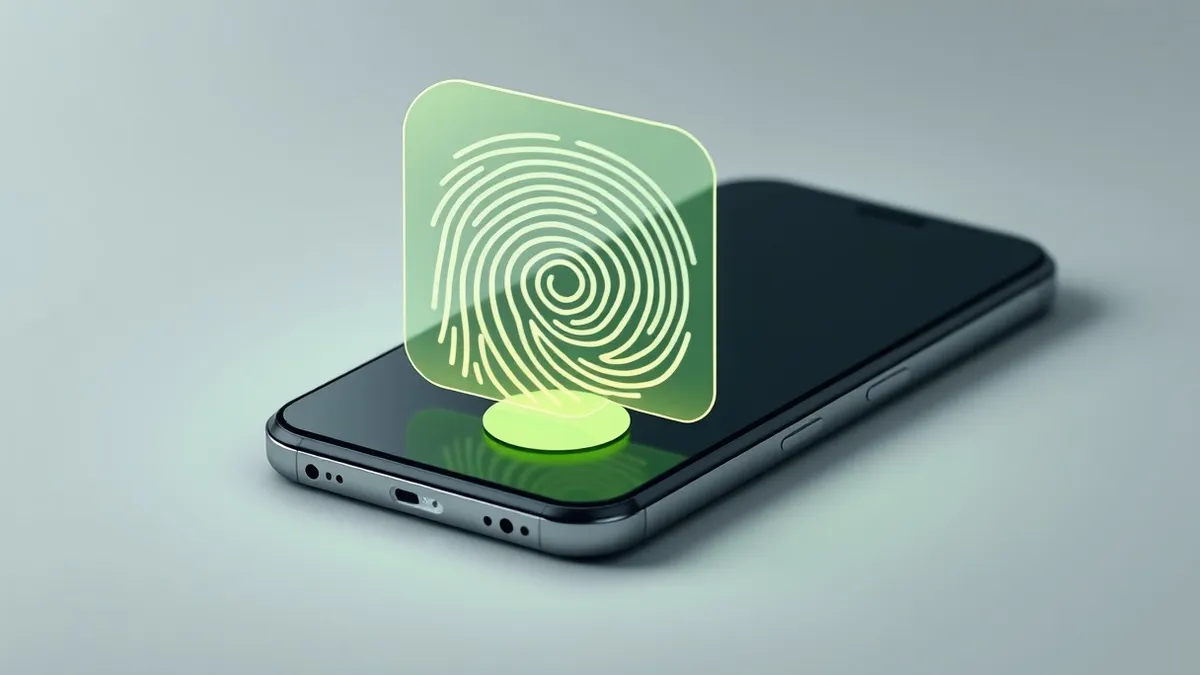
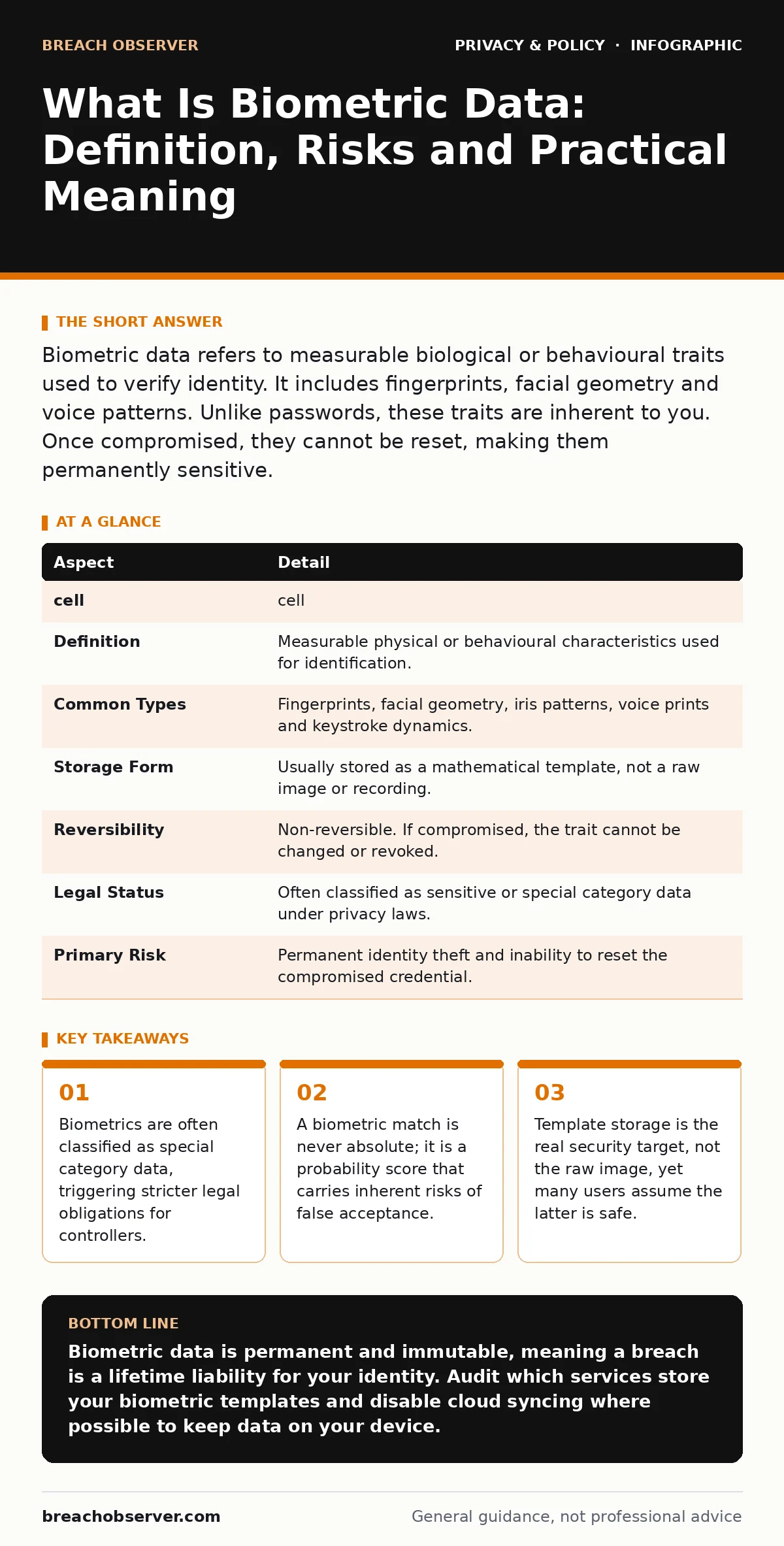
Biometric data refers to measurable biological or behavioural traits used to verify identity. It includes fingerprints, facial geometry and voice patterns. Unlike passwords, these traits are inherent to you. Once compromised, they cannot be reset, making them permanently sensitive.
The Lock That Cannot Be Changed
Imagine you leave your house keys in a broken lock. You can cut new keys. You can re-key the lock. The security model remains intact because the credential is replaceable. Now imagine the lock uses the unique ridge pattern of your fingerprint. If that pattern is stolen, you cannot change your fingers. You cannot issue a new thumb. The credential is permanent. This fundamental difference defines biometric data. It is not merely identification; it is an immutable link to your physical self.
Most people view biometrics as a convenience. They allow you to unlock devices or pay for coffee without typing a code. This frictionless experience masks a significant structural shift in how identity is managed. You are no longer proving who you are by showing something you know or possess. You are proving it by showing who you are. This shifts the burden of security from the system to your body.
At a Glance
| Aspect | Detail |
|---|---|
| cell | cell |
| Definition | Measurable physical or behavioural characteristics used for identification. |
| Common Types | Fingerprints, facial geometry, iris patterns, voice prints and keystroke dynamics. |
| Storage Form | Usually stored as a mathematical template, not a raw image or recording. |
| Reversibility | Non-reversible. If compromised, the trait cannot be changed or revoked. |
| Legal Status | Often classified as sensitive or special category data under privacy laws. |
| Primary Risk | Permanent identity theft and inability to reset the compromised credential. |
Where the Term Comes From in Practice
The term biometric data arises from the intersection of biology and metrics. It requires a measurable trait that is unique and consistent. In practice, this means the system must capture a sample, process it into a digital format and compare it against a stored reference. The "data" is not the photograph of your face. It is the mathematical representation of the distance between your eyes, the shape of your jawline and the texture of your skin.
This processing step is critical. Most modern systems do not store images of your face. They store a hash or template. A hash is a fixed-length string of characters generated by an algorithm. In theory, you cannot reverse this process to recreate the original image. However, research has shown that some templates can be approximated or reconstructed. This means the data remains sensitive even in its processed form. The distinction between raw data and derived templates is often lost in user interfaces, leading to false confidence.
How Biometrics Function Day to Day
You encounter biometric systems in many daily interactions. Your smartphone likely uses a fingerprint sensor or facial scanning to unlock. These are 1:1 comparisons. The system checks your input against one stored template: yours. This is relatively secure because the scope of comparison is narrow. The system only needs to decide if you are you.
More complex systems use 1:N comparisons. Here, your biometric sample is compared against a database of many templates. This is common in law enforcement or large-scale access control. The computational load is higher, and the risk of error increases. The system must calculate the probability that your traits match any record in the database. This introduces a threshold for acceptance. If the match score is above the threshold, access is granted. If it is below, it is denied.
This threshold creates two types of errors. A false rejection occurs when the system fails to recognise a legitimate user. A false acceptance occurs when the system admits an impostor. Balancing these errors is a constant trade-off. Lowering the threshold reduces false rejections but increases false acceptances. Raising it does the opposite. Most consumer devices prioritise convenience, accepting a higher rate of false acceptances to ensure you rarely have to re-authenticate.
What People Usually Get Wrong
A common misconception is that biometric data is anonymous. It is not. Because it is tied to your physical body, it is inherently personal. Even if a system removes your name, the biometric template can still be linked to you. This is why anonymization techniques that work for transaction data often fail for biometrics. You cannot strip the identity from a fingerprint template without destroying its utility.
Another error is assuming that local storage is perfectly secure. Many devices store biometric templates in a dedicated secure enclave. This hardware-isolated area protects the data from the main operating system. However, this does not make it invulnerable. Side-channel attacks can sometimes extract information from the enclave. Furthermore, if the device is lost or stolen, the attacker has physical access to the sensor. While the software may block repeated attempts, sophisticated attacks can bypass these counters.
See also: Account Lockout Policies for Small Business: Prevent Lockouts and Breaches · Data Exfiltration: How Attackers Steal Information and How to Stop It
The Hidden Cost of Convenience
The trade-off for frictionless authentication is a permanent expansion of your digital footprint. Every time you use a biometric feature, you are asserting your physical identity. This creates a trail that is difficult to obscure. Unlike a password, which you can choose to be random and unique, your biometric traits are constant. They do not vary. This consistency makes them attractive for tracking.
Imagine a city where every door uses facial recognition. You walk through the streets, and every camera logs your face. You are not just identified; you are tracked. This level of surveillance is possible because the credential is always with you. You cannot "log out" of your face. This raises significant concerns regarding digital privacy rights. The ability to remain anonymous in public spaces is eroded when biometric systems become ubiquitous.
This erosion affects more than just privacy. It affects autonomy. If a system can identify you without your consent, you lose control over who sees you and when. This is distinct from ad tracking, which relies on cookies and device identifiers that can be cleared. Biometric tracking is persistent and resistant to standard privacy tools. Clearing your browser history does not remove your face from a database.
Navigating the Risks
You cannot prevent the collection of biometric data if you use systems that require it. However, you can manage the risk. The first step is to understand the scope. Do you need facial recognition for a bank app? If the app offers an alternative, such as a PIN or hardware key, consider using it. Hardware keys provide cryptographic authentication without exposing your biological traits.
Review the privacy policies of services that use biometrics. Look for details on how the data is stored, who has access and how long it is retained. If the policy is vague, treat the service with caution. You may also wish to explore social media privacy risks related to facial recognition. Many platforms scan uploaded photos to create biometric profiles. Adjusting your privacy settings can limit this scanning, though it may not stop it entirely.
Conclusion on Identity
Biometric data offers convenience at the cost of permanence. It shifts the security model from replaceable credentials to immutable traits. This shift requires a different approach to privacy and security. You must assume that any biometric data you share is potentially exposed forever.
The goal is not to reject biometrics entirely. It is to use them wisely. Limit their use to trusted devices and systems. Prefer local processing over cloud storage. Demand transparency from service providers. By understanding the mechanics and risks, you can make informed choices about how much of your physical identity you are willing to digitise.
Key takeaways
- Biometrics are often classified as special category data, triggering stricter legal obligations for controllers.
- A biometric match is never absolute; it is a probability score that carries inherent risks of false acceptance.
- Template storage is the real security target, not the raw image, yet many users assume the latter is safe.
Biometric data is permanent and immutable, meaning a breach is a lifetime liability for your identity. Audit which services store your biometric templates and disable cloud syncing where possible to keep data on your device.
Frequently asked questions
Can biometric data be hacked?
Yes, while the templates are hashed, they can be stolen from databases or devices. Once stolen, the data cannot be changed.
Is facial recognition data stored as a photo?
No, most systems store a mathematical template derived from facial features. This template is used for matching, not viewing.
How do I delete my biometric data?
You can usually delete it within the app or device settings. For cloud services, you may need to submit a deletion request.
Are biometrics safer than passwords?
Biometrics are more convenient but less secure in the long term because they cannot be reset if compromised.
How this guide was produced: written by the Breach Observer editorial team with AI assistance, checked against the public references listed below, and reviewed when the facts change. See our editorial policy or report an error.