
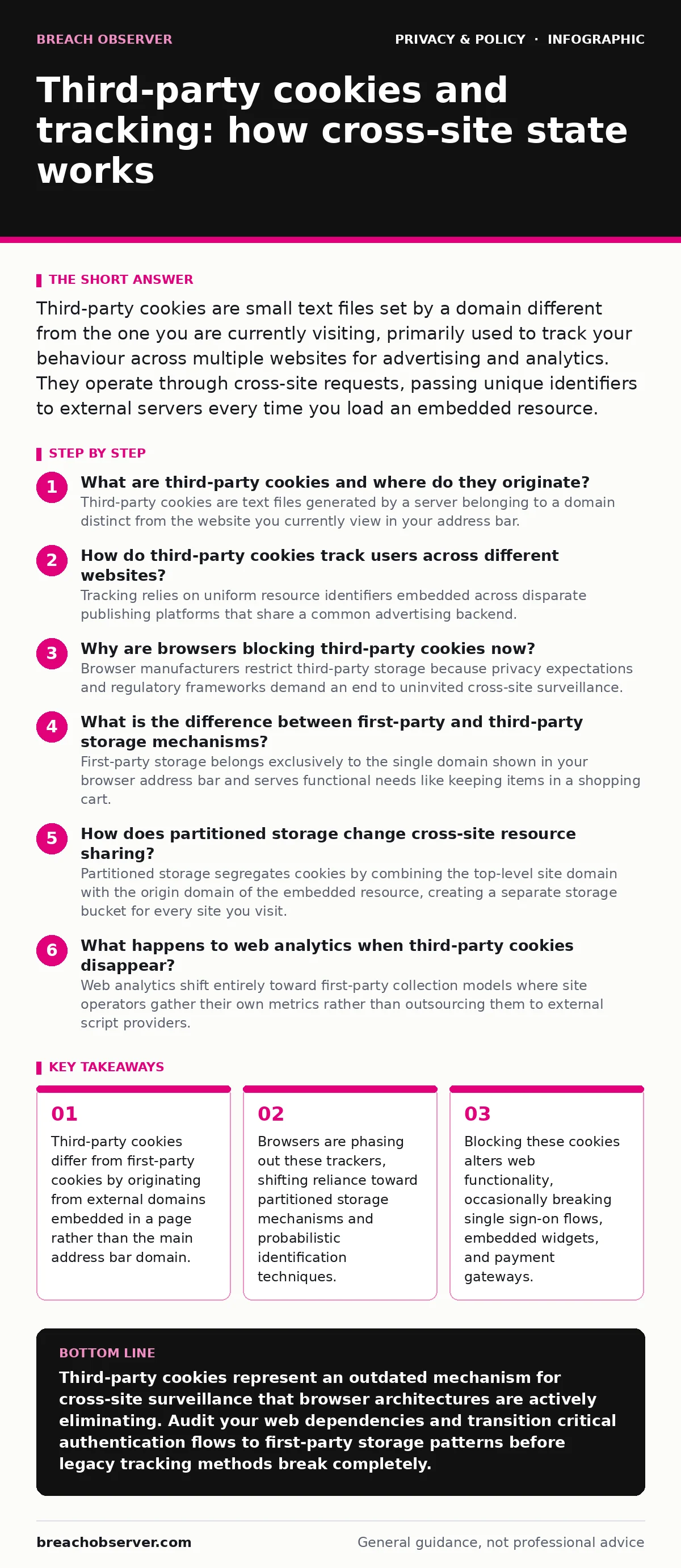
Third-party cookies are small text files set by a domain different from the one you are currently visiting, primarily used to track your behaviour across multiple websites for advertising and analytics. They operate through cross-site requests, passing unique identifiers to external servers every time you load an embedded resource.
What are third-party cookies and where do they originate?
Third-party cookies are text files generated by a server belonging to a domain distinct from the website you currently view in your address bar. External advertising networks, analytics providers, and social media widgets drop these files onto your device via embedded content like images, scripts, or iframes.
Every single time you load a webpage containing resources from an external provider, your browser sends back the cookie associated with that external domain. This silent communication happens instantly in the background without your direct interaction. Marketing firms aggregate these requests to build detailed profiles of your interests across millions of independent web properties.
How do third-party cookies track users across different websites?
Tracking relies on uniform resource identifiers embedded across disparate publishing platforms that share a common advertising backend. Suppose you visit a news site and a recipe blog on the same morning, both hosting advertisements from the same digital network.
The advertising server reads the unique string stored in your cookie during the first visit and reads that exact same string during the second visit. Connecting these dots allows the external entity to map your journey from journalism to cooking without the consent of either website operator. Data brokers purchase these aggregated streams to enrich offline consumer profiles.
Why are browsers blocking third-party cookies now?
Browser manufacturers restrict third-party storage because privacy expectations and regulatory frameworks demand an end to uninvited cross-site surveillance. Users increasingly object to invisible entities cataloguing their daily routines for targeted advertising auctions.
Regulatory pressure penalises unchecked data collection, forcing software developers to redesign default settings. Privacy by design principles dictate that web architectures should not leak state across domain boundaries by default. Eliminating these cross-site tokens reduces the financial incentive for invasive profiling networks.
What is the difference between first-party and third-party storage mechanisms?
First-party storage belongs exclusively to the single domain shown in your browser address bar and serves functional needs like keeping items in a shopping cart. Third-party storage crosses domain boundaries, allowing entities with no direct relationship to you to read and write data as you browse.
| Storage Type | Domain Scope | Primary Purpose | Cross-Site Access |
|---|---|---|---|
| First-Party | Single site | Site functionality | Blocked externally |
| Third-Party | Multiple sites | Tracking and ads | Allowed universally |
| Partitioned | Double-keyed | Embedded widgets | Isolated per site |
Applications rely on first-party cookies for secure session management and user preferences. External tracking scripts exploit third-party access to bypass site boundaries and correlate activity across unrelated publishers.
How does partitioned storage change cross-site resource sharing?
Partitioned storage segregates cookies by combining the top-level site domain with the origin domain of the embedded resource, creating a separate storage bucket for every site you visit. Embedding a widget from a third-party provider on 3 distinct websites means that provider receives 3 entirely isolated storage spaces.
This double-keying mechanism prevents external entities from linking your identity between site A and site B because the stored tokens cannot communicate. Developers must adapt their authentication architectures to handle these strict boundaries without breaking legitimate embedded tools.
What happens to web analytics when third-party cookies disappear?
Web analytics shift entirely toward first-party collection models where site operators gather their own metrics rather than outsourcing them to external script providers. Measuring user journeys requires routing tracking requests through the primary domain name system using custom server configurations.
Traffic measurement becomes fragmented because each publisher only sees interactions occurring on their own properties. External measurement vendors must rely on statistical modelling to estimate reach and frequency instead of tracking individual browsers across the entire web.
Can website logins function without cross-site cookie access?
Web logins frequently fail when third-party storage disappears because authentication flows often rely on embedded frames that require immediate cookie access. Integrating a third-party identity provider into an independent forum requires passing tokens securely without triggering browser blocking rules.
Developers redesign these login flows using modern browser APIs that permit temporary, user-initiated storage access under strict cryptographic conditions. Applications must explicitly request permission to share authentication state across origins rather than assuming blanket access.
How does probabilistic fingerprinting replace third-party cookie tracking?
Fingerprinting gathers system characteristics like screen resolution, operating system version, installed fonts, and audio processing stacks to construct a unique identifier without storing any files on your device. Combining these hardware and software variables creates a statistical signature that distinguishes your browser from others in a crowd.
Defending against this technique requires browsers to randomise hardware signals or inject noise into JavaScript application programming interfaces. Users seeking complete anonymity often consult resources on VPNs to obscure network routing indicators alongside their browser signatures.
What are the unintended privacy consequences of blocking cross-site storage?
Blocking cross-site tracking mechanisms inadvertently drives advertising networks toward more invasive, harder-to-detect identification methods like network-level tracking and deep packet inspection. Publishers face severe revenue drops, pushing some toward forced login walls that demand real-world identity verification for basic access.
Smaller websites suffer disproportionately when advertising yields plummet, consolidating traffic onto a handful of dominant technology conglomerates. Maintaining open access to information becomes complicated when privacy fixes inadvertently strengthen platform monopolies that control authenticated user bases.
Key takeaways
- Third-party cookies differ from first-party cookies by originating from external domains embedded in a page rather than the main address bar domain.
- Browsers are phasing out these trackers, shifting reliance toward partitioned storage mechanisms and probabilistic identification techniques.
- Blocking these cookies alters web functionality, occasionally breaking single sign-on flows, embedded widgets, and payment gateways.
Third-party cookies represent an outdated mechanism for cross-site surveillance that browser architectures are actively eliminating. Audit your web dependencies and transition critical authentication flows to first-party storage patterns before legacy tracking methods break completely.
Frequently asked questions
Do incognito windows block third-party cookies automatically?
Private browsing modes typically block third-party cookies by default to prevent session history from persisting locally. However, advanced fingerprinting scripts can still identify your browser session during a single private browsing visit.
Will clearing my browser cache delete third-party cookies?
Clearing your browser cache and cookies removes stored third-party tracking files, but it does not prevent new ones from loading the moment you revisit those websites. Persistent trackers reappear immediately unless you enable strict blocking settings in your browser preferences.
How do mobile applications handle third-party tracking compared to web browsers?
Mobile applications rely on platform-specific advertising identifiers embedded within the operating system rather than traditional web cookies. Operating system providers require users to explicitly grant permission before applications can access these hardware-linked tracking tokens.
Are session cookies considered third-party if they come from an external script?
Session cookies can be third-party if the script setting them originates from a domain different from the main address bar. The classification depends entirely on the origin domain of the server setting the cookie, regardless of how long the cookie is designed to persist.
How this guide was produced: written by the Breach Observer editorial team with AI assistance, checked against the public references listed below, and reviewed when the facts change. See our editorial policy or report an error.