
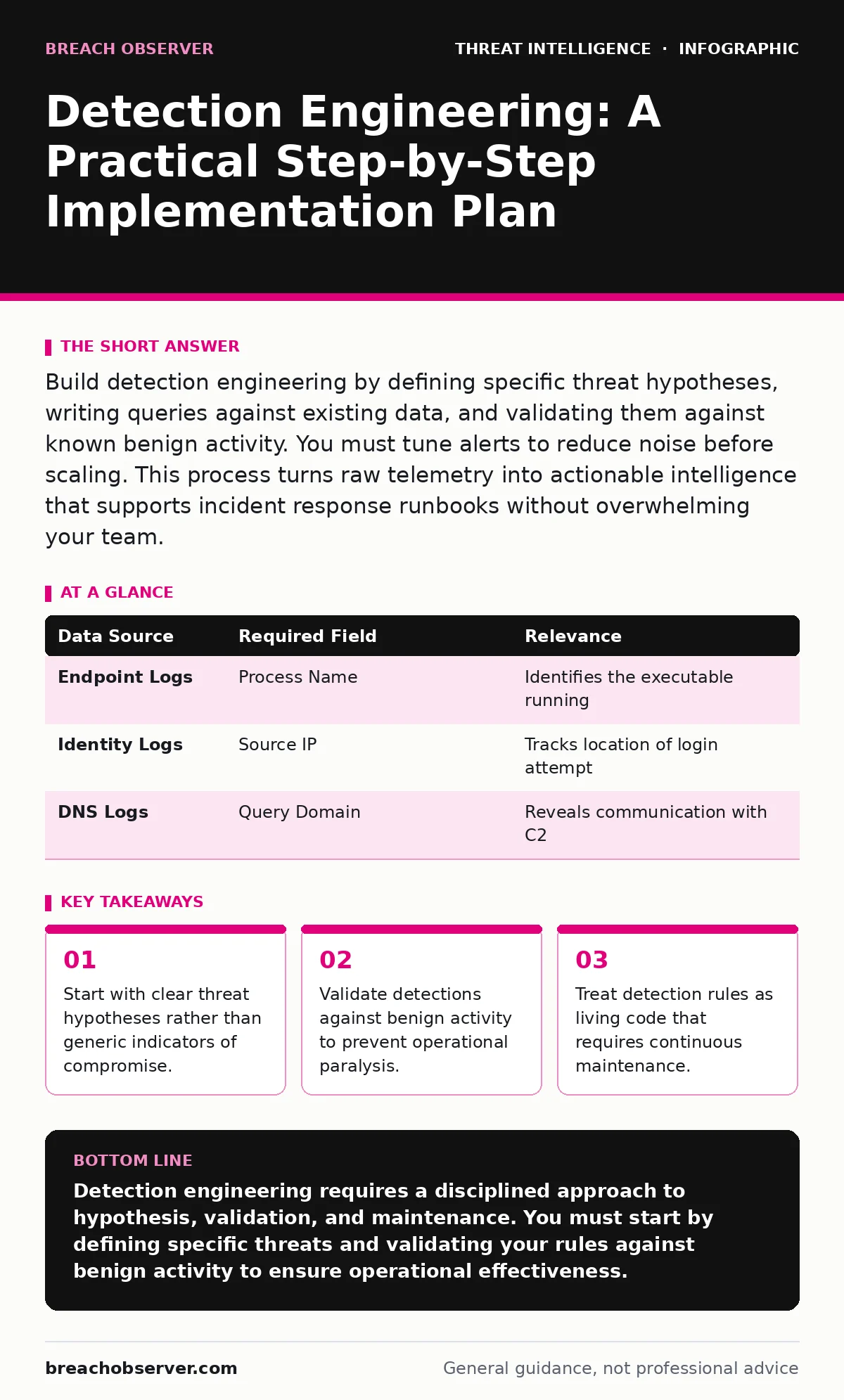
Build detection engineering by defining specific threat hypotheses, writing queries against existing data, and validating them against known benign activity. You must tune alerts to reduce noise before scaling. This process turns raw telemetry into actionable intelligence that supports incident response runbooks without overwhelming your team.
Defining the Threat Hypothesis
You cannot detect what you have not defined. Many teams begin by copying signatures from public feeds, which creates noise rather than signal. You must start with a specific adversary behaviour. Imagine an attacker attempting to escalate privileges via a legacy authentication method. You write a hypothesis that describes this exact action. This approach grounds your detection logic in reality. It prevents you from building rules for scenarios that never occur in your environment. You align your efforts with actual risk.
Mapping Telemetry to Data Sources
Detection engineering fails when the required data does not exist. You must verify that your logging infrastructure captures the necessary fields. Check if your endpoints record process creation events with command-line arguments. Verify if your identity provider logs successful and failed authentications with source IP addresses. If the data is missing, no amount of tuning will help. You must enable the correct logs before writing the detection logic. This step often reveals gaps in your visibility.
| Data Source | Required Field | Relevance |
|---|---|---|
| Endpoint Logs | Process Name | Identifies the executable running |
| Identity Logs | Source IP | Tracks location of login attempt |
| DNS Logs | Query Domain | Reveals communication with C2 |
Writing the Detection Logic
You translate your hypothesis into a query or rule. This logic must distinguish between normal and abnormal behaviour. You might use user and entity behavior analytics to establish a baseline for login times. If a user typically logs in during office hours, a login at midnight becomes suspicious. You define the threshold for this deviation. The rule triggers only when the behaviour exceeds this baseline. This reduces false positives caused by routine administrative tasks. You must document the logic clearly for future reviewers.
Validating Against Benign Activity
A detection rule is useless if it alerts on every normal operation. You must test your logic against known benign activity. Run your query against a week of historical data from your environment. Identify alerts that correspond to scheduled tasks or legitimate administrative actions. If the rule triggers on a backup job, you must refine it. You add exclusions for known service accounts or specific process paths. This validation phase is critical for maintaining analyst trust. You avoid alert fatigue by ensuring every alert requires investigation.
Implementing and Tuning
You deploy the validated rule to your production environment. You start with a low sensitivity threshold to capture all potential matches. You monitor the initial alerts closely. You categorise each alert as true positive, false positive, or benign. You adjust the sensitivity based on this feedback. If too many alerts are false positives, you tighten the criteria. If you miss a known attack simulation, you broaden the criteria. This tuning process continues until the signal-to-noise ratio is acceptable. You document the tuning decisions for audit purposes.
See also: User and Entity Behavior Analytics Mistakes That Blind Your Defenders · Coordinated Vulnerability Disclosure: Meaning, Process, and Risk Management
Integrating with Response Playbooks
Detection is only the first step. You must connect your alerts to incident response runbooks. When a detection triggers, the analyst needs clear guidance. You define the initial triage steps. You specify the data to collect for further analysis. You determine the escalation path if the alert is confirmed. This integration reduces the time to respond. It ensures that the detection leads to action. You review these playbooks regularly to ensure they remain relevant.
Maintaining and Updating Rules
Detection rules degrade over time. Systems change, adversaries adapt, and your environment evolves. You must schedule regular reviews of your detection logic. You check for changes in software versions or infrastructure. You update exclusions as new legitimate tools are introduced. You retire rules that no longer provide value. This upkeep prevents technical debt from accumulating. You treat your detection library as a living product. You assign ownership of each rule to a specific engineer.
Checking Effectiveness with Simulations
You verify your detection engineering by simulating attacks. You use controlled environments to mimic adversary behaviour. You compare the results against your detection rules. You identify gaps where the simulation went undetected. You update your rules to cover these gaps. This process ensures your detections remain effective against current tactics. You repeat this simulation regularly. You document the results to track improvement over time. This evidence demonstrates the value of your security programme.
Verification Checklist
You use this checklist to ensure your detection engineering is complete.
- Threat hypothesis is clearly defined and documented.
- Required telemetry is available and correctly formatted.
- Detection logic distinguishes between benign and malicious activity.
- Rule has been tested against historical data.
- False positives have been minimised through tuning.
- Alert is linked to a specific incident response runbook.
- Ownership and maintenance schedule are assigned.
Common Pitfalls in Detection Engineering
You must avoid common pitfalls that undermine your efforts. One pitfall is relying solely on indicators of compromise. These are easily changed by attackers. You must focus on behaviour. Another pitfall is ignoring the operational impact. If your rules generate too much noise, analysts will ignore them. You must balance sensitivity with usability. You also risk over-engineering. Simple rules often outperform complex ones. You should aim for clarity and maintainability.
Key takeaways
- Start with clear threat hypotheses rather than generic indicators of compromise.
- Validate detections against benign activity to prevent operational paralysis.
- Treat detection rules as living code that requires continuous maintenance.
Detection engineering requires a disciplined approach to hypothesis, validation, and maintenance. You must start by defining specific threats and validating your rules against benign activity to ensure operational effectiveness.
Frequently asked questions
How do I prioritise which threats to detect first?
You prioritise based on the likelihood and impact of the threat within your specific environment. You focus on adversaries that are known to target your industry and the assets that hold your most sensitive data.
What is the difference between detection engineering and threat hunting?
Detection engineering builds automated rules to identify known patterns. Threat hunting involves manually searching for hidden threats that may not trigger automated alerts. Both are necessary for a complete defence.
How often should I review my detection rules?
You should review your detection rules quarterly or whenever significant changes occur in your environment. Regular reviews ensure that your rules remain accurate and relevant to current threats.
Can I use YARA rules for endpoint detection?
Yes, YARA rules are effective for identifying malicious files based on content patterns. You can integrate them into your endpoint detection and response platform to enhance your file-based detection capabilities.
How this guide was produced: written by the Breach Observer editorial team with AI assistance, checked against the public references listed below, and reviewed when the facts change. See our editorial policy or report an error.