What is threat intelligence? It is processed data about existing or emerging dangers to an organisation. It transforms raw alerts into actionable insights. You use it to prioritise risks, automate defences and understand adversary tactics. Without context, data remains useless noise that overwhelms your operations.
The Signal In The Noise
Imagine a security camera that records every person who walks past your building. The footage exists, but it tells you nothing until you identify the person wearing a mask at 3am. Threat intelligence operates on this same principle. It filters vast amounts of raw data to identify signals that matter to your specific environment.
You cannot defend against everything. You must defend against what matters. What is threat intelligence? It is the knowledge derived from data collection, analysis and contextualisation. It answers who is attacking, how they attack and why. This knowledge allows you to shift from reactive panic to proactive defence.
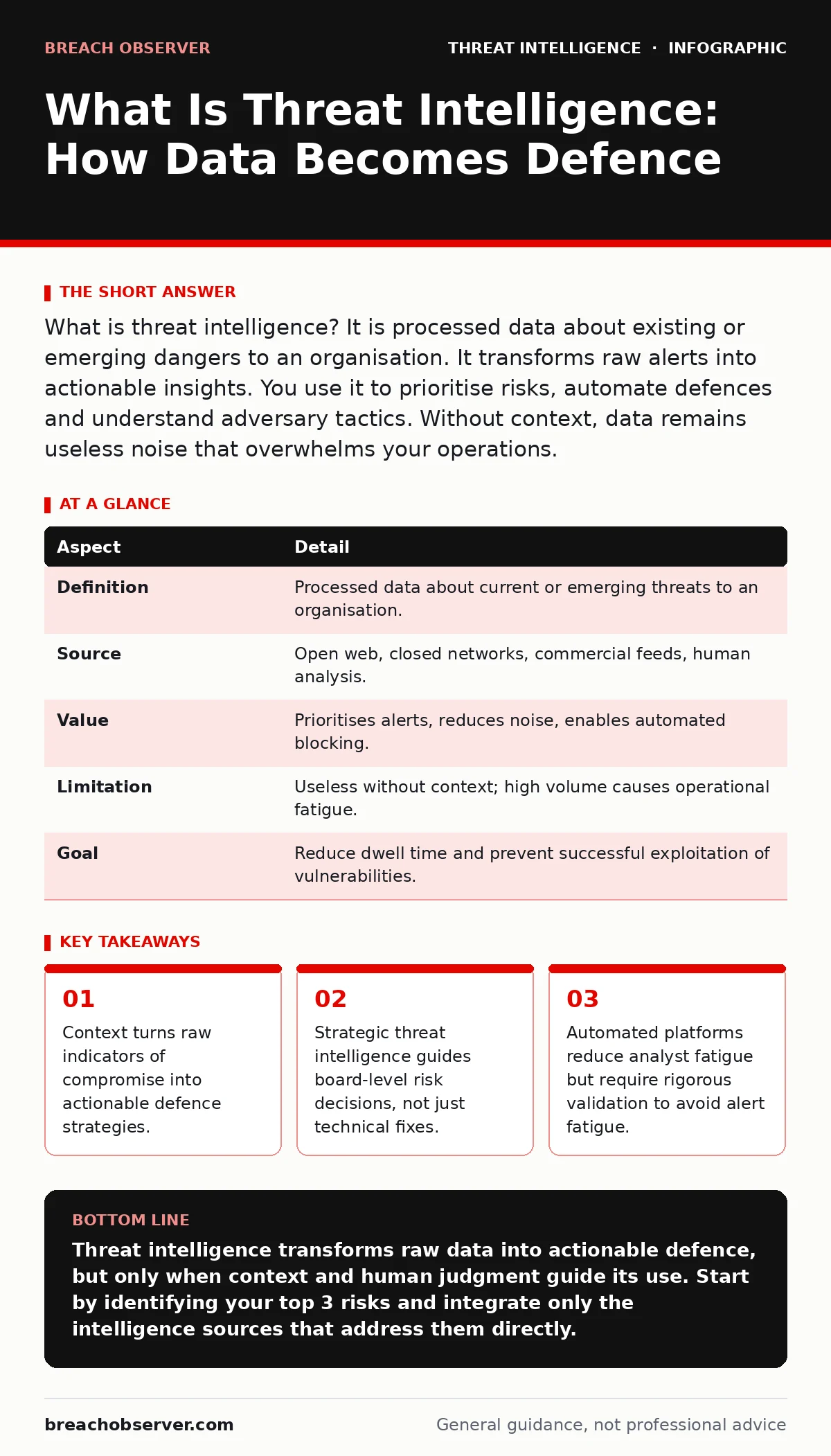
| Aspect | Detail |
|---|---|
| Definition | Processed data about current or emerging threats to an organisation. |
| Source | Open web, closed networks, commercial feeds, human analysis. |
| Value | Prioritises alerts, reduces noise, enables automated blocking. |
| Limitation | Useless without context; high volume causes operational fatigue. |
| Goal | Reduce dwell time and prevent successful exploitation of vulnerabilities. |
How Intelligence Platforms Function
Modern platforms ingest data from multiple sources simultaneously. They normalise this data into a common format. Common formats include STIX (Structured Threat Information eXpression) and TAXII (Trusted Automated eXchange of Intelligence Information). These open standards allow different systems to speak the same language.
The platform then enriches raw indicators. An IP address becomes an entry. The platform checks this entry against global databases. It adds context: is this IP associated with known ransomware groups? Does it match traffic patterns from your own infrastructure? This enrichment happens in milliseconds.
You integrate these platforms with your SIEM (Security Information and Event Management) or SOAR (Security Orchestration, Automation and Response) tools. When a new indicator arrives, the platform updates your defence rules automatically. If the intelligence is accurate, you block the threat before it reaches your users. If the intelligence is flawed, you block legitimate traffic. This is the core trade-off.
The Three Tiers Of Intelligence
Intelligence is not monolithic. It serves different audiences with different needs. You must distinguish between these tiers to avoid wasting resources.
Strategic threat intelligence informs executive decisions. It discusses geopolitical risks, industry trends and budget implications. It does not contain IP addresses. It answers whether you should expand into a high-risk region.
Operational intelligence supports incident response runbooks. It details adversary tactics and techniques. It helps you understand how threat actors move laterally within a network. This tier bridges the gap between strategy and technical execution.
Technical intelligence provides specific indicators of compromise. These are file hashes, IP addresses and URLs. Your firewalls and endpoint detection systems use this data. It is the most abundant but also the most ephemeral. An IP address may be clean one day and malicious the next.
Who Needs This Data
Every organisation with digital assets needs threat intelligence. The depth of that need varies by exposure. A small retailer with a simple web store needs basic technical intelligence. They need to know which known bad domains to block.
Large enterprises with complex supply chains need all three tiers. They face targeted attacks from state-sponsored groups. These groups use advanced persistent threats to remain hidden for months. Understanding the cyber kill chain helps you identify where these groups enter and persist.
Threat actors are diverse. Some seek financial gain through token theft. Others pursue hacktivism to send a political message. Each group has distinct motivations and methods. Your intelligence program must reflect your specific risk profile. You do not need to defend against every group in existence. You need to defend against those who want you.
Common Misconceptions And Errors
Many teams confuse data with intelligence. Raw logs are not intelligence. They are only records of activity. Intelligence requires human or automated analysis to derive meaning. A list of 10,000 malicious IPs is useless if you do not know which 10 are targeting you.
Another error is assuming automation eliminates the need for analysts. Platforms reduce manual work, but they do not replace judgment. False positives occur. Context changes. An analyst must validate high-impact decisions. Without human oversight, automated blocks can disrupt business operations severely.
You may also overlook the hidden cost of storage. Keeping historical intelligence data consumes significant resources. You must balance retention policies with investigative needs. Old data loses relevance quickly. Keeping it indefinitely creates noise and compliance risks.
See also: Cyber Kill Chain Lockheed Martin: Stages, Weaknesses, and Defence
Integrating Intelligence Into Defence
Integration is where value is realised. You must connect your intelligence platform to your detection and response tools. This creates a feedback loop. When your system detects an anomaly, it queries the intelligence platform. The platform provides context. The system then takes action.
You should also use intelligence to update your detection rules. If threat actor naming conventions change, your rules must reflect this. If a new technique for defense evasion emerges, you need new sensors. Intelligence drives the evolution of your defences.
Regularly review your sources. Not all feeds are equal. Some prioritise volume over accuracy. Others specialise in specific sectors. Choose sources that align with your industry and geography. A feed focused on banking threats may be irrelevant for a manufacturing firm.
Building A Sustainable Programme
Start small. Define what you need to protect. Identify your top 3 risks. Find intelligence sources that address these risks specifically. Do not buy every feed available.
Train your team. They must understand how to interpret the data. They must know how to distinguish between noise and signal. Regular exercises help build this intuition. Simulate attacks using known indicators to test your detection capabilities.
Review and refine. Your threat environment changes. Your business changes. Your intelligence programme must evolve. Quarterly reviews ensure your sources and processes remain relevant. Discard sources that provide low value. Add new sources as your risks shift.
The Human Element
Technology supports the process, but people drive it. Analysts must collaborate across teams. They share insights with developers, operations and leadership. This cross-functional sharing ensures intelligence reaches those who can act on it.
Developers use intelligence to build secure code. They understand what vulnerabilities attackers exploit. Operations teams use intelligence to harden infrastructure. They know which configurations are targeted. Leadership uses intelligence to allocate resources. They understand the broader risk picture.
Key takeaways
- Context turns raw indicators of compromise into actionable defence strategies.
- Strategic threat intelligence guides board-level risk decisions, not just technical fixes.
- Automated platforms reduce analyst fatigue but require rigorous validation to avoid alert fatigue.
- Understanding the cyber kill chain helps you map intelligence to specific defence stages.
Threat intelligence transforms raw data into actionable defence, but only when context and human judgment guide its use. Start by identifying your top 3 risks and integrate only the intelligence sources that address them directly.
Frequently asked questions
How do I measure the effectiveness of my threat intelligence?
Track reduction in alert noise and time to detect known threats. Measure how often intelligence leads to actionable changes in your defence posture.
Can I rely entirely on automated threat intelligence feeds?
No. Automation lacks context and can generate false positives. Human analysts must validate high-impact indicators and adjust strategies based on nuanced changes in adversary behaviour.
What is the difference between threat intel and vulnerability management?
Vulnerability management identifies weaknesses in your systems. Threat intelligence identifies who exploits those weaknesses and how. Combining both allows you to prioritise patching based on actual attack likelihood.
Is open-source threat intelligence reliable for enterprise defence?
It is a valuable component but insufficient alone. Open sources provide broad coverage but lack specific context for your environment. Combine them with commercial feeds and internal telemetry for a complete picture.
How this guide was produced: written by the Breach Observer editorial team with AI assistance, checked against the public references listed below, and reviewed when the facts change. See our editorial policy or report an error.