
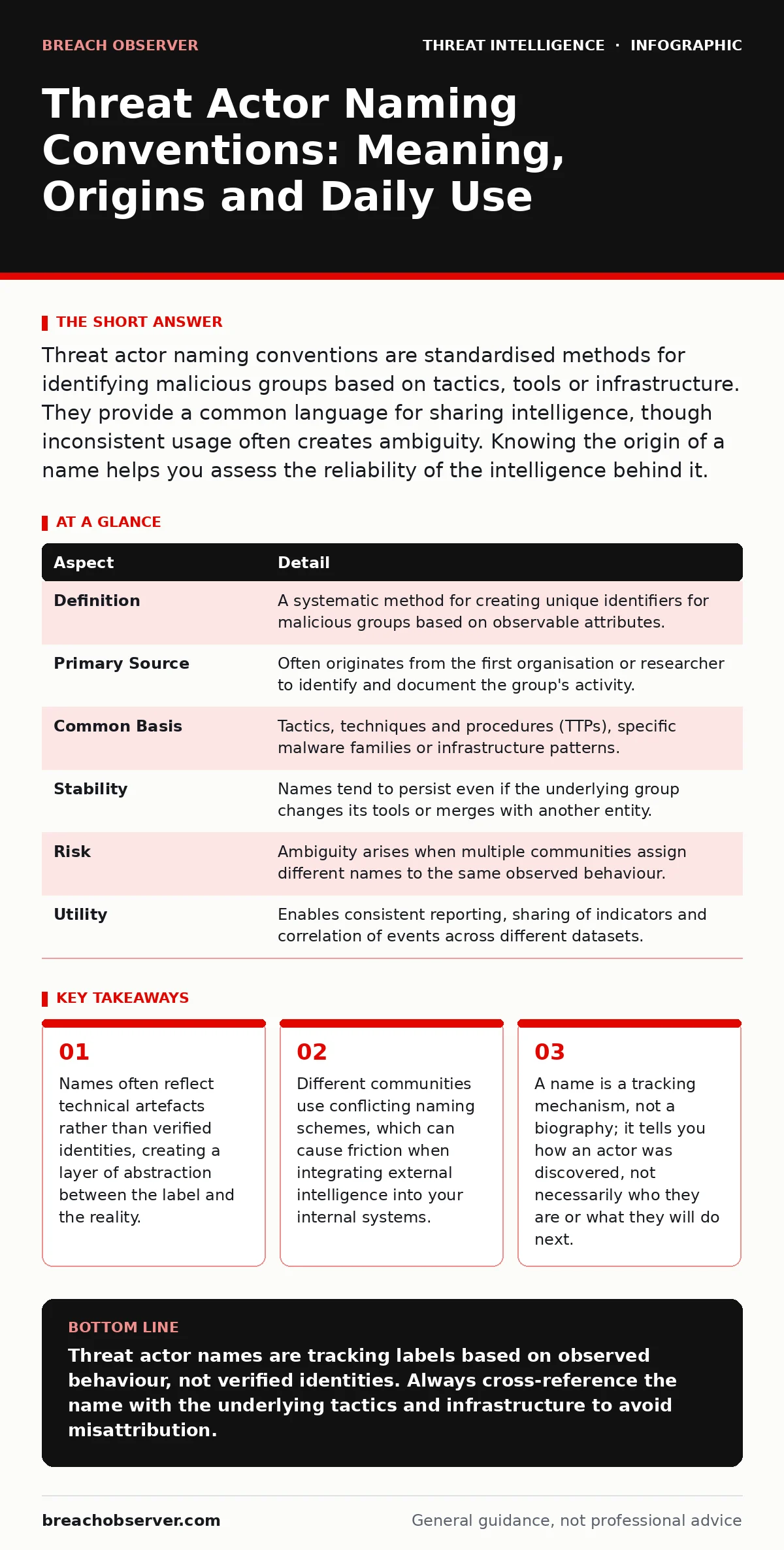
Threat actor naming conventions are standardised methods for identifying malicious groups based on tactics, tools or infrastructure. They provide a common language for sharing intelligence, though inconsistent usage often creates ambiguity. Knowing the origin of a name helps you assess the reliability of the intelligence behind it.
The Alias Problem in Cybersecurity
Imagine trying to track a serial burglar who changes their jacket colour every time they break in. You cannot rely on clothing to identify them. You must look at the method of entry, the tools used to jimmy the lock, and the specific pattern of windows left open. In cybersecurity, threat actors operate with similar fluidity. They change infrastructure, alter code and adopt new personas. To track them, analysts assign names. These names serve as aliases that stick to a set of behaviours rather than a confirmed identity.
The term "threat actor naming convention" refers to the structured approach used to create these aliases. It is not a single global standard but a collection of practices adopted by different communities. Some groups name actors after the malware they use. Others name them after the geographic origin suspected by intelligence agencies. Still others use code names derived from mythology or animals. The convention is the rule set that dictates which attribute becomes the name.
| Aspect | Detail |
|---|---|
| Definition | A systematic method for creating unique identifiers for malicious groups based on observable attributes. |
| Primary Source | Often originates from the first organisation or researcher to identify and document the group's activity. |
| Common Basis | Tactics, techniques and procedures (TTPs), specific malware families or infrastructure patterns. |
| Stability | Names tend to persist even if the underlying group changes its tools or merges with another entity. |
| Risk | Ambiguity arises when multiple communities assign different names to the same observed behaviour. |
| Utility | Enables consistent reporting, sharing of indicators and correlation of events across different datasets. |
Where the Names Come From
The origin of a name usually lies in the initial discovery of the threat. When a security team first encounters a new campaign, they need a way to discuss it internally and externally. They look for the most distinctive feature of the intrusion. If the malware has a unique string in its code, that string might become the name. If the command and control servers all resolve to a specific country code top-level domain, the actor might be named after that region.
This process is inherently reactive. The name is a snapshot of the actor at the moment of discovery. It captures what was visible then, not what might be hidden. Over time, as the actor evolves, the name can become misleading. An actor named after a specific virus may stop using that virus entirely, yet the name remains in use because it is easier to say than "the group formerly known as X". This inertia keeps outdated labels in circulation long after they lose their descriptive accuracy.
Daily Usage in Operations
In your daily work, these names appear in alerts, reports and briefings. You see them in the headers of emails from intelligence feeds and in the tags of your security information and event management system. The name acts as a handle for the adversary. It allows you to pull up all known activities associated with that label. This aggregation helps you see patterns that would be invisible if you looked at each incident in isolation.
When you read a report about "Group Alpha", you are not reading a biography. You are reading a collection of observed behaviours that analysts have linked together. The value lies in the linkage. If Group Alpha typically targets supply chains, and you see a new intrusion with similar techniques, the name triggers a specific set of defensive actions. You check your supply chain partners. You look for the specific lateral movement techniques associated with that label. The name is a shortcut to a playbook.
The Trap of Anthropomorphism
A common mistake is treating a named threat actor as a single, cohesive organisation with a unified command structure. This is anthropomorphism: attributing human characteristics to something that may be a loose collection of individuals, a state-sponsored unit or even automated scripts. The name suggests a person or a team, but the reality is often more fragmented.
Different analysts may assign different names to what is actually a single operational cell, or they may merge two distinct cells under one name because they share a tool. When you consume intelligence, you must remember that the name is a hypothesis. It is a working theory about who is behind the attacks. It is not a verified fact. Treating it as fact can lead to misattribution and wasted resources. You might focus on defending against a state actor when the real threat is a criminal group renting the same tools.
Navigating Conflicting Labels
The cybersecurity community is not monolithic. Different vendors, government agencies and independent researchers use different naming conventions. One organisation might call a group "Dark Spider", while another calls it "Web Crawler". This fragmentation creates noise. When you integrate external intelligence feeds, you must map these aliases to your internal taxonomy.
This mapping is not trivial. It requires careful analysis of the supporting evidence. You must look beyond the name to the underlying indicators of compromise and tactics. If two names share the same infrastructure and code snippets, they are likely the same actor. If they differ significantly, they may be distinct. Failure to reconcile these differences can lead to duplicate alerts and confusion during incident response. You might treat a single campaign as two separate threats, diluting your defensive efforts.
See also: Cyber Kill Chain Lockheed Martin: Stages, Weaknesses, and Defence
The Impact on Detection Logic
Your detection rules often rely on these names. You might create a rule that triggers when a file matches the hash of malware used by a specific named actor. This is effective but narrow. It misses the actor if they change their code. A more resilient approach is to build rules based on the behaviours associated with the name, not the specific artefacts.
If the name "Blue Fox" is associated with a specific method of credential dumping, your detection should focus on that method. The name is a label for the behaviour. If Blue Fox stops using their old malware and starts using a new tool, but they keep using the same credential dumping technique, your behaviour-based rule will still catch them. The name helps you define the behaviour, but the behaviour is what you actually detect.
Beyond the Label: Contextual Analysis
To use these conventions effectively, you must look at the broader context. A name is just the start. You need to understand the motivations, the targets and the evolution of the actor. This deeper analysis helps you predict future actions. If an actor named after a financial motive starts targeting critical infrastructure, the name no longer fits the reality. The context has shifted.
You should also consider the source of the name. Names assigned by well-respected, transparent organisations tend to be more reliable than those from anonymous blogs. However, even reputable sources can make mistakes. The key is to treat the name as a pointer to a body of evidence, not as the evidence itself. Always verify the claims behind the name with your own data.
Integrating this understanding into your threat intelligence program ensures that you are not just collecting names, but building a coherent picture of the threat environment. It allows you to move from reactive alerting to proactive defence. By understanding the limitations and origins of these conventions, you can use them as powerful tools without being misled by their simplicity.
Key takeaways
- Names often reflect technical artefacts rather than verified identities, creating a layer of abstraction between the label and the reality.
- Different communities use conflicting naming schemes, which can cause friction when integrating external intelligence into your internal systems.
- A name is a tracking mechanism, not a biography; it tells you how an actor was discovered, not necessarily who they are or what they will do next.
Threat actor names are tracking labels based on observed behaviour, not verified identities. Always cross-reference the name with the underlying tactics and infrastructure to avoid misattribution.
Frequently asked questions
How do I know if a threat actor name is reliable?
Check the source of the intelligence and the evidence provided. Reliable names are backed by detailed technical analysis and are consistent across multiple reputable sources.
Can threat actors change their names?
Actors do not choose their own names; analysts assign them. As an actor's behaviour changes, analysts may create new names or retire old ones, leading to multiple labels for the same group.
What is the difference between a threat actor and a threat group?
These terms are often used interchangeably. A threat actor is the entity behind the attack, while a threat group implies a more organised, persistent collection of actors working together.
How do naming conventions help in incident response?
They provide a common language for sharing information and allow responders to quickly access known tactics and indicators associated with a specific adversary, speeding up the investigation.
How this guide was produced: written by the Breach Observer editorial team with AI assistance, checked against the public references listed below, and reviewed when the facts change. See our editorial policy or report an error.