
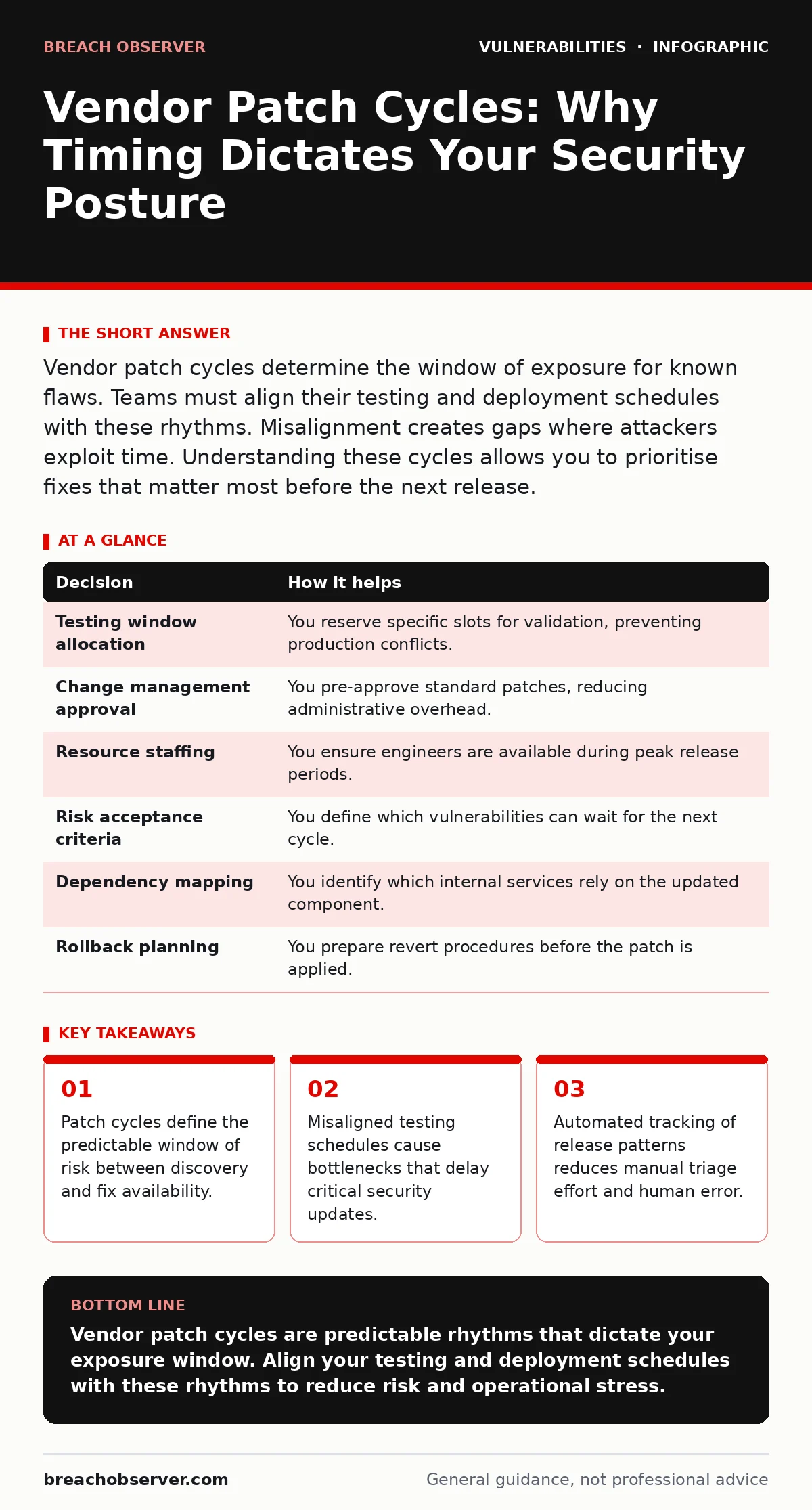
Vendor patch cycles determine the window of exposure for known flaws. Teams must align their testing and deployment schedules with these rhythms. Misalignment creates gaps where attackers exploit time. Understanding these cycles allows you to prioritise fixes that matter most before the next release.
The Rhythm of Release
Vendor patch cycles are the scheduled intervals at which software providers release updates. These cycles are rarely random. They follow internal development sprints, regulatory requirements, or community consensus. You must treat these cycles as predictable events rather than sporadic emergencies. When you understand the rhythm, you can prepare your infrastructure for the incoming changes. This preparation reduces the shock of sudden security alerts.
Imagine a team that treats every update as a surprise. They scramble to test and deploy. Imagine another team that knows the vendor releases patches on the second Tuesday of every month. The second team prepares their staging environments in advance. They have already validated compatibility. The difference is not effort. The difference is timing. Timing determines whether you react to a crisis or manage a routine process.
Decisions Informed by Cycle Knowledge
Knowing when patches arrive changes how you allocate resources. You stop guessing and start planning. The table below shows how cycle awareness directly informs operational decisions.
| Decision | How it helps |
|---|---|
| Testing window allocation | You reserve specific slots for validation, preventing production conflicts. |
| Change management approval | You pre-approve standard patches, reducing administrative overhead. |
| Resource staffing | You ensure engineers are available during peak release periods. |
| Risk acceptance criteria | You define which vulnerabilities can wait for the next cycle. |
| Dependency mapping | You identify which internal services rely on the updated component. |
| Rollback planning | You prepare revert procedures before the patch is applied. |
What Goes Wrong Without Alignment
Without alignment to vendor cycles, your security operations become reactive. You face a constant state of alert fatigue. Every new security bulletin feels like an emergency. This exhaustion leads to shortcuts. Teams might skip testing to deploy quickly. They might ignore patches that seem low risk. Both actions increase exposure.
Suppose a vendor changes their release schedule without notice. Your automated tools continue to expect updates on the old schedule. You miss the new release. Your systems remain vulnerable. The gap widens. Attackers scan for known weaknesses. They find your unpatched systems. The lack of synchronization creates a blind spot. You cannot protect what you do not track.
How Teams Use Cycle Data
Security operations teams integrate cycle data into their workflows. They do not just read dates. They build logic around them. This logic automates the initial triage of vulnerabilities. When a new CVE is published, the system checks the vendor’s expected release date. If the patch is due soon, the system flags it for standard testing. If the patch is delayed, the system flags it for manual review.
This approach reduces noise. You focus only on the items that require immediate attention. You ignore the rest until they become relevant. This filtering is vital for maintaining focus. It prevents the team from drowning in irrelevant data. It also supports remediation tracking by providing a clear timeline for expected fixes. You can measure your performance against the vendor’s schedule, not an arbitrary deadline.
The Hidden Cost of Synchronization
Synchronising with vendor cycles has a hidden cost. It requires discipline. You must resist the urge to deploy every patch immediately. Some patches introduce new bugs. Some patches change configuration defaults. Deploying too quickly can break your systems. The cost is the time spent validating.
However, the cost of not synchronising is higher. You face unpredictable outages. You face security breaches. You face wasted engineering hours. The trade-off is clear. Spend time validating during known windows. Save time reacting during unknown crises. This balance is the core of effective patch management. It requires you to accept some risk in exchange for stability.
See also: Out-of-Band Patches: How Emergency Updates Prevent Downtime · Detection Engineering: A Practical Step-by-Step Implementation Plan
Edge Cases and Exceptions
Not all vendors follow standard cycles. Some operate on a continuous integration model. They release patches as soon as they are ready. Others release quarterly. You must adapt your strategy to each vendor. A one-size-fits-all approach fails here. You need a flexible framework.
For continuous release vendors, you rely on automation. You test small changes frequently. You deploy often. For quarterly release vendors, you plan major maintenance windows. You batch updates. You test thoroughly. This differentiation is key. It prevents you from applying the wrong process to the wrong vendor. It also helps you manage firmware update management which often has longer, less frequent cycles.
Integrating with Broader Security
Patch cycles do not exist in isolation. They interact with other security processes. For example, security bulletins often provide early warnings. They might hint at upcoming patches. You can use this information to prepare. You can also cross-reference with vulnerability embargoes to ensure you are not disclosing information prematurely.
Understanding cycles also helps you assess the severity of pre-authentication vulnerabilities. These are dangerous because they do not require login. If a vendor has a short cycle, you might trust that a fix is coming soon. If the cycle is long, you must implement compensating controls immediately. The cycle length dictates your risk tolerance. It tells you how long you must wait for a permanent fix.
Building a Sustainable Process
A sustainable patch process is built on knowledge, not panic. You map your vendors. You understand their rhythms. You align your resources. You automate what you can. You manual-review what you must. This structure reduces stress. It improves security. It allows your team to focus on higher-value tasks.
You should also consider command injection risks when applying patches. Some patches might change how input is handled. Testing for these changes is part of the cycle. You must verify that the fix does not introduce new attack vectors. This verification is part of the validation step. It ensures that the patch solves the problem without creating a new one.
The Long Term View
Over time, your understanding of vendor cycles deepens. You notice patterns. You predict delays. You adjust your expectations. This experience becomes a competitive advantage. You are no longer surprised by releases. You are prepared for them. Your security posture improves. Your risk decreases.
This approach requires patience. It requires consistency. It requires you to document your processes. It requires you to train your team. But the result is a resilient system. A system that can withstand the constant pressure of new vulnerabilities. A system that is secure, not by chance, but by design. You build this resilience one cycle at a time.
Key takeaways
- Patch cycles define the predictable window of risk between discovery and fix availability.
- Misaligned testing schedules cause bottlenecks that delay critical security updates.
- Automated tracking of release patterns reduces manual triage effort and human error.
Vendor patch cycles are predictable rhythms that dictate your exposure window. Align your testing and deployment schedules with these rhythms to reduce risk and operational stress.
Frequently asked questions
How do I handle vendors with irregular patch cycles?
Treat irregular cycles as high-risk. Implement stricter monitoring and faster validation processes for these vendors. Do not rely on historical patterns.
Can I automate patch deployment entirely?
Automation is possible for low-risk updates. High-risk updates require manual validation. A hybrid approach balances speed and safety.
What if a vendor stops releasing patches?
You must isolate the system. Consider virtual patching. Plan for replacement. End-of-life software is a significant security risk.
How do I track multiple vendor cycles?
Use a centralised asset management tool. Tag assets by vendor. Set up alerts for expected release dates. Review and update tags regularly.
How this guide was produced: written by the Breach Observer editorial team with AI assistance, checked against the public references listed below, and reviewed when the facts change. See our editorial policy or report an error.