
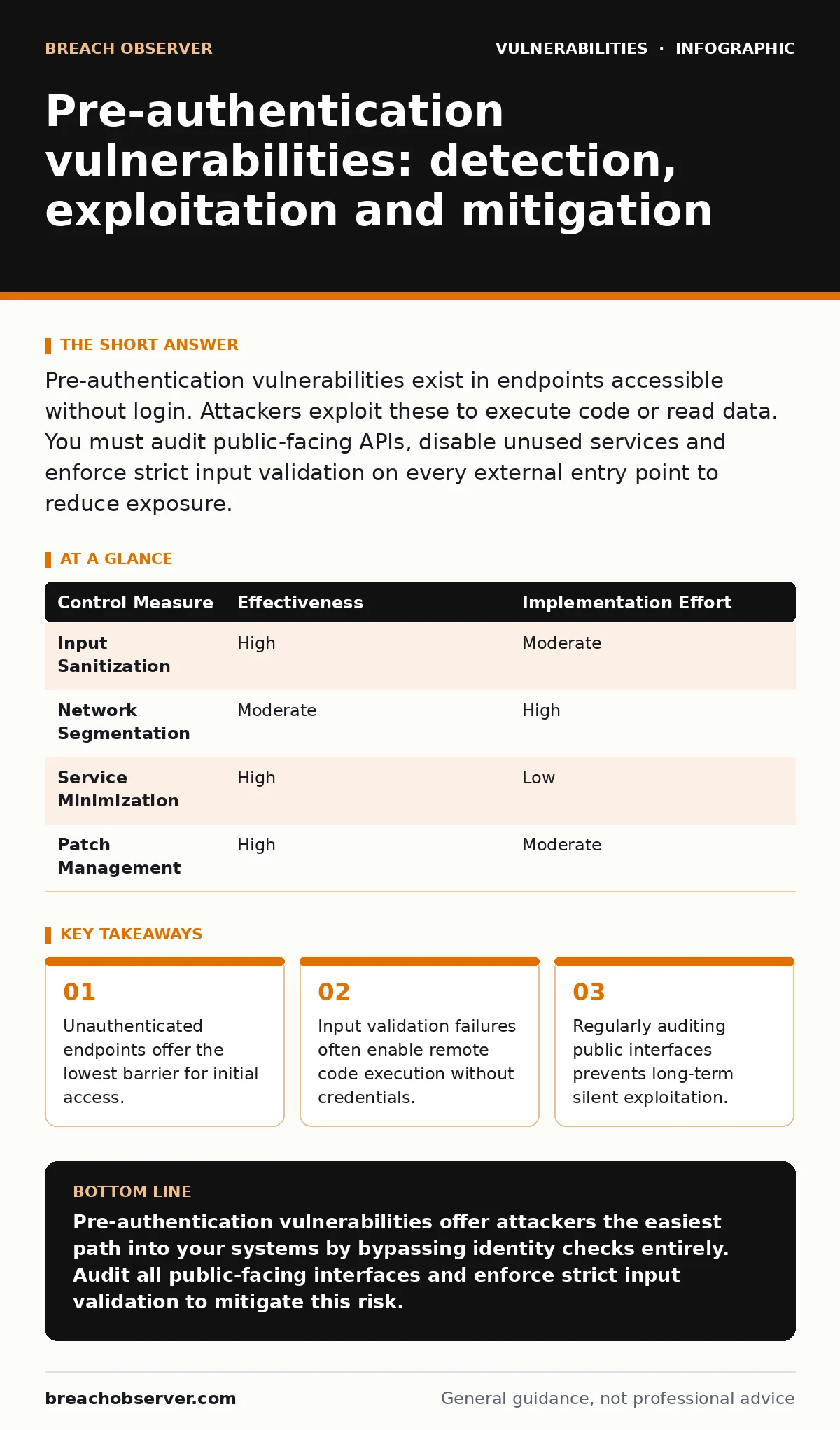
Pre-authentication vulnerabilities exist in endpoints accessible without login. Attackers exploit these to execute code or read data. You must audit public-facing APIs, disable unused services and enforce strict input validation on every external entry point to reduce exposure.
What defines a pre-authentication vulnerability?
A pre-authentication vulnerability is a security flaw in a system component that is accessible to anyone without requiring valid credentials or authentication tokens. These flaws exist in the outer layer of your infrastructure, such as public APIs, web interfaces or network services. Attackers exploit these weaknesses to gain initial access, often bypassing identity verification entirely. This category includes flaws that allow data leakage, denial of service or remote code execution before any user session is established.
Why are these flaws more dangerous than authenticated bugs?
Pre-authentication flaws present a lower barrier to entry because attackers do not need to steal or guess passwords. They can launch automated scans against the entire internet to find vulnerable targets. This broad attack surface allows for mass exploitation at scale. An authenticated bug requires an attacker to already possess valid credentials, which adds friction. A pre-authentication bug removes that friction, enabling immediate impact upon discovery.
How do attackers typically exploit these weaknesses?
Attackers often use automated tools to probe for known signatures or misconfigurations in public-facing services. They may send crafted requests to trigger buffer overflow vulnerabilities in memory handling routines. Other techniques include manipulating API parameters to bypass logic checks or injecting malicious payloads into input fields. Some exploits rely on type confusion vulnerabilities where the system misinterprets data types. These methods allow attackers to execute arbitrary code or read sensitive memory contents without ever logging in.
What role does input validation play in prevention?
Input validation ensures that all data entering a system conforms to expected formats and lengths. Without strict validation, an attacker can send malformed data that crashes the service or executes unintended commands. You must validate inputs at the earliest possible point in the request pipeline. This includes checking for special characters, length limits and data types. Proper validation prevents injection attacks and ensures that the application processes only legitimate requests.
| Control Measure | Effectiveness | Implementation Effort |
|---|---|---|
| Input Sanitization | High | Moderate |
| Network Segmentation | Moderate | High |
| Service Minimization | High | Low |
| Patch Management | High | Moderate |
Can zero-day exploits target unauthenticated endpoints?
Zero-day exploits can target any accessible component, including those that require no authentication. These attacks leverage previously unknown flaws in software logic or memory management. Because the flaw is unknown, no patch exists to mitigate it immediately. Attackers often reserve these exploits for high-value targets or use them in zero-click exploits where no user interaction is required. The lack of authentication means the exploit can be delivered remotely and silently.
See also: Why Vulnerability Embargoes Matter for Security Operations · Dependency Scanning Misconceptions That Leave Code Exposed
How does broken access control relate to pre-auth issues?
Broken access control occurs when a system fails to restrict user actions based on their permissions. In pre-authentication contexts, this means public interfaces expose functions that should be private. For example, an API endpoint might allow data retrieval without checking if the request originates from an authorised source. This misconfiguration effectively grants anonymous users the same privileges as authenticated administrators. You must enforce strict permission checks on every endpoint.
What is the impact of subdomain takeover on security?
Subdomain takeover occurs when an organisation abandons a subdomain but leaves the DNS record pointing to a non-existent service. An attacker can then register that service and host malicious content on the subdomain. This allows them to serve phishing pages or malware that appears to come from your domain. It also enables the attacker to bypass some security controls that trust the domain name. This is a form of pre-authentication risk because it exploits configuration errors rather than software bugs.
How do VPN appliance vulnerabilities fit this category?
VPN appliances often have management interfaces accessible from the internet. If these interfaces contain pre-authentication flaws, attackers can bypass the VPN entirely. They may exploit known weaknesses in the firmware or default credentials to gain administrative access. This grants them control over the entire network perimeter. You must treat VPN appliances as critical infrastructure and ensure they are patched and configured securely.
What is the connection to Rowhammer attacks?
Rowhammer attacks exploit physical properties of memory chips to flip bits in adjacent memory rows. While often discussed in the context of cloud isolation, some implementations allow remote triggering via unauthenticated network requests. If an attacker can send specific memory access patterns without authentication, they may corrupt data or gain elevated privileges. This demonstrates how hardware-level flaws can manifest as pre-authentication risks in software interfaces.
How do you detect these vulnerabilities early?
Regular penetration testing helps identify pre-authentication flaws before attackers do. You should automate scans for known signatures and misconfigurations. Manual review of API documentation and code logic reveals hidden entry points. Monitoring logs for unusual traffic patterns from unauthenticated sources can also indicate probing activity. Combining automated tools with human expertise provides the best defence against these complex threats.
What steps reduce the attack surface effectively?
Minimise the number of public-facing services by disabling unused features and ports. Implement strict network segmentation to isolate critical systems. Use web application firewalls to filter malicious requests before they reach your servers. Keep all software updated to patch known vulnerabilities. Conduct regular reviews of access controls and API permissions. These measures collectively reduce the opportunities for attackers to exploit pre-authentication weaknesses.
How do buffer overflow vulnerabilities enable pre-auth attacks?
Buffer overflow vulnerabilities occur when a program writes more data to a memory buffer than it can hold. If an unauthenticated service processes user input without bounds checking, an attacker can overflow the buffer. This overwrites adjacent memory, potentially executing arbitrary code. Since the service is accessible without login, the attacker can trigger this remotely. Proper memory management and safe coding practices prevent this class of exploit.
Key takeaways
- Unauthenticated endpoints offer the lowest barrier for initial access.
- Input validation failures often enable remote code execution without credentials.
- Regularly auditing public interfaces prevents long-term silent exploitation.
Pre-authentication vulnerabilities offer attackers the easiest path into your systems by bypassing identity checks entirely. Audit all public-facing interfaces and enforce strict input validation to mitigate this risk.
Frequently asked questions
Are pre-authentication vulnerabilities common in cloud environments?
Yes, misconfigured cloud storage buckets and public APIs frequently expose pre-authentication flaws.
How do I know if my API is vulnerable?
Test your API endpoints without authentication tokens to see if they return sensitive data or allow actions.
Can firewalls prevent pre-authentication attacks?
Firewalls can block known malicious IP addresses but cannot stop attacks from new or legitimate-looking sources.
Is encryption enough to protect against these flaws?
Encryption protects data in transit but does not prevent attackers from exploiting logic flaws or input validation errors.
How this guide was produced: written by the Breach Observer editorial team with AI assistance, checked against the public references listed below, and reviewed when the facts change. See our editorial policy or report an error.